

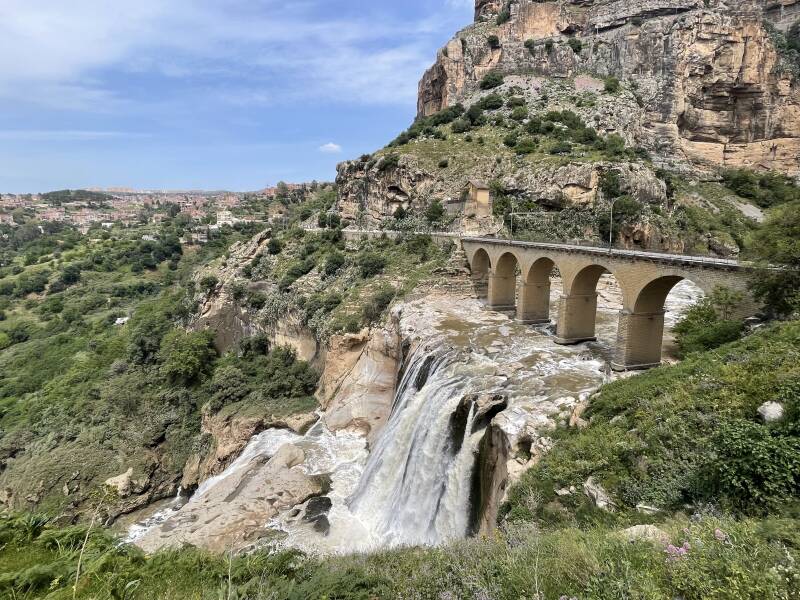
The Pont des Chutes (Falls Bridge) in Constantine, Algeria, a 5-arch bridge built in 1928, situated at the bottom of the Rhumel Gorge.
Algeria, Africa's largest country and one of the ten biggest in the world, remains largely overlooked by international travellers. Despite its extraordinary Roman ruins, Saharan landscapes and seven UNESCO World Heritage Sites, it attracts only a fraction of the visitors drawn to neighbouring Morocco. The reasons are obvious enough: a notoriously bureaucratic visa process, the lingering reputation of the civil conflict of the 1990s, and an economy fuelled by oil and gas rather than tourism.
For me, though, that was part of the attraction.
After travelling through Morocco, where I simply arrived visa free, and Mauritania, whose visa application involved passport photos, letters of introduction and online pre-authorisation, Algeria proved to be in a league of its own. At the time of my visit, most travellers needed either a guided tour or a local fixer to obtain a visa. As one of my Algerian guides later told me with a shrug, "They don't need tourism."
Instead of seeing that as a drawback, I embraced it. I joined a hiking tour with British operator Lupine Travel. It offered exactly what I wanted: spectacular scenery, manageable walks and, best of all, no camping. I liked the itinerary so much that I planned my entire five-month, 20-country journey around its departure date.
The uncertainty, however, didn't end there. Because I would already be travelling for months before reaching Algeria, Lupine warned me I might not know whether my visa had been approved until just a couple of weeks before departure. Thankfully, mine came through several months in advance. Even then, I still had to arrive with both euros and US dollars because the visa fee depended on however many days the authorities decided to grant me.
I flew into Algiers from Nouakchott, Mauritania, and appeared to be the only passenger heading to the Visa on Arrival desk. Even the immigration officers looked slightly puzzled, quietly conferring before taking my passport and directing me to an empty waiting room.
Earlier, one officer had asked for my itinerary. I opened the full tour schedule on my phone, along with a list of every hotel we would be staying in that our tour leader, Robert, had sent me. He studied it, raised an eyebrow, murmured, "Mmm," and took a photo with his phone.
Eventually, I was called back, paid €70, and received an A4 receipt. Everything was handwritten correctly, except my nationality, which had somehow become Austria instead of Australia.
When I pointed out the mistake, the officer corrected one reference before waving away the others. "It doesn't matter," he said.
Sleep deprived after my overnight flight, I also failed to notice that I'd been issued a visa valid for six days instead of the nine days covered by my tour. Only later did I realise the discrepancy, and I briefly imagined awkward conversations, or worse, when leaving the country.
Fortunately, Robert and his Algiers-based colleague, Islam, laughed off my concerns and assured me it wouldn't be a problem. I decided to trust them and enjoy the adventure.
I'd booked an early check-in at my hotel, hoping to sleep away the morning after my red-eye flight. Instead, I was serenaded by jackhammers before a cleaner cheerfully walked into my room while I was lying face down on the bed in very little clothing. Any hope of sleep vanished. I gave up, headed out into Algiers and started exploring.
I'm glad I did.
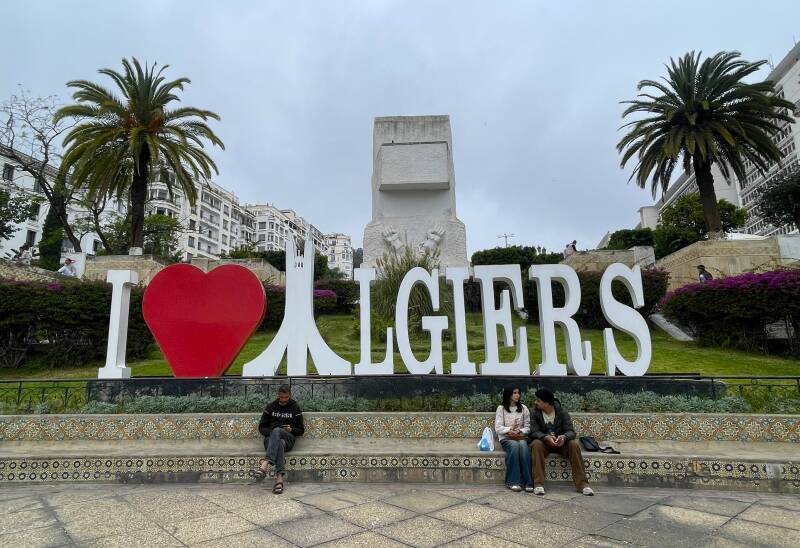
I ♥ Algiers sign with Paul Landowski's Le Pavois monument in the background.
The city felt surprisingly cosmopolitan, with Art Nouveau architecture reminiscent of Riga in Latvia (and probably Paris, which I haven't visited since I was 8) and manicured palm tree lined boulevards, sitting beside North African culture.
At times I had to remind myself that I was actually in Africa and not Europe especially as the weather was cold and misty while I was there. It is said that Algeria 'kicked the French out (after 130 years of colonial rule) but kept the buildings'.
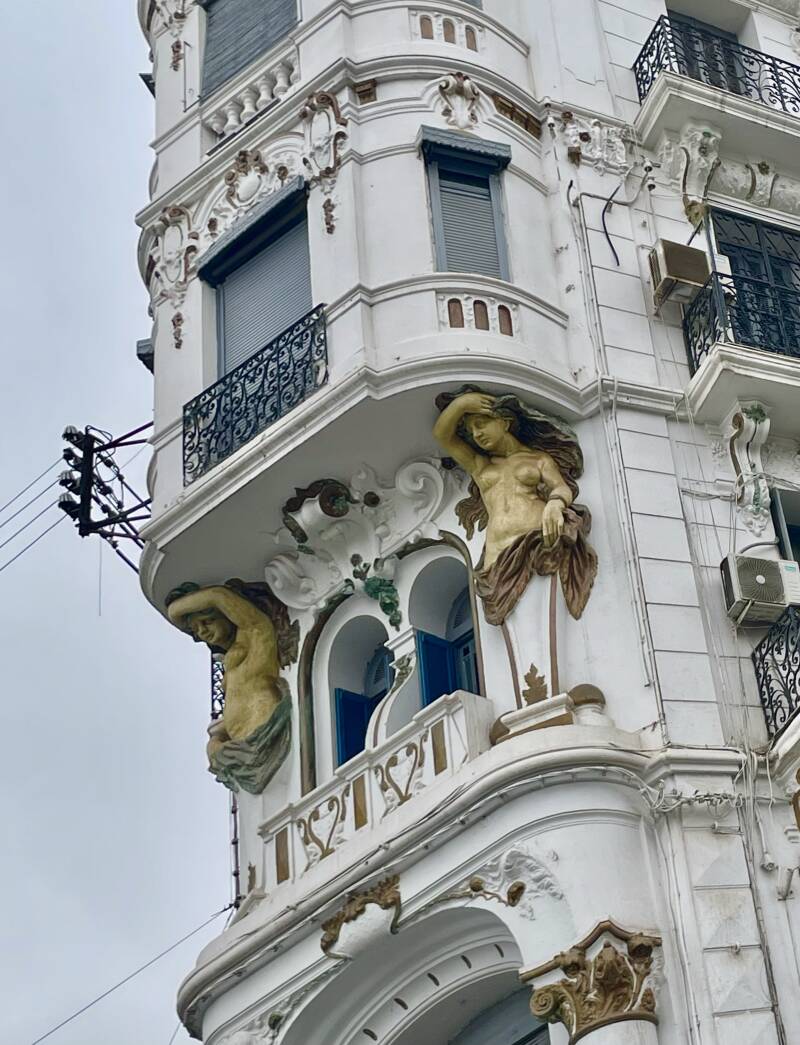
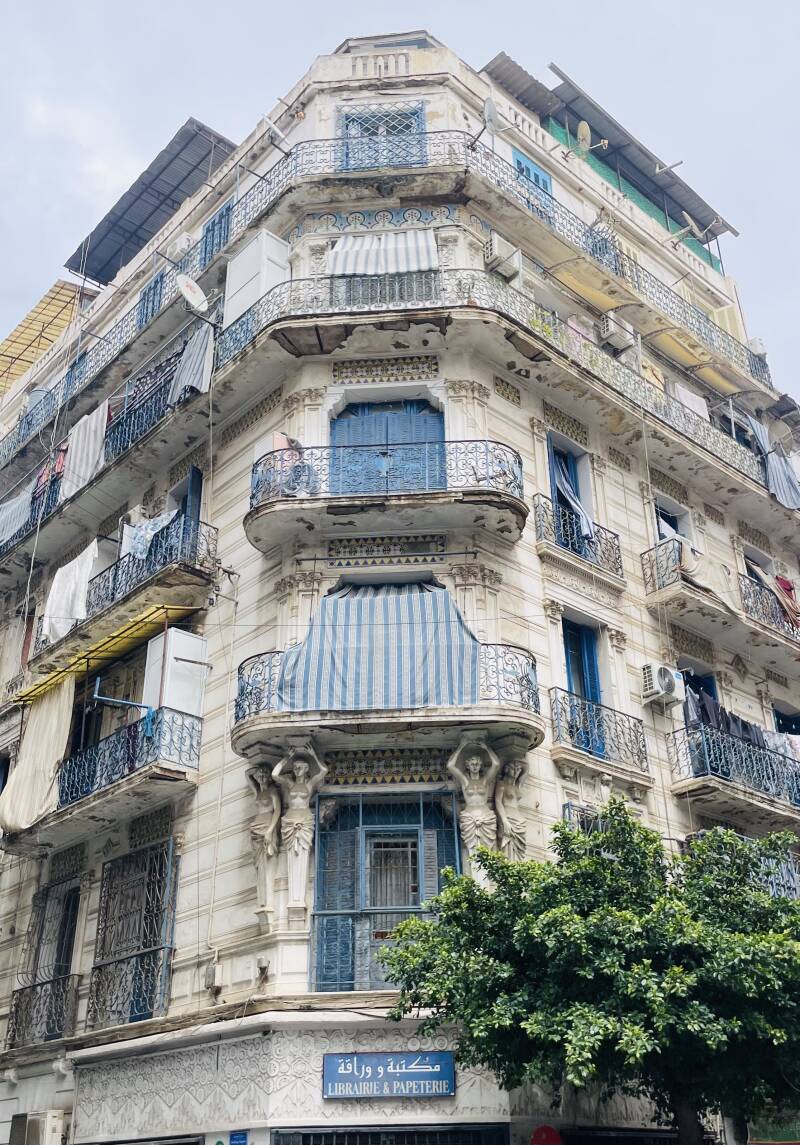
Stunning Art Nouveau buildings in Algiers. The irony of the classical topless statues is not lost on me.
Despite my lack of sleep, I packed a surprising amount into my first day in Algiers. I devoured museums, boulevards, historic buildings and monuments, including the Ali la Pointe Museum, the Bardo Museum, the Palais des Rais, the Abdul Latif House, the Musée Public National de l'Enluminure (a Calligraphy Museum) and the Museum of Antiquities.
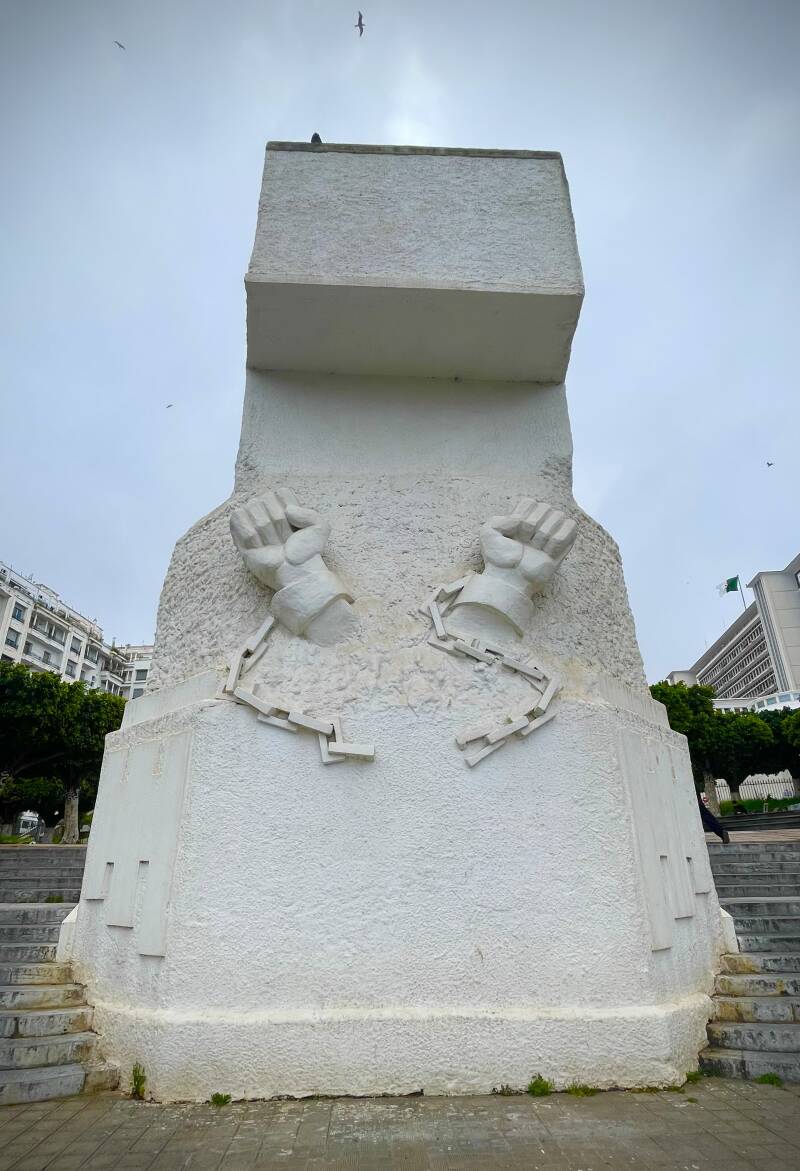
Paul Landowski's Le Pavois memorial.
Standing behind the city's dominant "I ♥ Algiers" sign is the Memorial to the Liberation of Algeria, a vast Brutalist structure that at first glance appears to be a straightforward independence monument. Like much of Algeria, however, it reveals a far more complicated story upon closer inspection.
The memorial occupies a prominent position on Boulevard Mohamed-Khemisti and is framed by elegant Art Nouveau buildings on either side, including government offices whose grand façades would not look out of place in Paris, Marseille or Brussels. It is a striking juxtaposition: an independence monument surrounded by architecture that serves as a reminder of the country's colonial past.
The memorial was created in 1978 by Algerian artist M'hamed Issiakhem as the city prepared to host the All-Africa Games. What makes it remarkable is that it conceals an earlier French colonial monument within its concrete shell.
The original monument, known as Le Pavois, was unveiled in 1928 and commemorated the dead of the First World War. The name refers to the shield upon which the body of a fallen soldier was carried. Designed by French sculptor Paul Landowski, it depicted a winged Victory figure alongside a French soldier and an Algerian spahi, all supporting the shield that bore their fallen comrade. Additional figures represented the families and communities left behind by war.
Following independence, Algeria faced a dilemma familiar to many post-colonial nations: what should be done with monuments inherited from a former regime? Demolition would have erased part of the country's history, yet leaving the monument untouched would have continued to privilege a colonial narrative that many Algerians rejected.
Issiakhem's solution was both practical and symbolic. Rather than destroy the monument, he encased it within a new structure dedicated to Algeria's liberation. The colonial monument remains there today, hidden but intact beneath the concrete. Algeria neither erased the past nor celebrated it. Instead, it quite literally built a new story around it.
Standing there, surrounded by French-era boulevards, ornate façades and a monument that simultaneously conceals and preserves its colonial predecessor, the monument showed that history here is layered rather than replaced.
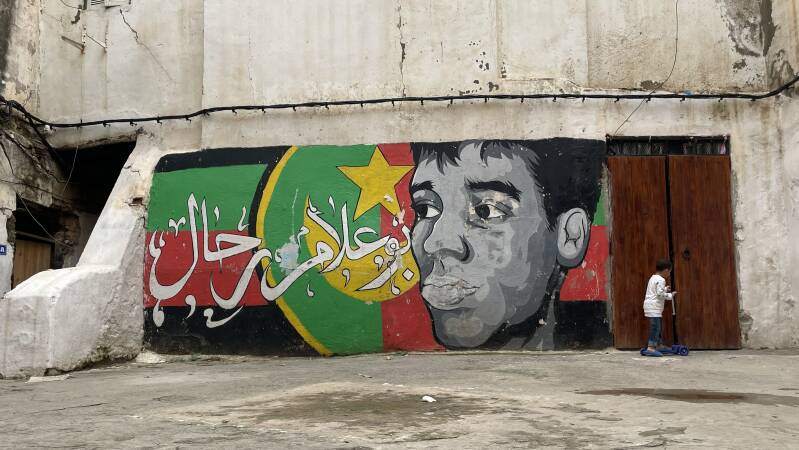
One of many patriotic murals in the Casbah.
A site that can almost be missed in the Casbah is the Ali La Pointe Museum, tucked away within the labyrinthine streets. I actually visited twice: once on my own during my first afternoon in Algiers, and then again later with the group and our guide.
Even before entering, the building stood out. Outside, colourful murals painted in Algeria's national colours of red, green and white celebrated figures from the independence struggle and reinforced the site's importance as a place of remembrance.
The museum occupies the very house where resistance fighter Ali La Pointe, together with Hassiba Ben Bouali, Mahmoud Bouhamidi and Omar Yacef, was killed by French forces in 1957 during the Battle of Algiers. Knowing that the events being described had occurred in the same rooms through which visitors now walk gave the museum a sense of immediacy that many historical museums lack.
Inside were personal belongings, photographs, weapons and other artefacts connected to the independence movement. On my first visit, I wandered through quietly, absorbing the exhibits at my own pace. Returning with our guide provided a different experience entirely, as the objects and rooms became part of a larger narrative about the Battle of Algiers and the struggle that eventually led to independence.
Algeria's recent history surfaced in museums, monuments, murals and conversations. Unlike the Roman ruins of Djemila or the Ottoman palaces of Constantine, the War of Independence still feels close enough to living memory that its presence remains woven into everyday life. Further down the Casbah, an older man sat under a similar mural which actually resembled himself; I am sure he would have had many stories to tell.
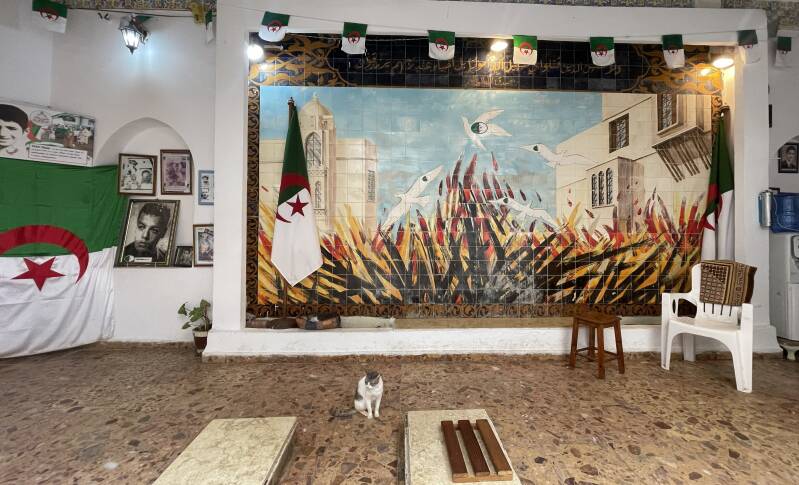
Inside the li La Pointe Museum.
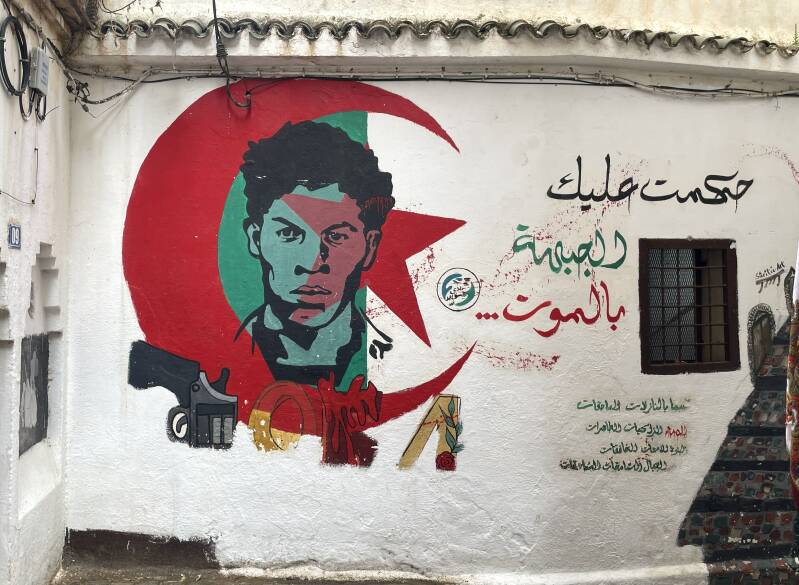
Outside the Ali La Pointe Museum, a portrait of Ali Ammar himself.
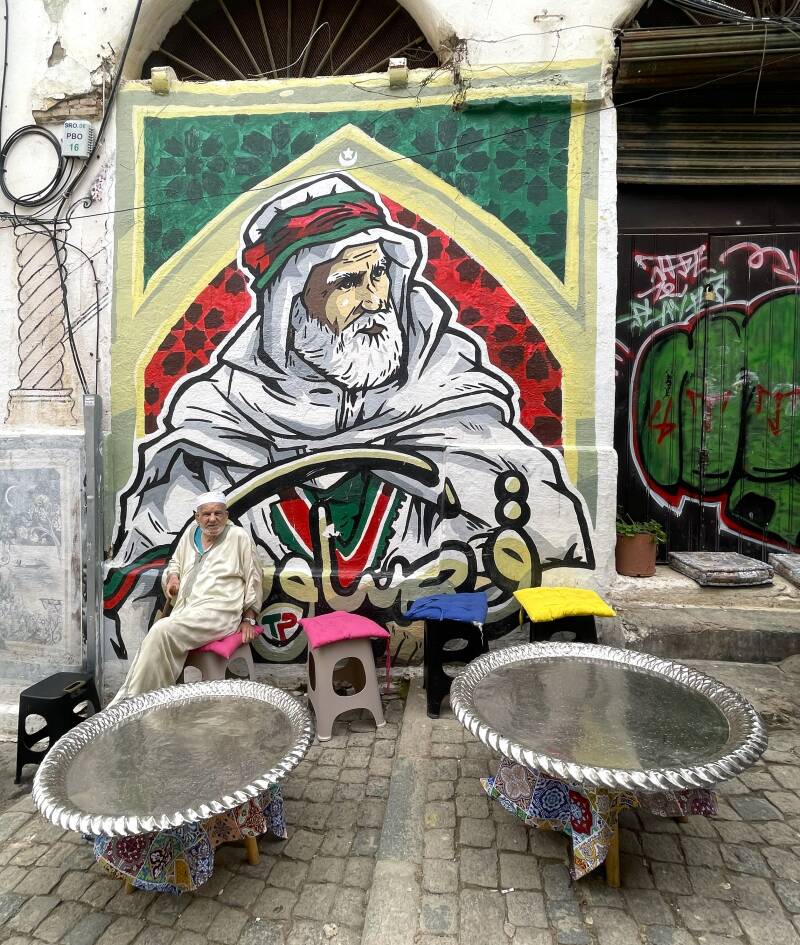
A man in the Casbah and one of many murals in Algerian colours at a tea shop.
One of the most sobering stops in Algiers, just around the corner from Le Pavois, was the Milk Bar Café. At first glance, it seemed like any ordinary café. Customers came and went, coffee was served, and cakes filled the display cabinet. Yet behind its unassuming façade is one of the most enduring stories of the Algerian War of Independence. Today, the café also serves as an informal museum, with photographs and memorabilia recalling one of the conflict's most infamous events.
I ordered coffee and cake and took a seat beneath a photograph of Zohra Drif, the woman who planted a bomb there in September 1956. As I looked at her image, I found myself grappling with a question that many foreign visitors have probably asked before me. Why would someone responsible for the deaths of civilians be commemorated in the very place where the attack occurred?
The answer, of course, depends on whose history you are reading.
Outside Algeria, the Milk Bar bombing is generally remembered as a terrorist attack that killed three young women and injured dozens of others, including children. Within Algeria, however, Zohra Drif is widely regarded as a heroine of the independence struggle. A law student at the time, she was part of the FLN network that sought to draw international attention to the Algerian cause during the Battle of Algiers. More than six decades later, she remains a prominent figure in Algerian public life. The Milk Bar is a reminder that the war is not simply history here. It remains a living part of the nation's identity.
Sitting there with my coffee, watching people browse the photographs on the walls, I realised the Milk Bar is not really about the bombing itself. It is about memory.
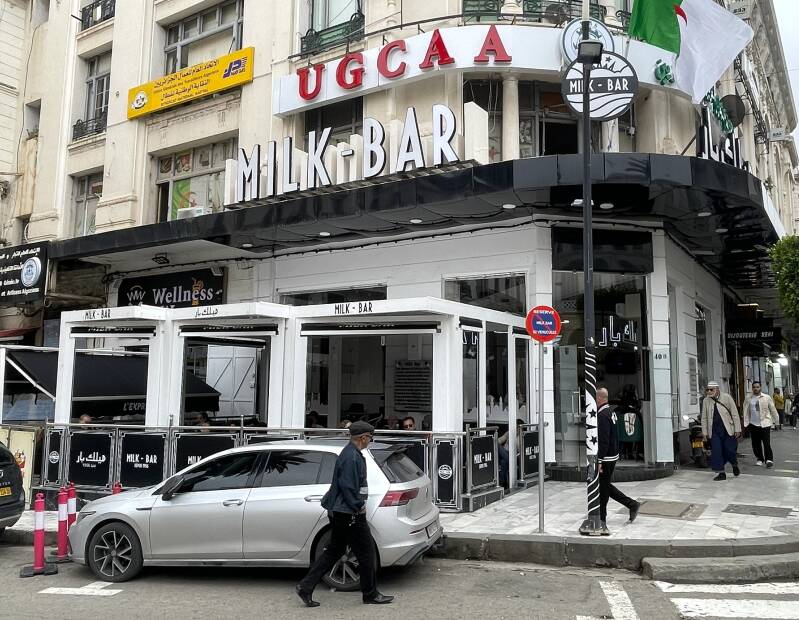
The Milk Bar Cafe.
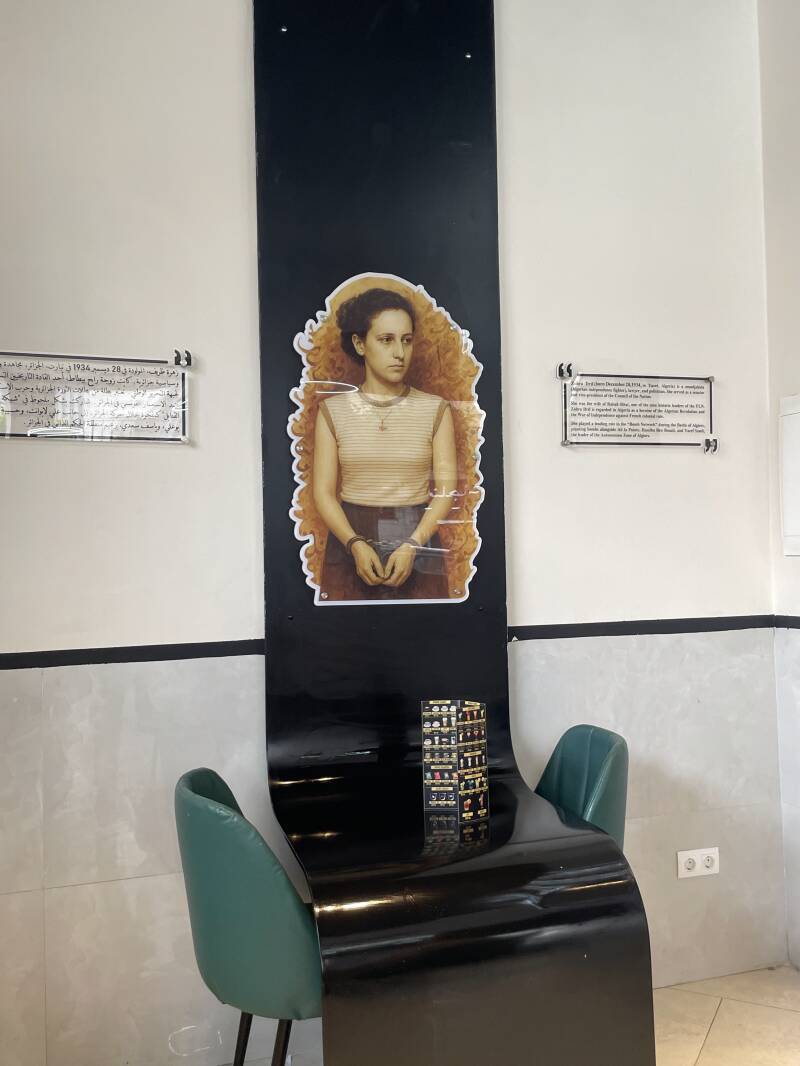
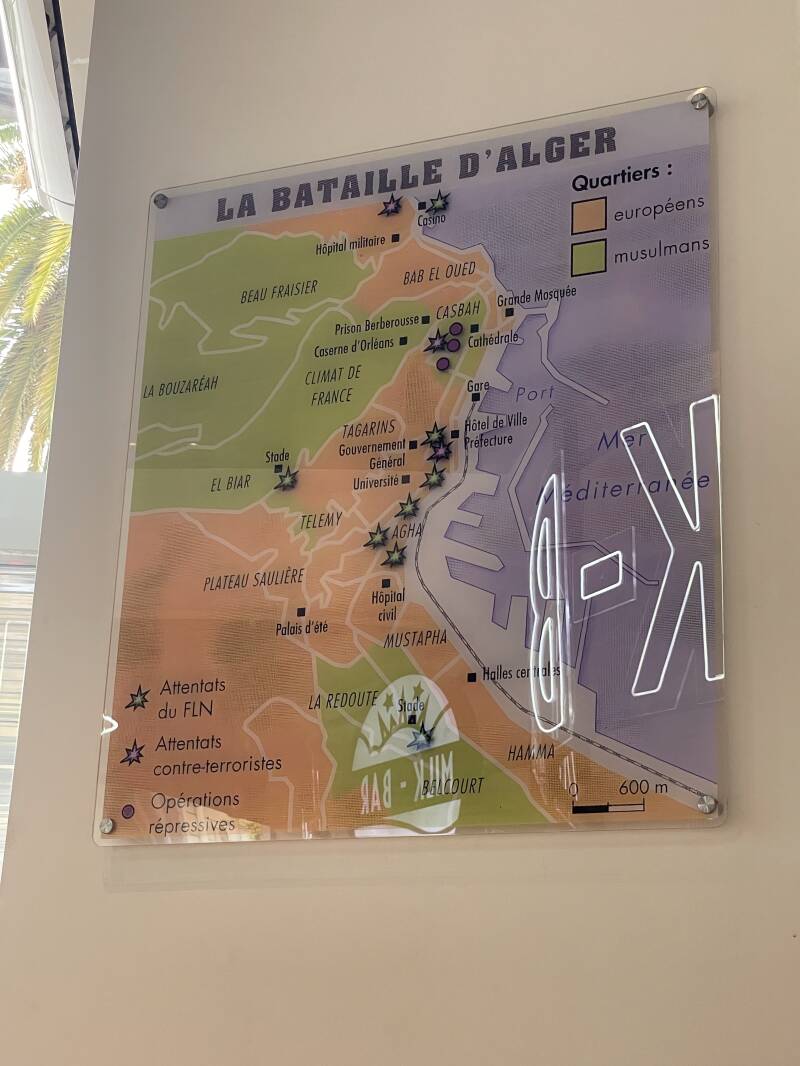
Portrait of Zohra Drif above the table where I sat. Map of the Battle of Algiers.
No city seems complete without an equestrian statue, and Algiers is no exception. A short stroll from the Milk Bar stands the Monument to Emir Abdelkader, founder of the modern Algerian state and leader of the resistance against the French invasion in the nineteenth century.
Like many such monuments around the world, it depicts its subject on horseback, looking resolute and heroic. Its setting, however, is what makes it especially striking. Surrounded by elegant French colonial buildings near the Grande Poste and only a short walk from the Milk Bar Café, it creates an intriguing juxtaposition: a national hero who fought French expansion framed by some of the finest architectural legacies of French rule.
As I admired the monument, however, my attention was repeatedly stolen by a local man who seemed blissfully oblivious to its historical significance. Despite the chilly weather, he darted through the fountains at its base every time the water burst into life, laughing as the jets soaked him before disappearing again a few minutes later. Whether he was simply eccentric or living with a mental illness, I couldn't say, but while visitors paused to photograph Emir Abdelkader, he appeared to regard the monument as little more than the backdrop to his own private water park.
It was another reminder that monuments ultimately belong to the people who live alongside them. They may commemorate pivotal moments in a nation's history, but everyday life continues around them, often in unexpected ways.
It was also something I noticed repeatedly during my time in Algeria. The country's history is not neatly separated into different districts or eras. Instead, Roman, Ottoman, French and modern Algerian influences coexist side by side, often within the same city block.
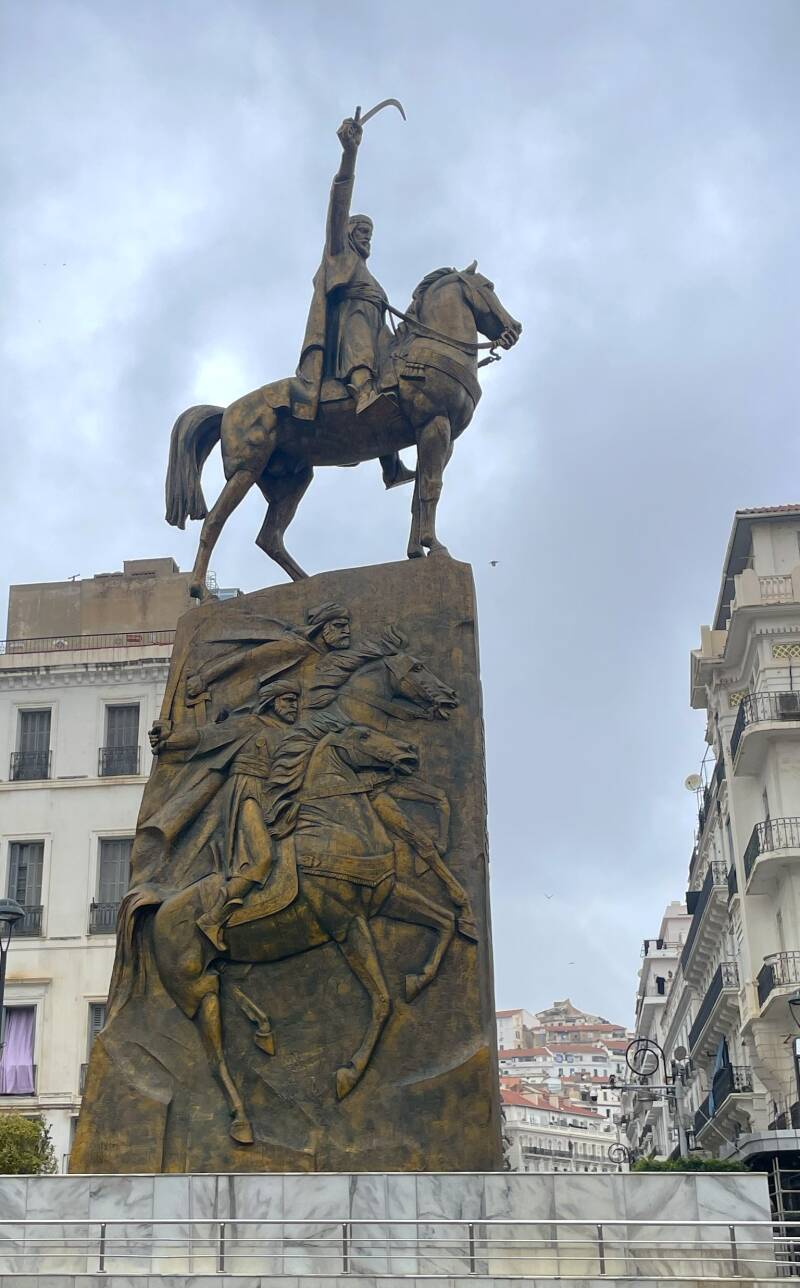
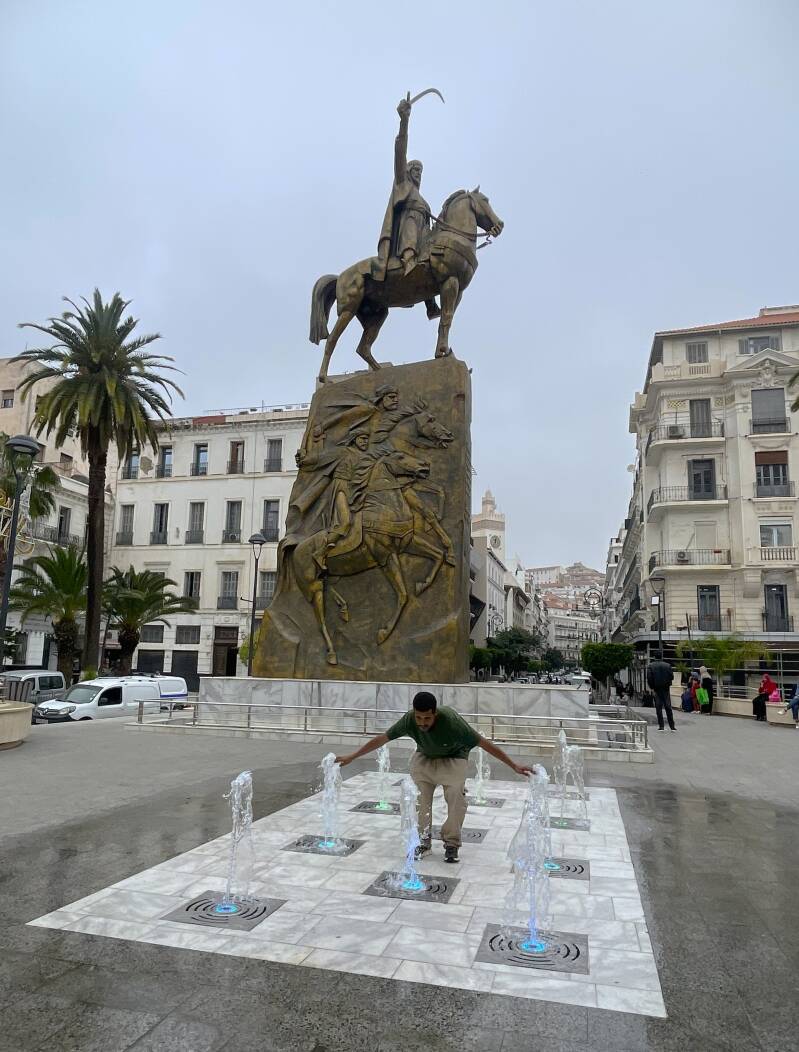
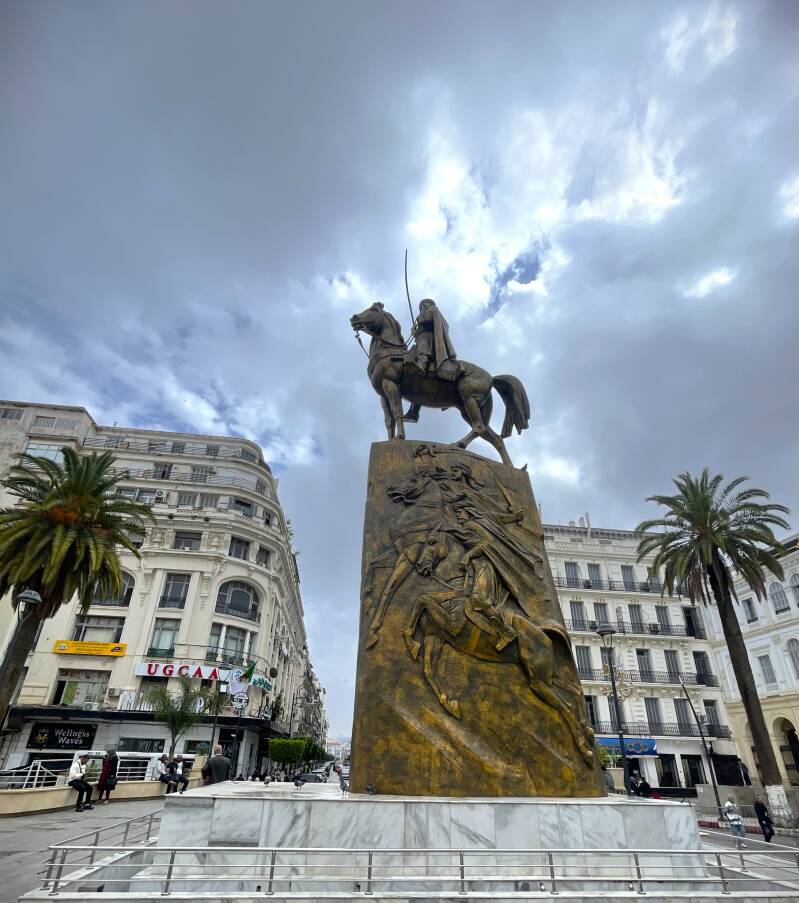
Monument to Emir Abdelkader, founder of the Algerian nation.
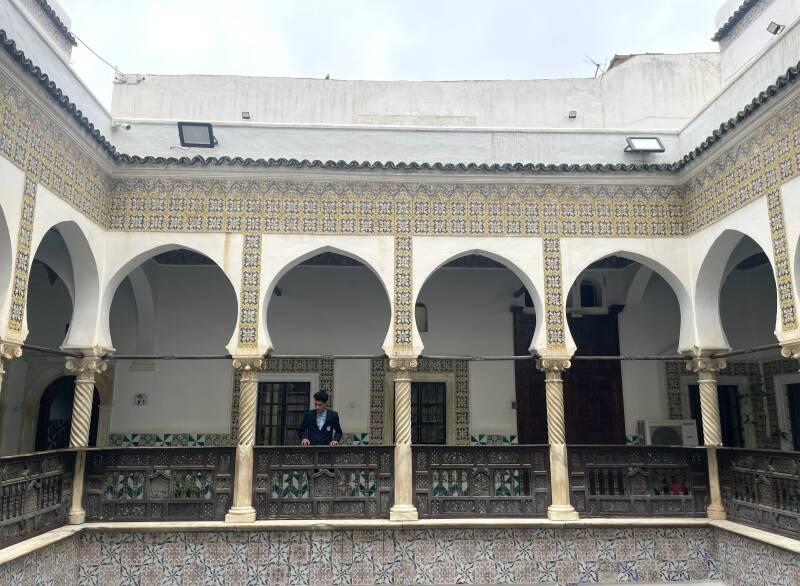
The Palais des Rais (Bastion 23) was one of the more interesting sites I visited in Algiers. This collection of Ottoman-era palaces and houses sits on the waterfront at the edge of the lower Casbah and today functions as a cultural centre.
It was the interior that reminded me of Morocco. Decorative tiles, geometric patterns and ornate courtyards would not have looked out of place in Fez or Marrakech, reflecting the shared architectural heritage of North Africa.
Built in the sixteenth century as part of the Ottoman defences of Algiers, Bastion 23 is the last surviving section of the city's historic waterfront quarter. Restored in the 1990s, it now serves as both a heritage site and a venue for cultural events.
One advantage of interrupted sleep was ending up with two full days to explore Algiers before the formal tour had even started. On my second 'free' day, I walked in the opposite direction to the Casbah, seeking out some renowned 20th century pieces of architecture and two museums. The Résidence Aéro-Habitat, designed by Louis Miquel and José Ferrer-Laloë is a sprawling Brutalist residential complex of 300 apartments in four blocks built in 1955 that is both ugly and impressive at the same time. Recognisably inspired by Le Corbusier's famous Unité d'Habitation in Marseille, it shares the same concrete aesthetic of rectangular windows, although the one in Marseille uses bright primary colours.
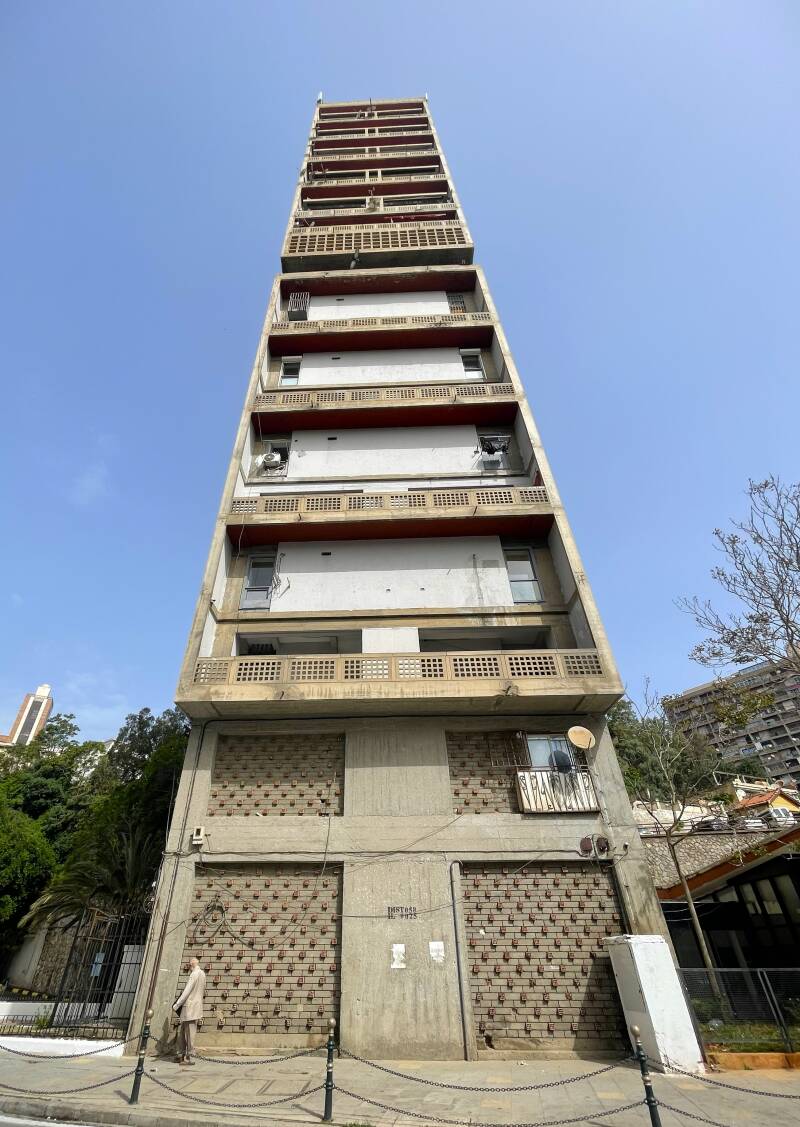
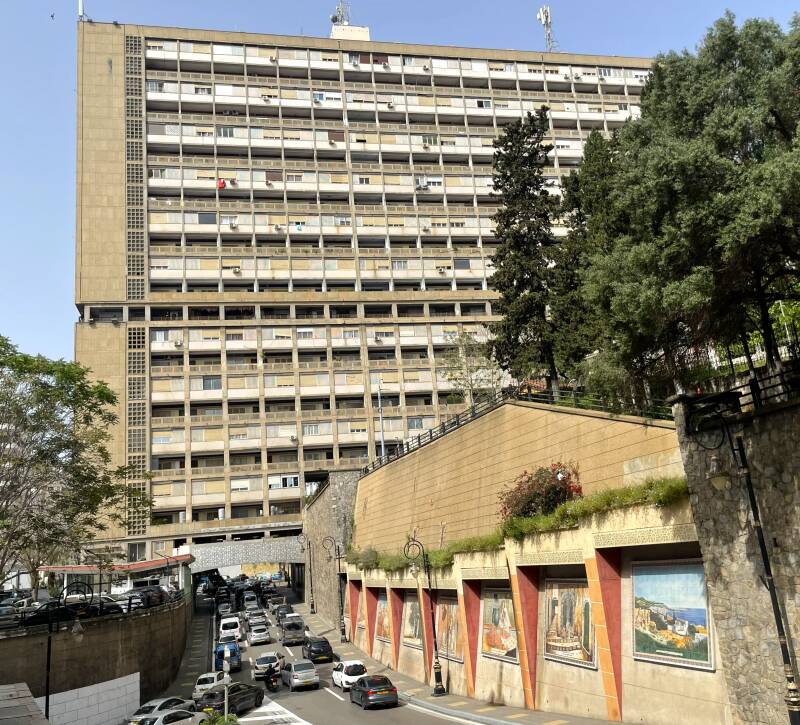
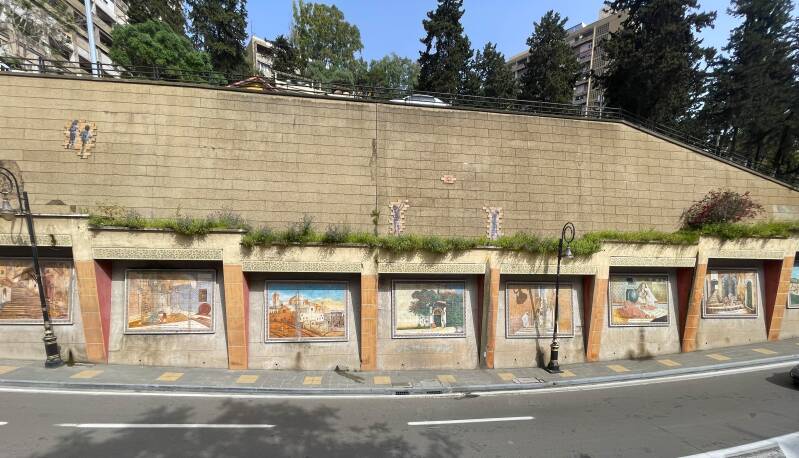
Different views of Résidence Aéro-Habitat.
One building I was keen to see was the Cathédrale du Sacré-Cœur. Unfortunately, like several museums and historic buildings I encountered in Algiers, it was undergoing renovation and closed to visitors. Undeterred, I spent several minutes circling the site trying to find a clear photographic angle, only to discover that the cathedral is remarkably difficult to capture. Trees, surrounding buildings and the steep terrain seem determined to conceal it from view.
The Sacré-Cœur Cathedral is another prime example of African Brutalism. Completed in 1956 by architects Paul Herbé and Jean Le Couteur, the church abandoned the domes, spires and ornamentation traditionally associated with religious buildings. Instead, it embraced exposed concrete, bold geometric forms and a distinctly modern aesthetic. Even from the outside, it looks more like an ambitious civic building or nuclear bunker than a conventional cathedral.
Whilst Algiers is often associated with the Casbah, Ottoman history and French colonial boulevards, there is also a fascinating layer of post-war modernism. Buildings such as the Sacré-Cœur Cathedral and the nearby residential blocks demonstrate that Algeria's architectural story did not end with independence or colonialism; it continued into the twentieth century.
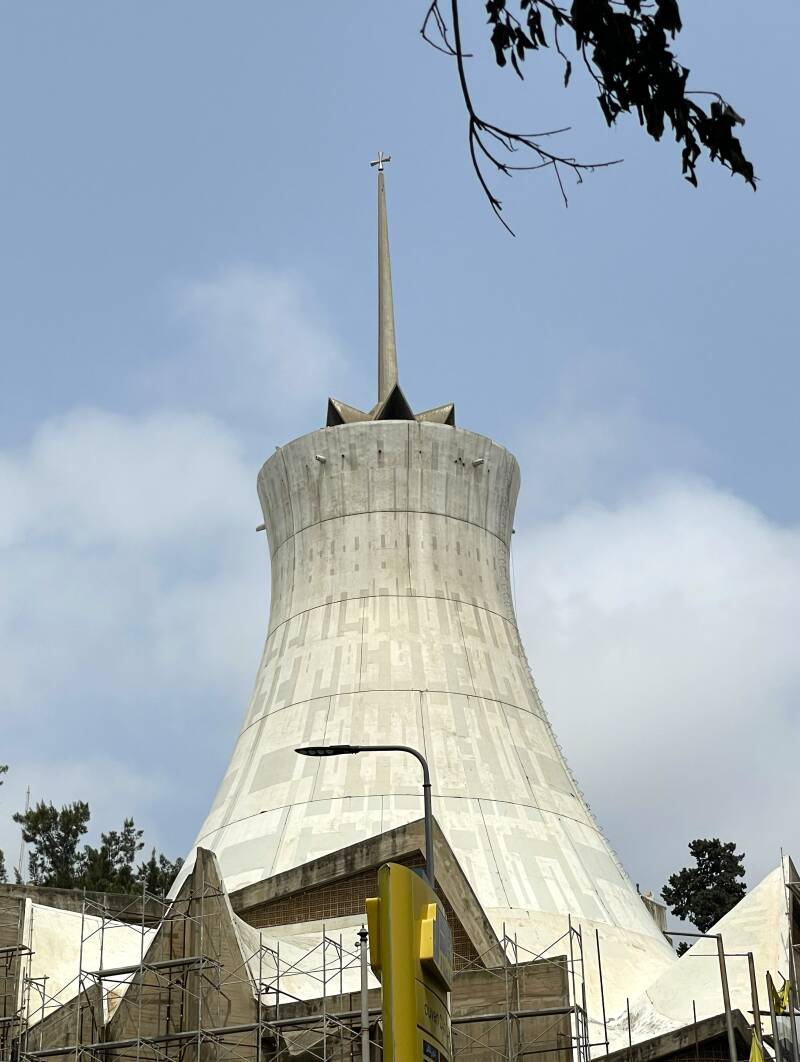
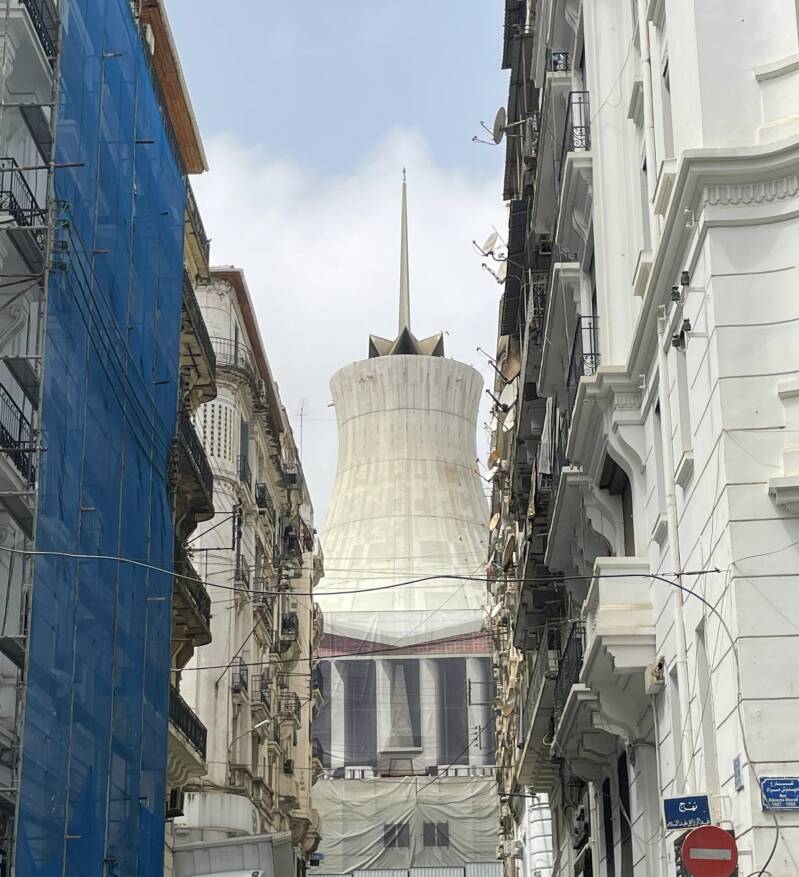
The Sacré-Cœur (Sacred Heart) Cathedral, under renovation.
That evening I met up with Robert and Bilel, our guide from Constantine, for dinner. Although the official tour had not yet begun, it already felt as though we were underway. Travellers were arriving at different times and gradually joining the group, creating numerous opportunities to get to know one another before the formal start date. Robert was constantly on hand, joining us for city walks, sightseeing and meals, which helped create a sense of camaraderie from the outset.
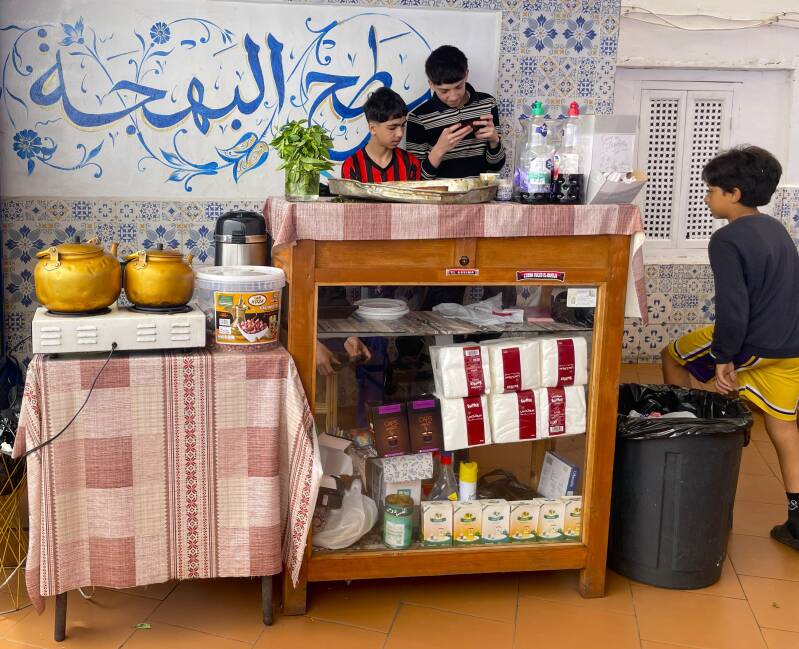
A tea/ coffee house in Algiers.
By the following morning, most of the group had arrived and it was finally time for the official start of the tour. Alongside Robert, we were joined by our local guide, Zaki. Like Bilel, whom I had met the previous evening, Zaki was young, spoke flawless English, possessed a wry sense of humour and seemed to have an encyclopaedic knowledge of Algeria. Throughout the day, he effortlessly switched between history, politics, architecture and local culture, making even the longest explanations entertaining.
We began in Martyrs' Square, one of the oldest parts of Algiers, before exploring the winding streets of the Kasbah, the UNESCO World Heritage-listed old city. The maze of narrow alleyways, staircases and hidden courtyards offered a vivid glimpse into centuries of Algerian history and felt worlds away from the grand French boulevards that define much of the modern city.
After a delicious lunch, we crossed the city using the Algiers Metro and tram network. Public transport proved to be modern, efficient and remarkably inexpensive, making it easy to move across a city built across steep hills above the sea.
Our destination was the hilltop Martyrs' Memorial, one of Algiers’ most iconic landmarks, commemorating those who died during the War of Independence. Even in misty conditions, its scale was striking, representing three sweeping concrete “palm fronds” rising above the city skyline.
Next to the monument is the National Museum of the Moudjahid, dedicated to Algeria’s independence struggle. It was one of the more unusual museums on the trip. Alongside photographs, artefacts and historical exhibits were large-scale dioramas populated with mannequins acting out scenes from the war. The displays included depictions of imprisonment and torture, arranged in highly theatrical poses that gave the museum bizarre aesthetic. No photography was permitted inside so you'll need to use your imagination!
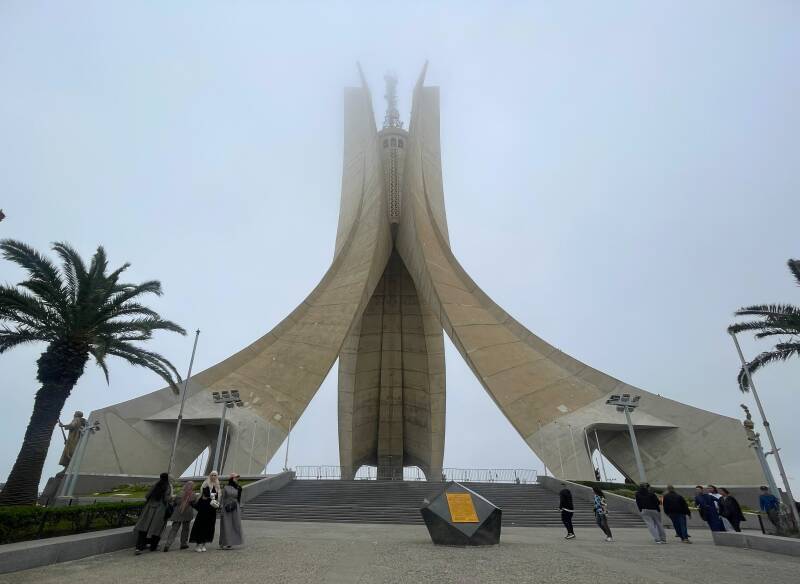
The Maqam Echahid is a concrete monument commemorating the Algerian War. The monument was opened on July 5, 1982, on the 20th anniversary of Algeria's independence. It is fashioned in the shape of three standing palm leaves, which shelter the "Eternal Flame" under it.
From there we continued to the Jardin d'Essai du Hamma, Algiers’ celebrated botanical gardens. Of all the places that day, this was the one I wished we had more time in. The gardens were full of local families enjoying the afternoon, and apart from our group there were very few visitors who appeared to be tourists.
One of the garden’s notable features is a tree marked with a sign confirming its appearance in one of the early Tarzan films starring Johnny Weissmuller. It stands quietly among the paths and greenery, an unexpected link between Algiers and early Hollywood cinema.
Reaching the gardens had been an experience in itself. With only one cable car in operation, queues stretched far beyond what our schedule allowed, so we instead took taxis up the hill and planned to take the cable car back down. By the time everyone had squeezed into the cabin, any notion of personal space had disappeared completely. We descended packed tightly together with locals and fellow travellers alike, pressed shoulder to shoulder in a way that suggested we were now collectively sharing more DNA than is medically advisable.
The surrounding parkland was alive with activity—families picnicking, children playing, and groups gathered beneath the trees. It was a side of Algiers that felt entirely lived-in and local, with almost no foreign tourists in sight.
As the day ended, Algiers continued to reveal itself as a city of contrasts: historic yet modern, formal yet chaotic, and consistently more engaging than I had expected.
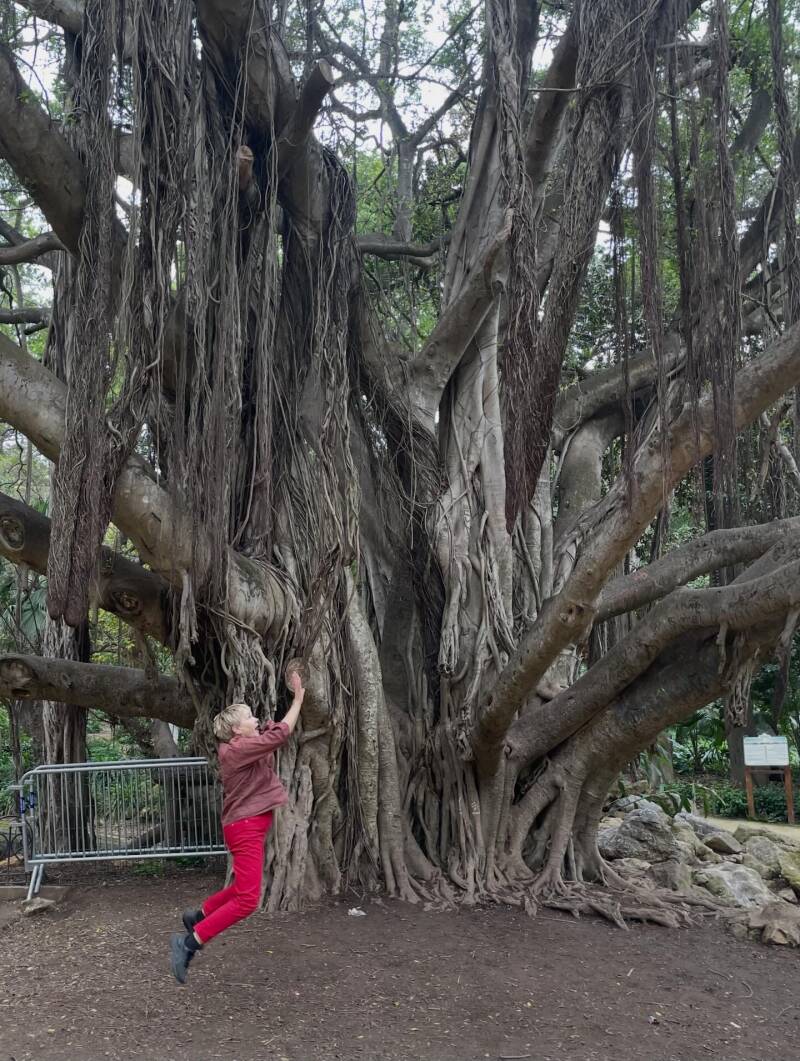
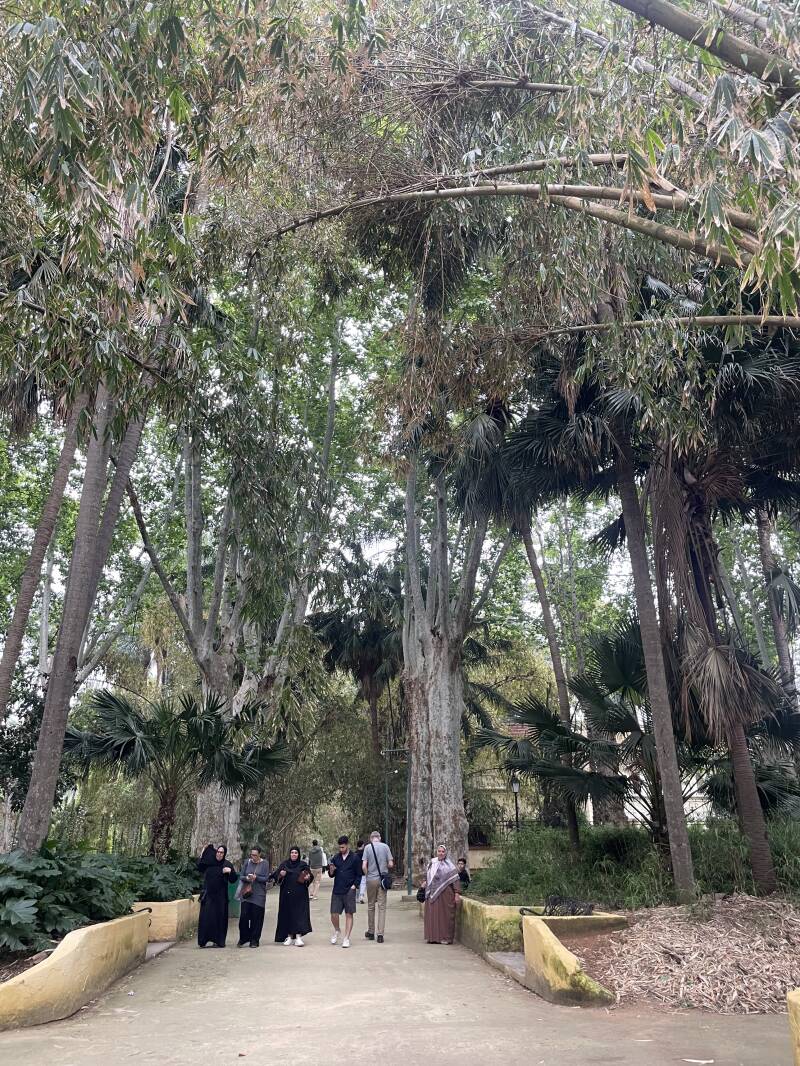
1 The iconic "Tarzan tree" from Algiers is located in the Jardin d'Essai du Hamma (Hamma Botanical Garden). It was used as a filming location for the opening sequence of the original 1932 classic, Tarzan the Ape Man, starring Olympic swimmer Johnny Weissmuller.
2 People enjoying the many pathways in the gardens.
Watching the film The Battle of Algiers after returning home gave me a very different perspective on the Casbah pf Algiers. Just over a month earlier I had been wandering its steep lanes, squeezing through narrow alleyways and pausing at viewpoints overlooking the bay. It was easy to appreciate its atmosphere and history, but harder to understand why images of Ali Ammar, better known as Ali La Pointe, seemed to appear everywhere.
The film helped fill in some of those gaps. Filmed only a few years after independence, many of the extras were ordinary residents who had lived through the Battle of Algiers themselves. Rather than feeling like a historical drama, it often resembles a documentary, with the Casbah acting as much as a character as the people who inhabit it.
The Casbah was far more than a picturesque old quarter. During the Algerian War of Independence it became the stronghold of the FLN in Algiers, its maze of narrow alleyways providing shelter, escape routes and meeting places for resistance fighters. Ali La Pointe emerged as one of the most famous figures of the urban resistance. In 1957, during the Battle of Algiers, he and several comrades were cornered by French paratroopers in a house in the Casbah. When they refused to surrender, the building was blown up, killing everyone inside. Today, his image appears throughout Algiers not because of the circumstances of his death, but because many Algerians view him as a symbol of resistance and sacrifice during the struggle for independence.
Having visited the Ali La Pointe Museum, the Milk Bar and the streets of the Casbah before watching the film, I found myself recognising locations and understanding their significance in a way I had not fully appreciated at the time. The museum itself occupies the very house where Ali La Pointe, Hassiba Ben Bouali and their comrades were killed. Standing there, it was difficult to imagine the events that unfolded within those walls; watching the film later brought those stories vividly to life.
The experience also helped me understand some of the apparent contradictions I had encountered during my visit. At the Milk Bar, where I stopped for coffee and cake beneath photographs of Zohra Drif Bitat, visitors wandered in to study the displays much as they would in a museum. From an outsider's perspective, it can seem surprising that figures associated with bombings and civilian deaths are commemorated in the very places where those acts occurred. Yet the film underscores how many Algerians view these individuals through the lens of anti-colonial resistance and national liberation. Whether one agrees with that interpretation or not, understanding that perspective is essential to understanding modern Algeria.
The Casbah is not simply a UNESCO-listed historic district; for many Algerians it remains a living memorial to one of the defining chapters of their nation's history. Walking its lanes was fascinating. Watching The Battle of Algiers afterwards gave those streets an entirely new dimension.
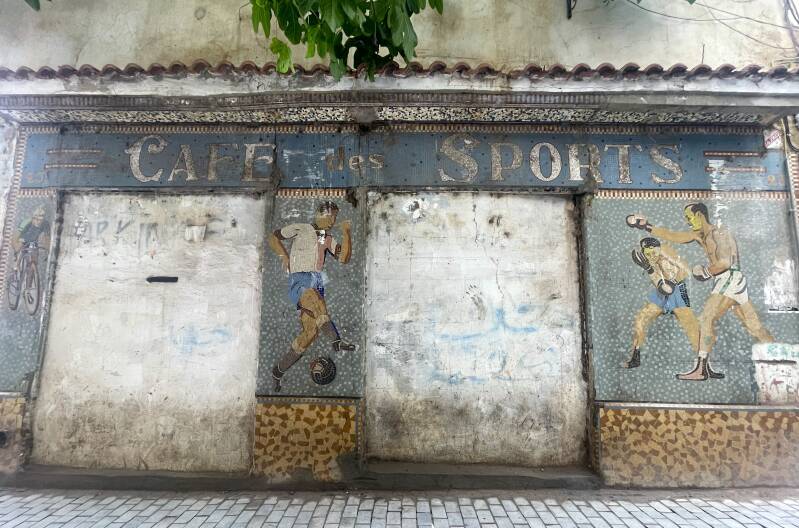
A mosaic Ghost Sign in Algiers.
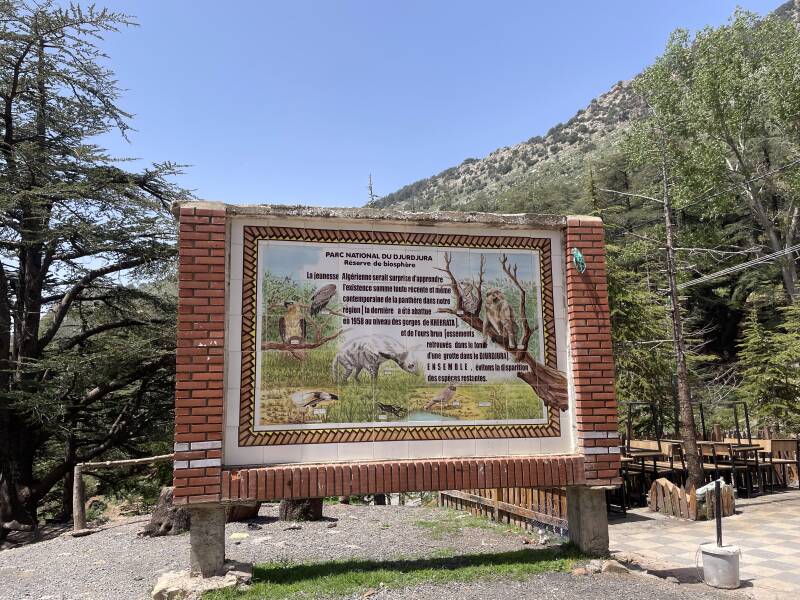
Djurdjura Park sign showing the various animals native to the area.
Departing Algiers with the group in the Sprinter minibus the next day marked the start of the next phase of the journey—the hiking section of the tour. The roads were notably well sealed, a welcome contrast after the state of infrastructure I had experienced in West Africa and the Horn of Africa (Eritrea in particular). One could see what oil and gas revenue can deliver when it is channelled into public works.
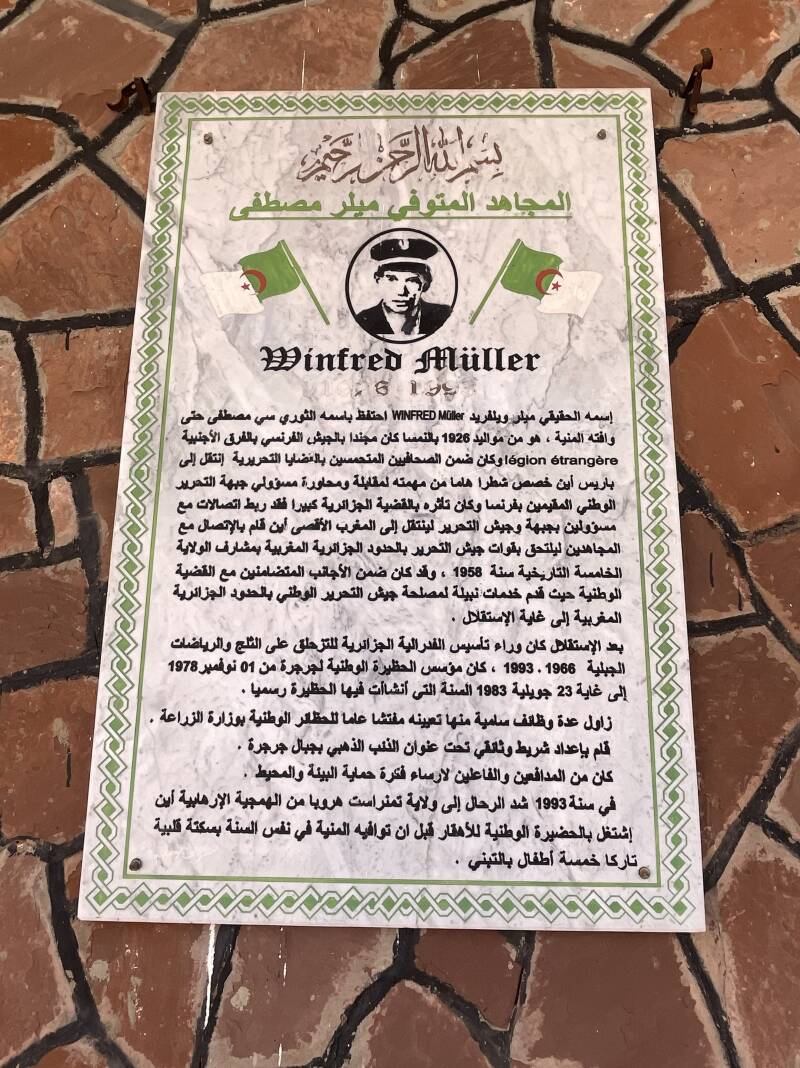

Plaque outside the Winfred Müller Nature Museum acknowledging the founder and one of the taxidermied animals.
That morning we headed towards Djurdjura National Park, making a stop at the Winfred Müller Nature Museum to learn about the ecosystem, flora and fauna of the region. In reality, the educational value was somewhat secondary to the entertainment provided by the taxidermy displays. Much of the group wandered through the exhibits with growing amusement. One fellow traveller, who has a particular interest in visiting taxidermy collections, remarked wryly that he was disappointed because the displays were “too professional”, which felt like a generous assessment. I, on the other hand, managed to locate a few specimens that appeared to be in a noticeably more advanced state of decay, which somewhat restored balance to his critique.
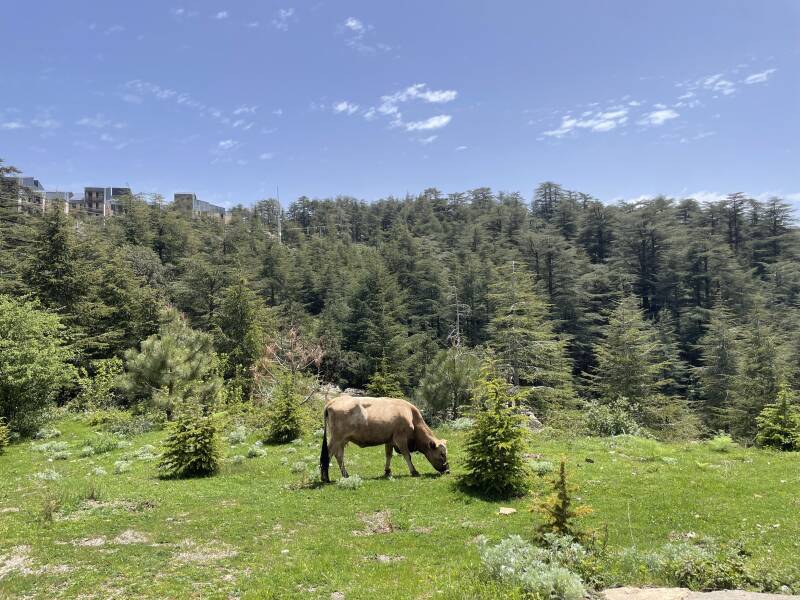
The cattle always seem happy in Tikjda.
From there we continued to the city of Lalla Tizi Ouzou, considered "The Capital Of Djurdjura" and on to Tikjda for a short introductory hike in the mountains. It was a gentle 2–3 hour walk designed to ease us into the terrain, and it proved to be a pleasant and accessible introduction to hiking in the Algerian highlands. I secretly wondered if Robert and the guides were using this shorter hike to see if any of us were likely to struggle with the impending 9 hour one!
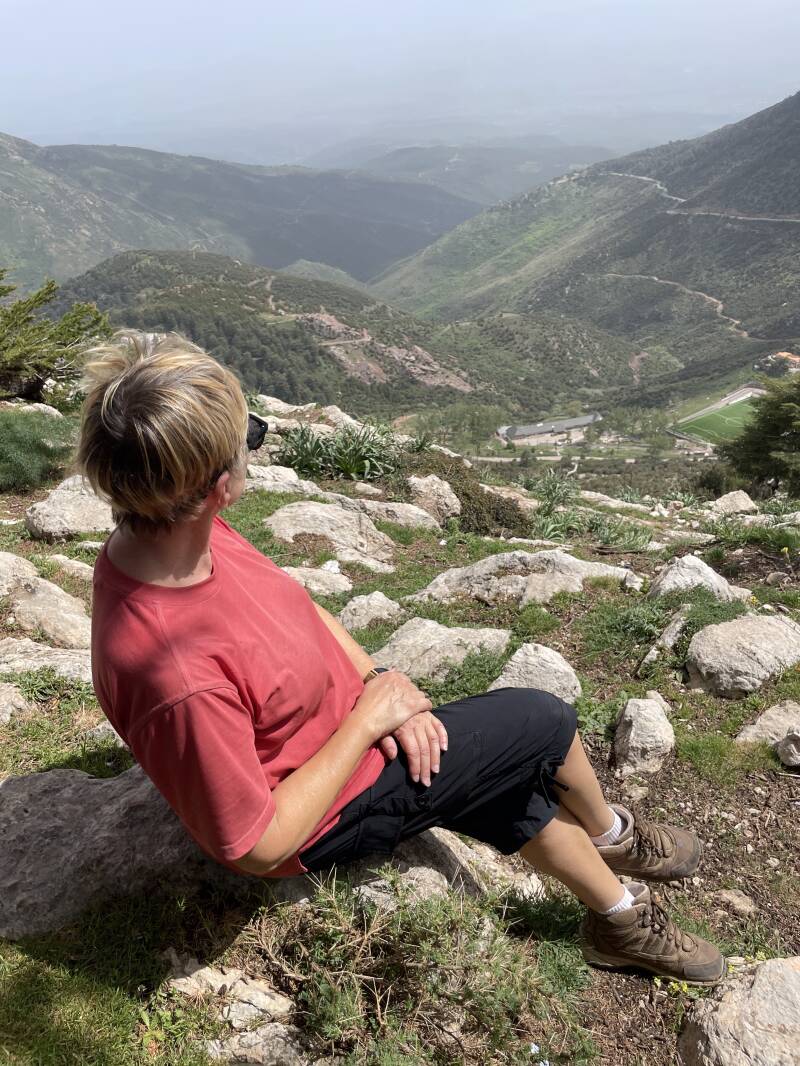
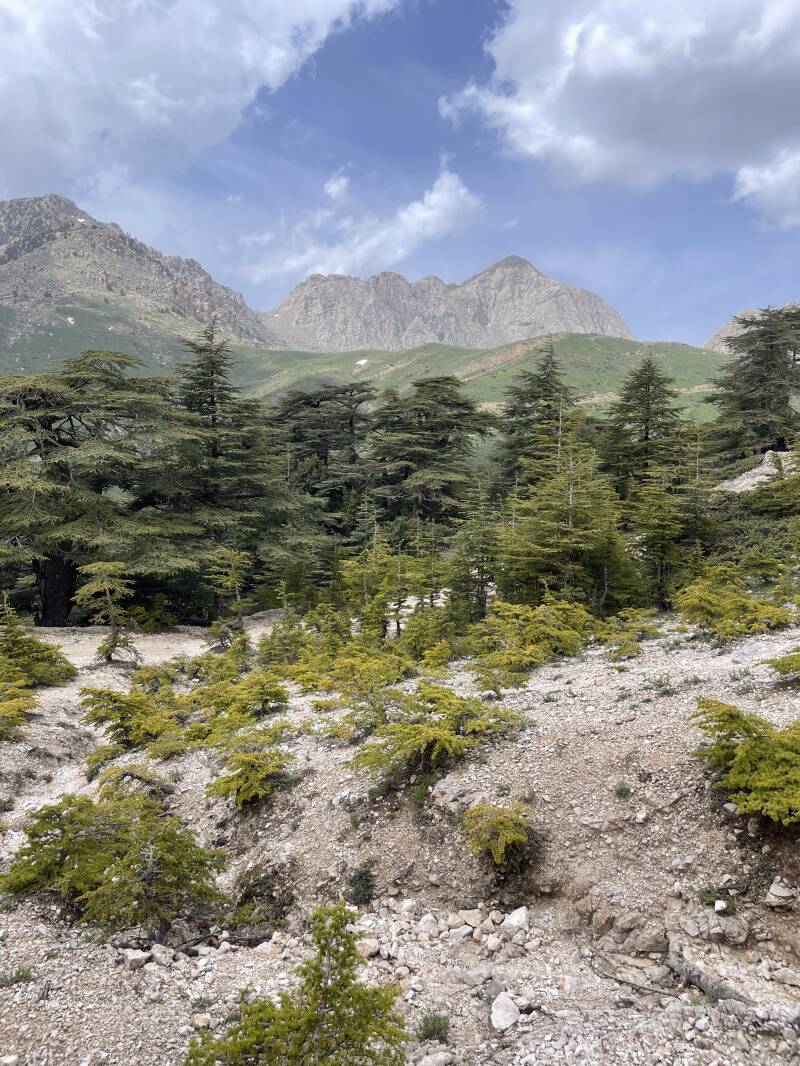
Views of Tikjda.
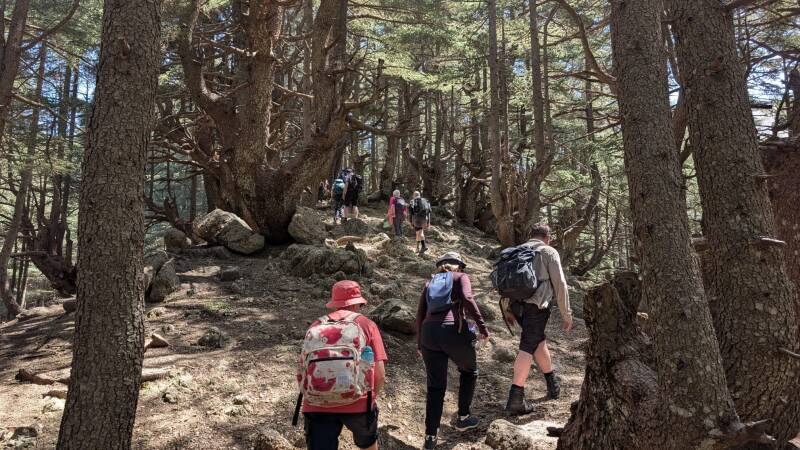
The group ascending a hill. Photo taken by someone from the group, not me.
Our accommodation for the night was the Tikjda Mountain Resort, a place that seemed to exist in a curious time warp. “Retro” would be one interpretation, and I was initially charmed with the intact Art Deco lounge suites, but there were moments when it evoked something between The Shining’s Overlook Hotel and the Bates Motel, albeit with less intentional design coherence.
Robert and I played a game of pool, although the experience was complicated by the absence of a proper cue tip, meaning each shot required a degree of forceful improvisation more than finesse.
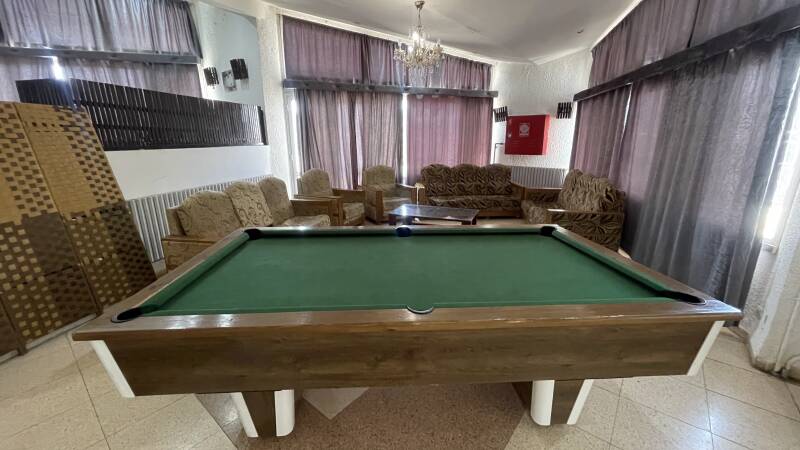
It's straight to the pool room! Art deco club chairs in the background at Tikjda Mountain Resort.
Dinner leaned heavily into an older culinary era; my stuffed chicken vegetable stuffed chicken felt firmly anchored in the 1980s, while breakfast the next morning, consisting of dry bread and cake-like items, was memorably described by one group member as “only good as recycling for building materials.” To his credit, Robert later arranged for omelettes the following day, which felt like a significant upgrade in operational logistics.
The bathroom facilities added another layer of unpredictability. Water from the basin in my room leaked out of the basin onto the floor, and at least one member of the group openly questioned whether the shower was worth the risk of engagement. The toilet, however, especially if I lifted the lid of the tank, functioned reliably, which in that context felt like a meaningful success.
Despite its eccentricities, the lodge did have one undeniable advantage: the views. Looking out across the mountains, it was an impressive setting that reminded us why we were there. However, we were also instructed to keep the doors to our balconies closed at all times, as macaques were known to roam the area and occasionally attempt entry.
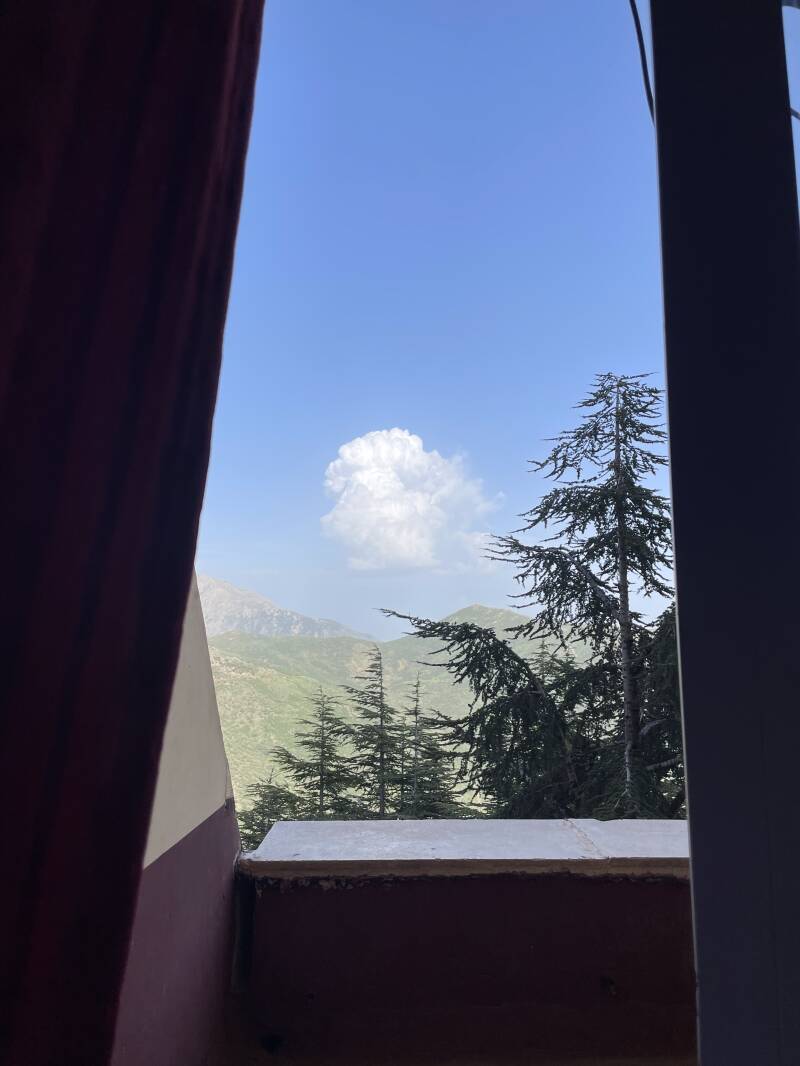
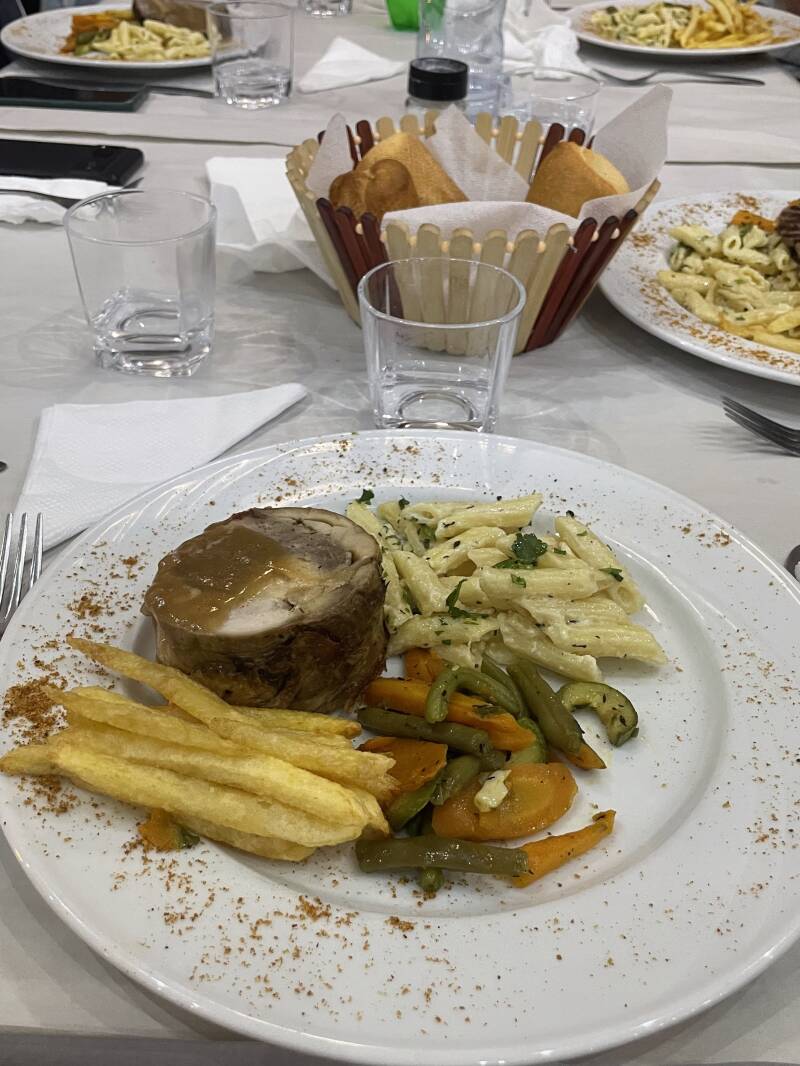
Peeking through the heavy curtains to the mountainous landscape; carbing up: dinner of stuffed chicken, chips, pasta and bread.
The next day we were set to experience Djurdjura National Park in all its splendour, spending the entire day hiking. The route would traverse the park from north to south, starting in Tala N’Yilef and finishing at Chalet du Kef. The difficulty was described as moderate, though with steep gradients at times and rough mountain paths. The estimated duration was 7 to 9 hours.
Along the way, we were promised a full immersion in the diversity of the Algerian Atlas: pine forests giving way to rugged bare peaks, alpine lakes such as Agoulmim, and the chance to encounter endemic Barbary macaques in their natural habitat. Birds of prey circled above the high ridges. At the end of the hike, we would return to the Tikjda Mountain Resort for the night.
At the entrance to the park, a hand tiled sign set the tone:
“Chaque parcelle du Djurdjura est une richesse accumulée patiemment depuis des millénaires et dont nous sommes les bénéficiaires et les dépositaires. Il est donc notre devoir à tous d’en garantir sa pérennité pour la transmettre en l’état aux générations futures.”
Every part of the Djurdjura is a richness patiently accumulated over millennia, of which we are both the beneficiaries and the custodians. It is our shared duty to ensure its longevity and to pass it on, intact, to future generations.
It was a poetic reminder that we were merely passing through and had a responsibility to preserve what surrounded us for those who come next.
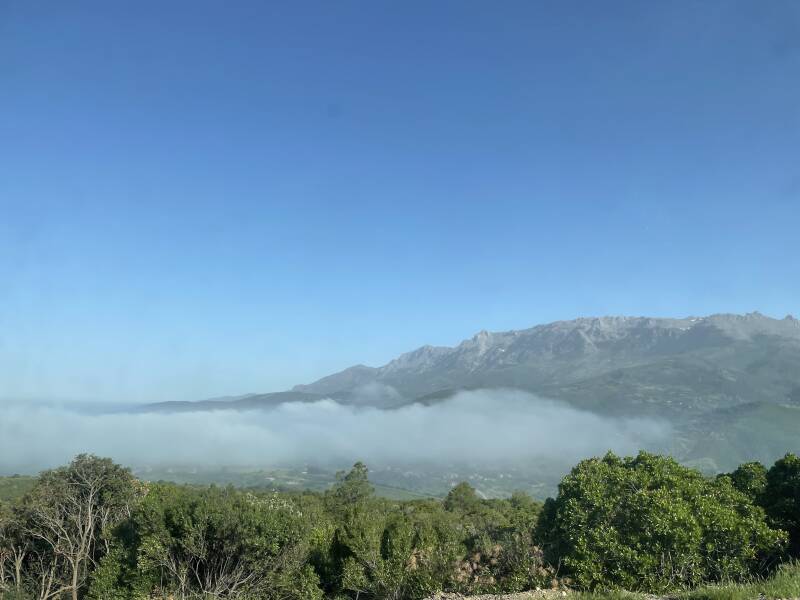
Through the bus window on the way to Djurdjura National Park.
In reality, this turned out to be one of the most challenging hikes I have ever done. Whether it was the altitude, the steep ascents and descents, or the fact I was starting to come down with a cold, I felt every metre of it. At several points the trail narrowed into exposed edges and I looked down to my left and realised that a single slip would mean certain death. I made a conscious decision not to think about that and just keep moving forward.
When I looked back, I realised many of the others were walking with their hands held by the guides over the steep parts, which seemed like a very sensible arrangement that I had somehow opted out of.
But it was absolutely worth it. The mountain views were immense, there were stretches of snow underfoot, and we descended towards Lake Agoulmim where we paused among cows that appeared to be genuinely frolicking, galloping around with no obvious agenda. I had never seen cattle behave quite like that before.
We were accompanied by two local guides, Mahmoud and Raouf, though at one point the group split during a faster section of the trail. One of the guides moved ahead at considerable speed, with Jon trying and failing to keep up. When the rest of the group caught up, it became clear that Jon had gone missing.
We stopped and waited, but there was no sign of him. Eventually the guide returned without Jon. For a moment there was real concern as we considered what could go wrong in this kind of terrain. Then Jon appeared, completely unbothered, smiling as if he had simply taken a scenic detour.
A brief, quiet meeting followed between Mahmoud, Raouf and Robert, one of those understated but clearly important discussions that usually signals that certain operational adjustments will be made.
After that, the group stayed a little closer together.
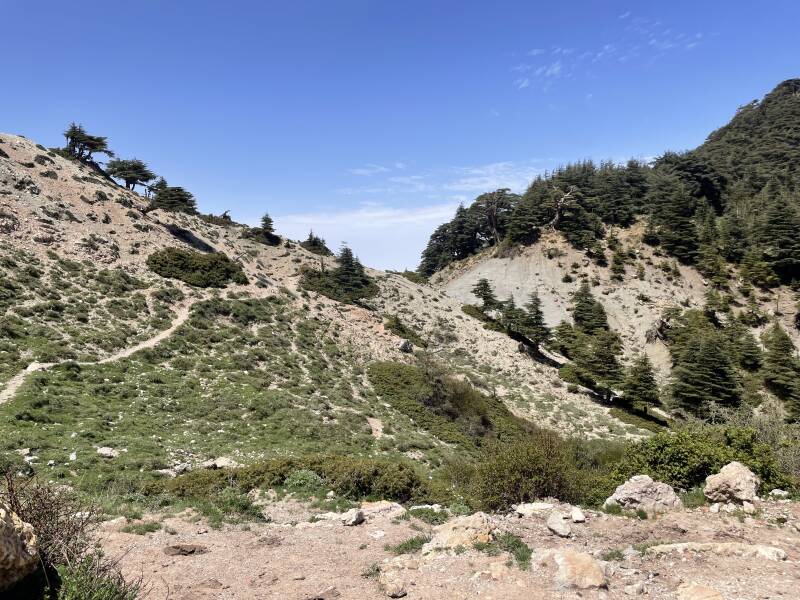
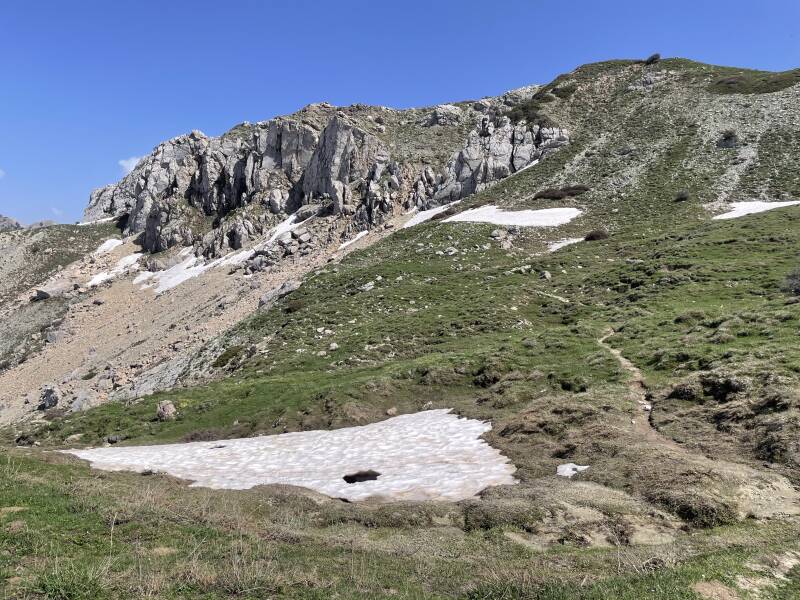
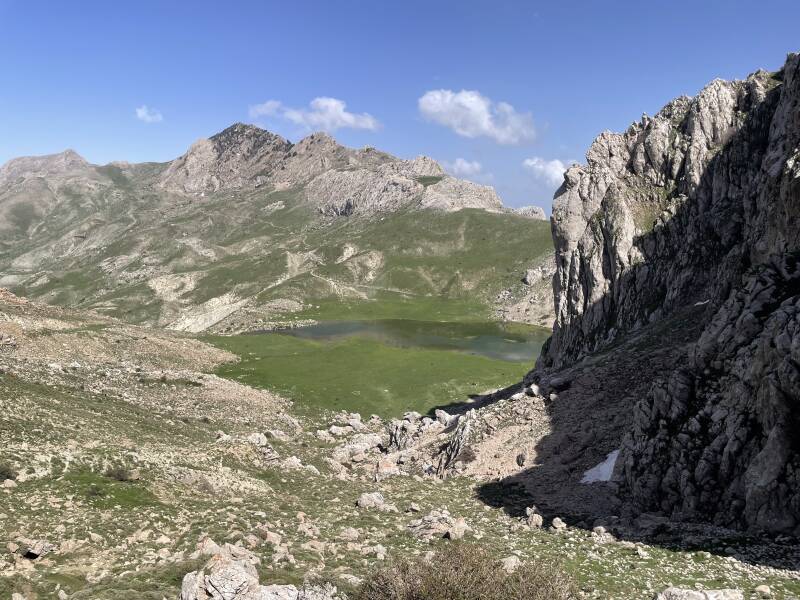
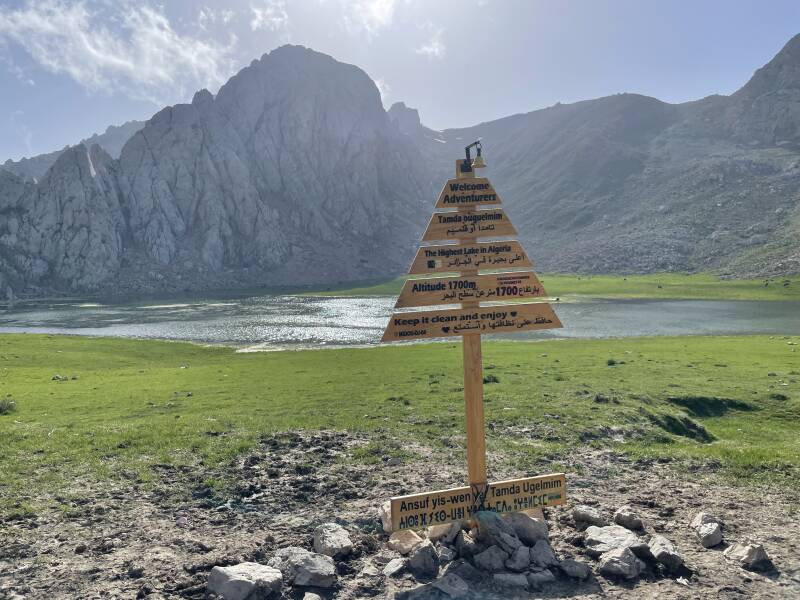
Views of Djurdjura National Park during our hike.
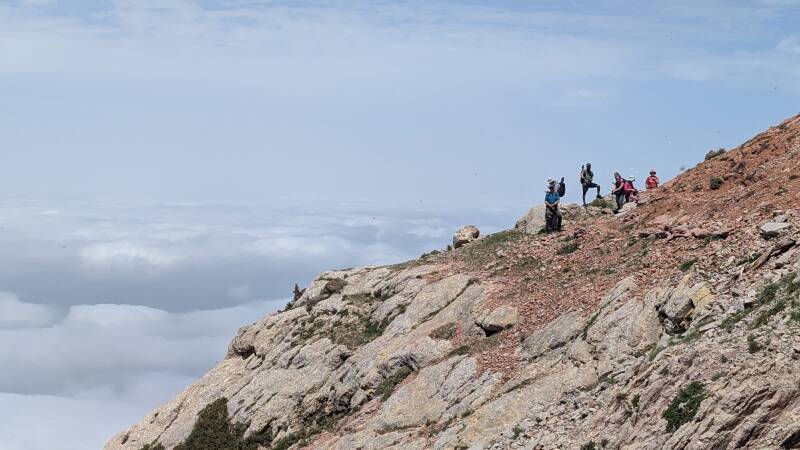
The group resting on a hill in Djurdjura National Park; photo taken by Robert, our guide.
Cleverly planned as a rest day from our mega hike yesterday, the next morning we visited Djemila (formerly Cuicul), one of the best-preserved Roman archaeological sites in North Africa. The landscape opened up as we left the mountains, revealing rolling green hills and wide meadows that felt lush after the harsher terrain of Djurdjura.
Before exploring the ruins, we visited the site museum, which contains a collection of restored Roman tiles and a detailed model of the ancient city. From there, we continued to the old Christian quarter, where one of the earliest known baptismal areas in Africa can still be seen.
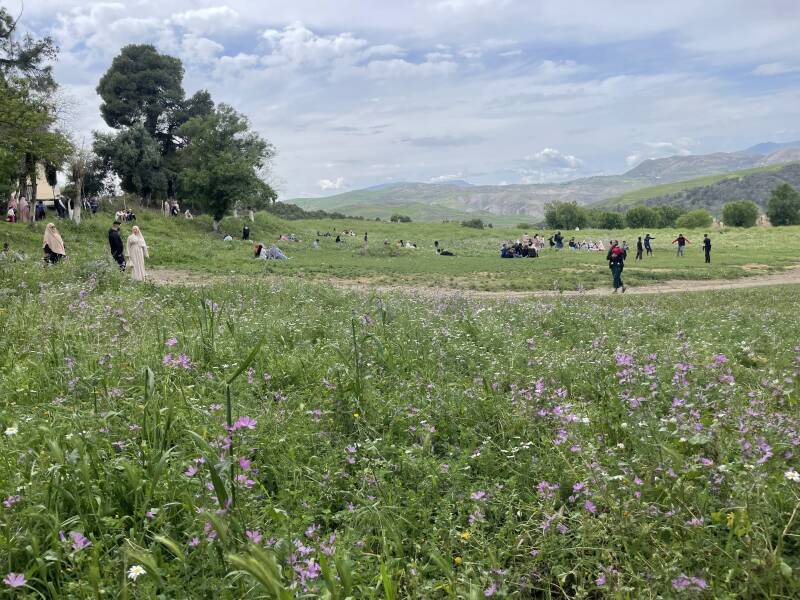
A gorgeous meadow in the parklands of Djemila.
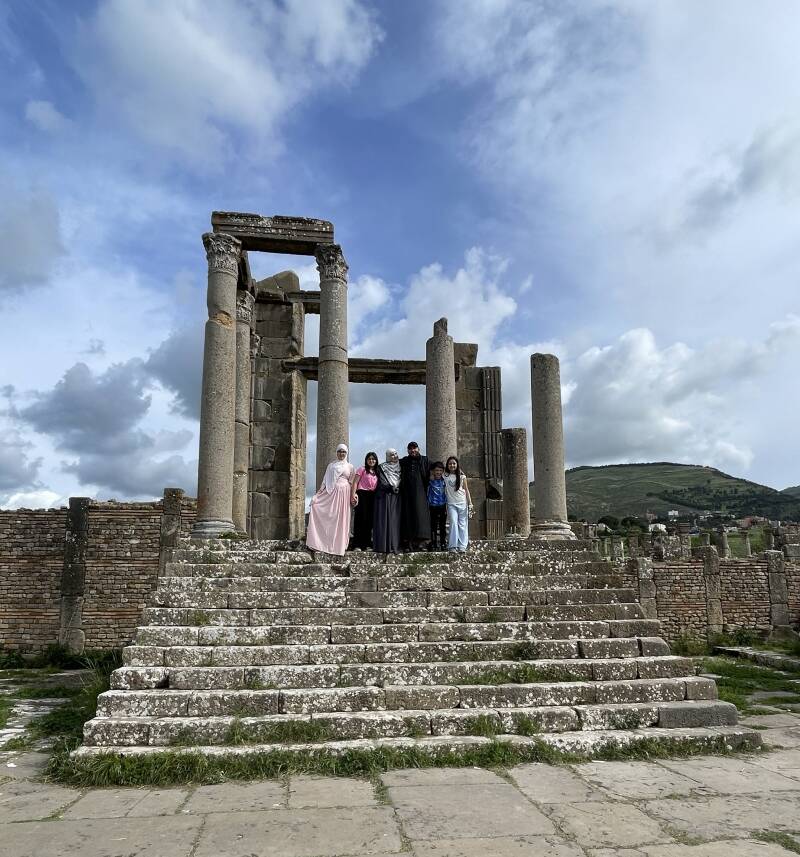
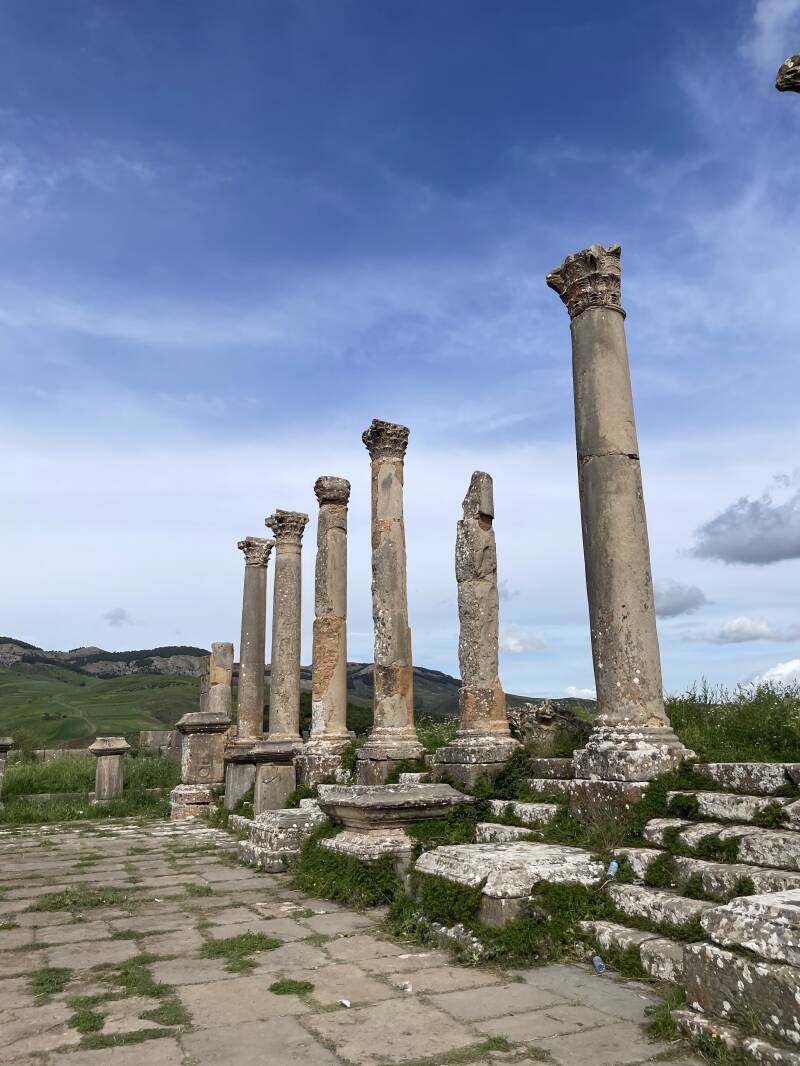
Djemila.
The site itself was a highlight of the trip for me. Coming from Australia, where I had left behind a drought-affected heatwave and bushfire warnings, the sweeping grassy landscapes already felt almost surreal. What made it even more striking, however, was how alive the place felt. Local families were out in force, many dressed for the day, enjoying the open space and the spring atmosphere as much as we were.
There is a tendency to assume that religious dress, particularly hijabs or abayas, is inherently restrictive, but what I saw here challenged that simplistic view. Women and girls moved freely through the landscape, and at one point a group of them were energetically playing football alongside boys, fully engaged in the chaos of the game.
At another moment, while our guide Bilel was giving a detailed explanation of the site, we overheard a group of girls peering down beneath an ancient archway suddenly exclaim, “Oh my God!” The entire group erupted into laughter. Curiosity got the better of me later and I went to investigate, only to find nothing but an empty space beneath the stone. Whatever they had seen had clearly been more imagination than archaeology, but it was a perfect reminder of how easily wonder and humour coexist in a place like this.
The museum itself was remarkable, with floor to wall mosaics and beautifully preserved artefacts displayed throughout the space. Groups of students, including scout groups, moved respectfully through the exhibits, listening attentively to their guides.
From Djemila we continued our journey towards Constantine.
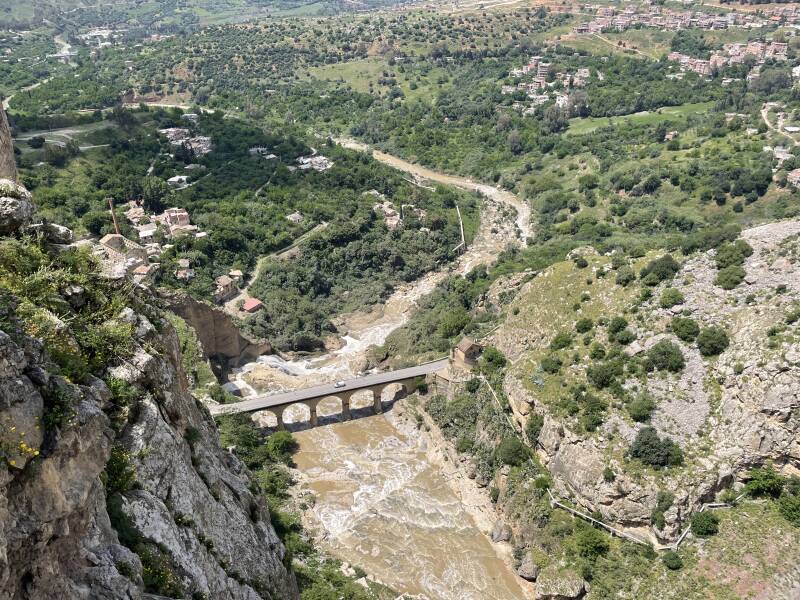
One of the many bridges giving Constantine its nickname 'City of Bridges'.
Arriving in the city felt like a change of pace again. After the rugged landscapes and ancient ruins, Constantine rose dramatically above its deep gorge and bridges, a city defined by its vertigo inducing geography. Our accommodation, the Panoramique Hotel (formerly Protea), was a welcome upgrade after the more rustic mountain lodge. Modern, comfortable, equipped with a lift and even a bar, it also offered a spectacular view over the canyon and surrounding buildings, fully living up to its name.
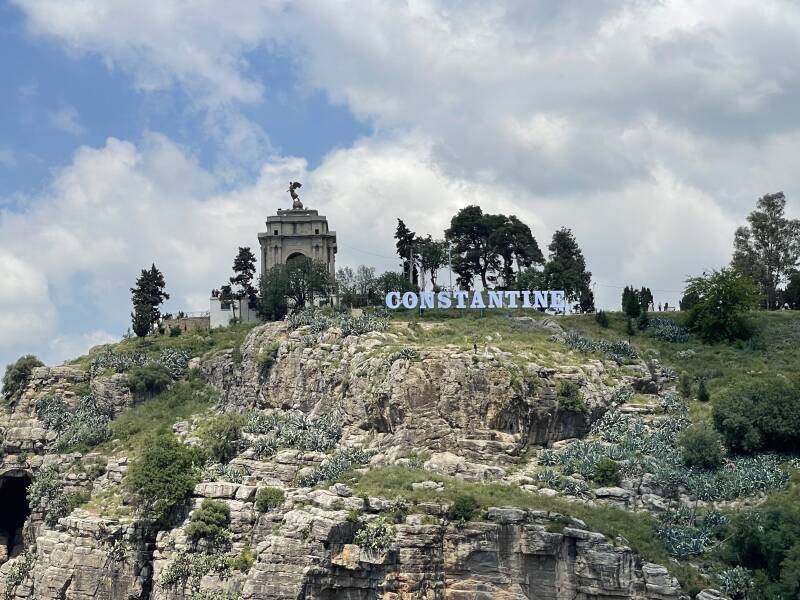
The Constantine War Memorial (Monument aux Morts). It features a prominent winged Victory statue atop an arch inspired by the Roman Arch of Trajan in Timgad. Built during the colonial era, it is located on the Sidi M'Cid plateau.
In the early morning, the group departed for the Aurès Mountains, heading towards Djebel Chelia, the second-highest peak in Algeria at 2,328 metres above sea level. It was described as another major hiking day in the itinerary.
After the intensity of the previous hikes, and with a general sense that my body was beginning to protest, I chose instead to stay in Constantine, (along with half the group, also sidelined by the lurgy that had been circulating through the Sprinter). It turned out to be one of those decisions that reshaped the day in a surprisingly positive way.
Constantine is often called the 'City of Bridges', and with good reason. Built dramatically across a deep gorge, it is a place defined by height, space and vertigo-inducing views.
I spent the morning at the Cirta Museum, which holds a rich collection of regional archaeology and modern Algerian art. I actually ended up visiting twice over the course of our stay in Constantine, once independently on this day, and again later with Bilel providing commentary for the group. On the first visit, the staff seemed genuinely impressed by my ICOM pass, which earned me an unexpectedly warm welcome.
I was immediately drawn to the museum's beautiful pastel pink façade, which glows in the North African sunshine. Designed by French architect Cestelli, and opened in 1931 as the Musée Gustave Mercier, the building was inspired by a Greco Roman villa, with elegant arches, classical porticos and peaceful courtyards that create a fitting home for its remarkable collection of antiquities.
Inside, the spacious galleries are filled with natural light, and the graceful arcades subtly echo the Roman cities of Djemila and Tiddis whose treasures are displayed here. The museum takes its name from Cirta, the ancient Numidian and Roman name for Constantine, making the building itself another link between the city's modern history and its ancient past.
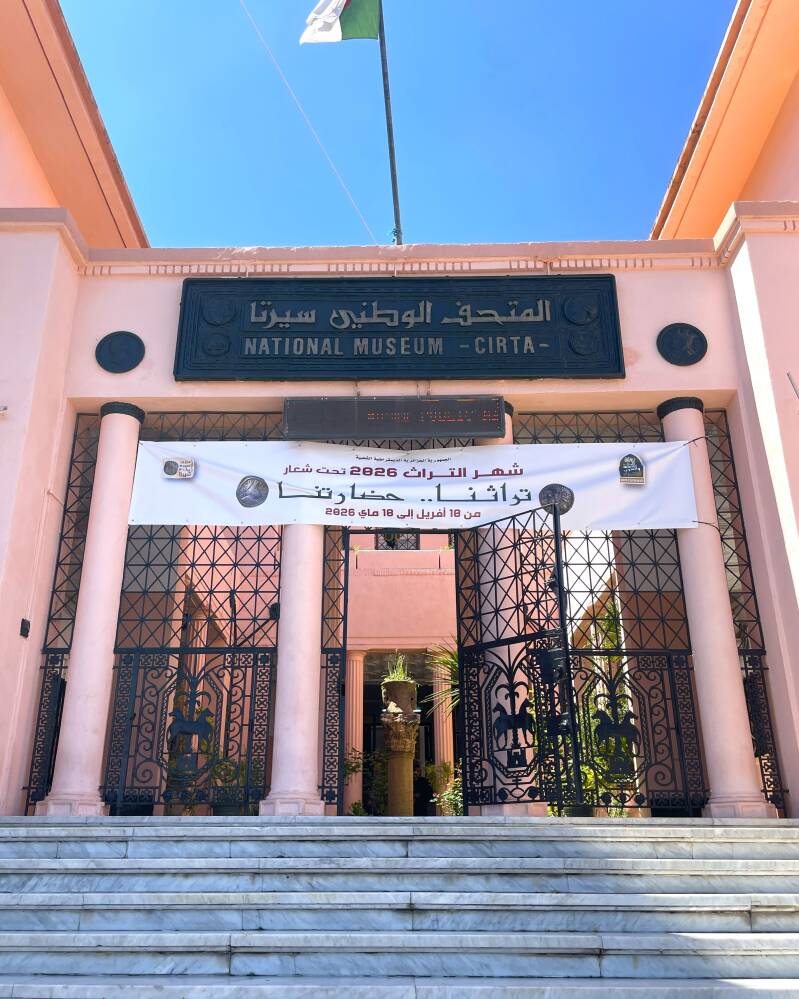
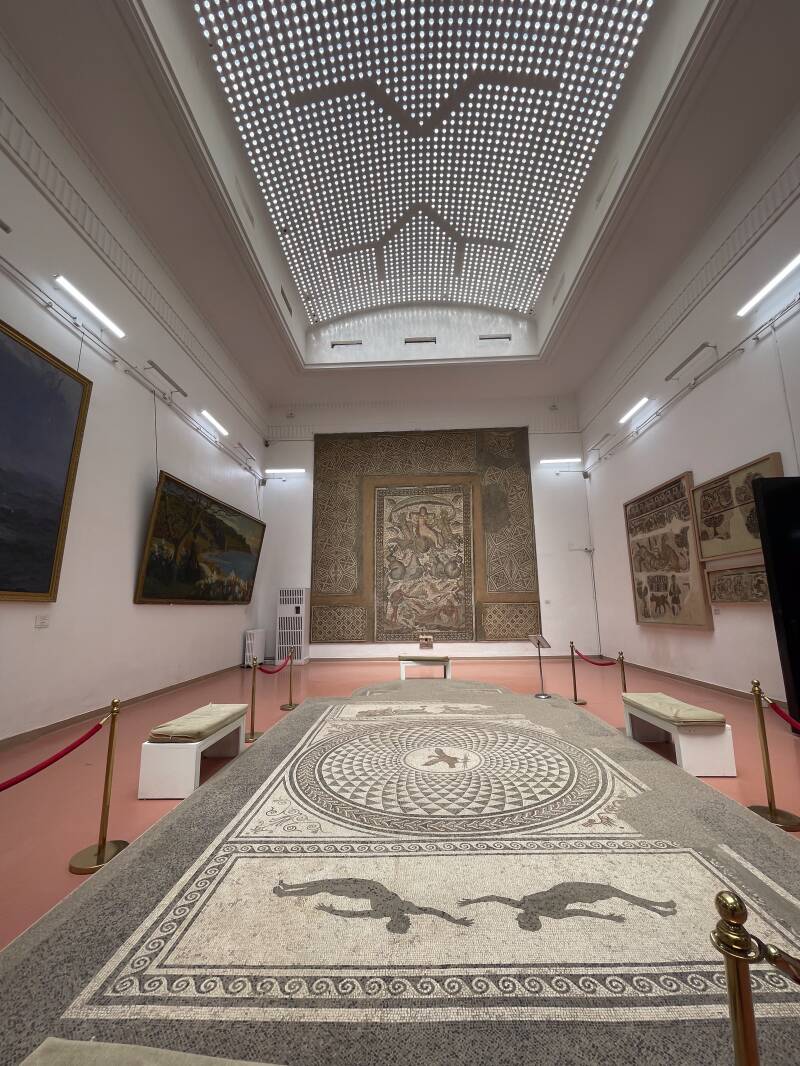
The Cirta Museum's grand entrance and interior with mosaics and paintings.
From there I visited the Palace of Ahmed Bey, a royal palace built in 1825, and one of the finest surviving examples of Ottoman architecture in Algeria. Its courtyards, intricate tilework, palm-filled gardens and beautifully preserved wooden doors offered a glimpse into the wealth and sophistication of nineteenth-century Constantine. What I had not expected was how busy the complex would be. A market or cultural event appeared to be underway, with stalls selling handicrafts and other goods while local families wandered through the courtyards and galleries. Most visitors seemed to be locals rather than tourists, giving the site a lively atmosphere.
It was easy to see why Constantine is so popular with tourists. The bridges, the gorge, the way the city seems to hang in space above the landscape gives it a sense of drama that feels almost theatrical.
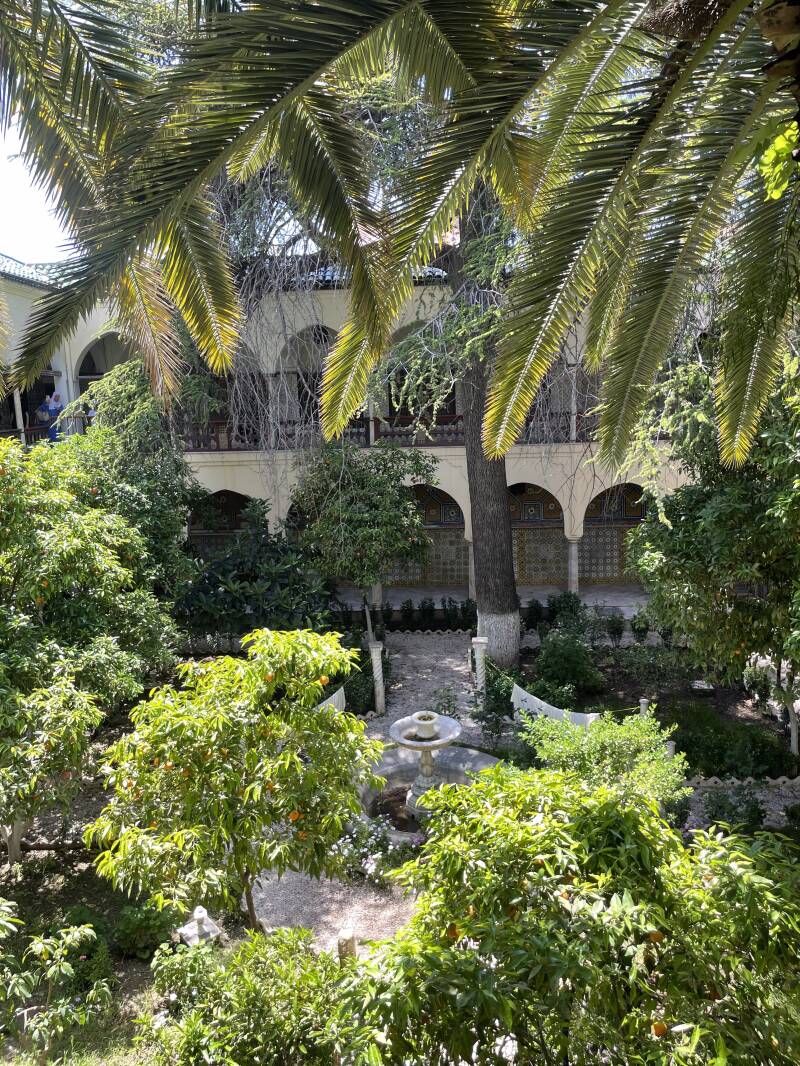
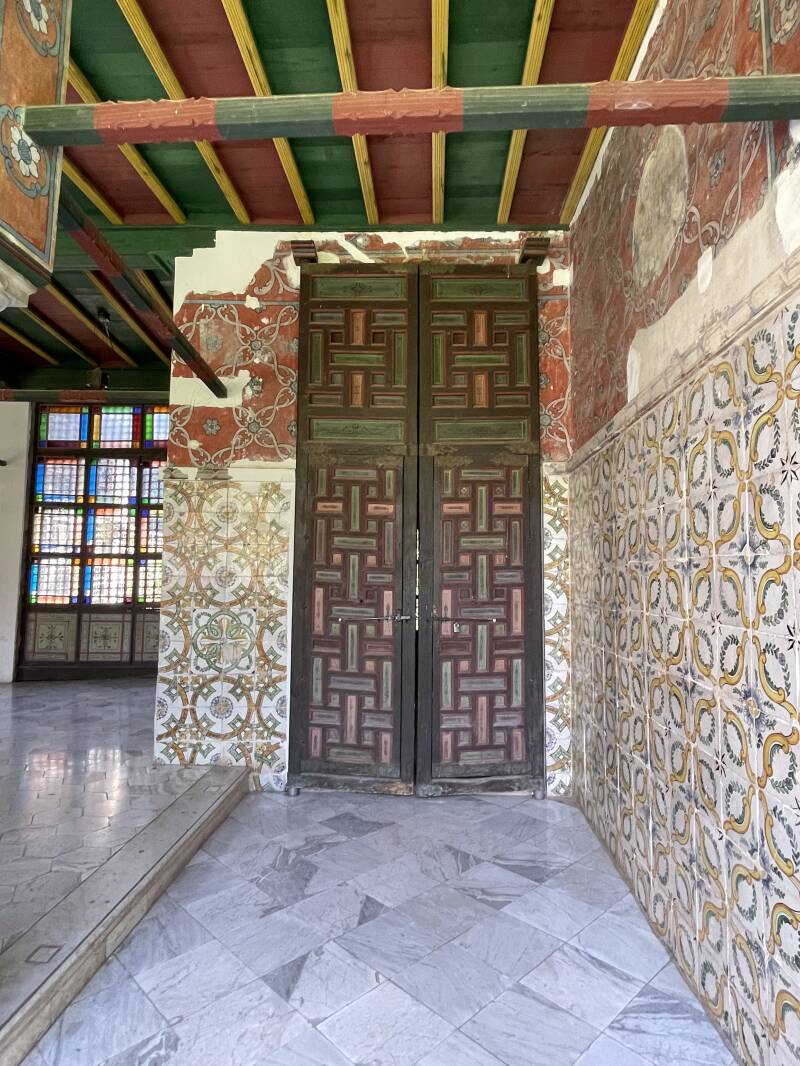
Courtyard and interior shots of Palace of Ahmed Bey, Constantine.
After breakfast, with the whole group reunited, we set out on a half-day tour of Constantine. Despite being a return visit for half of us there were no complaints as the tour and commentary gave context to what we had experienced the day before; I even found that I had walked an entirely different route to the one led by our guide Bilel (whom I had already met in Algiers). Together, we explored the labyrinthine streets of the old town before heading (back) to the Cirta Museum.
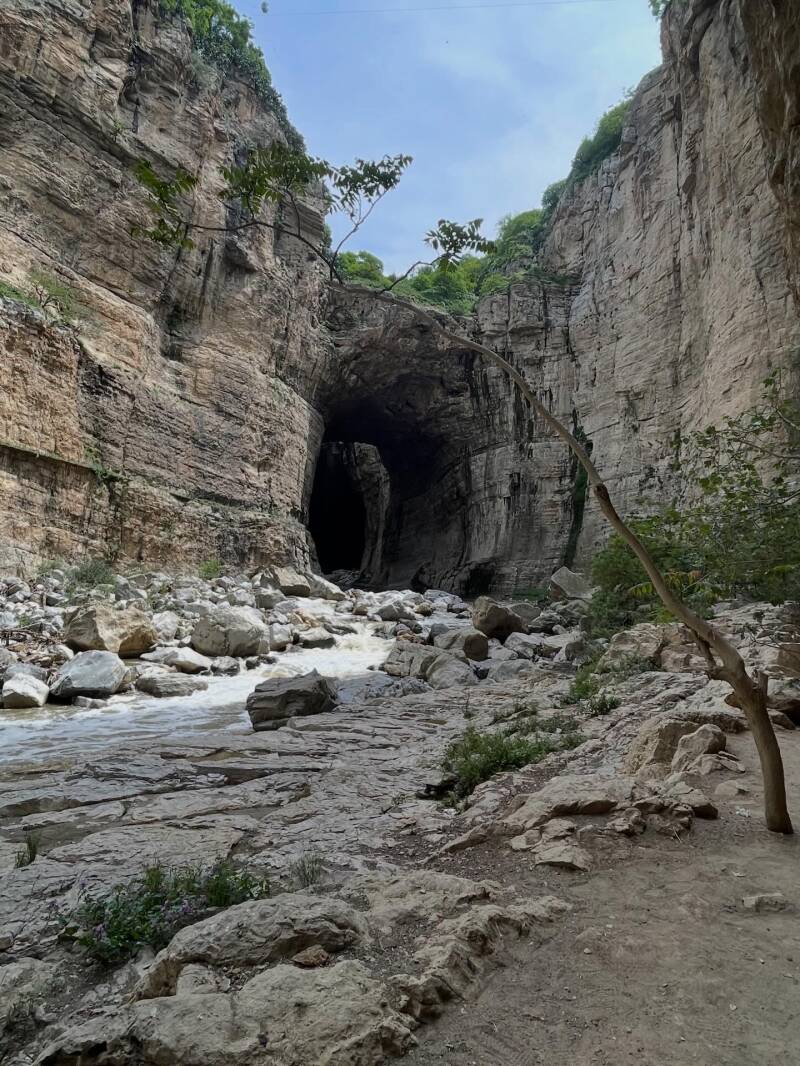
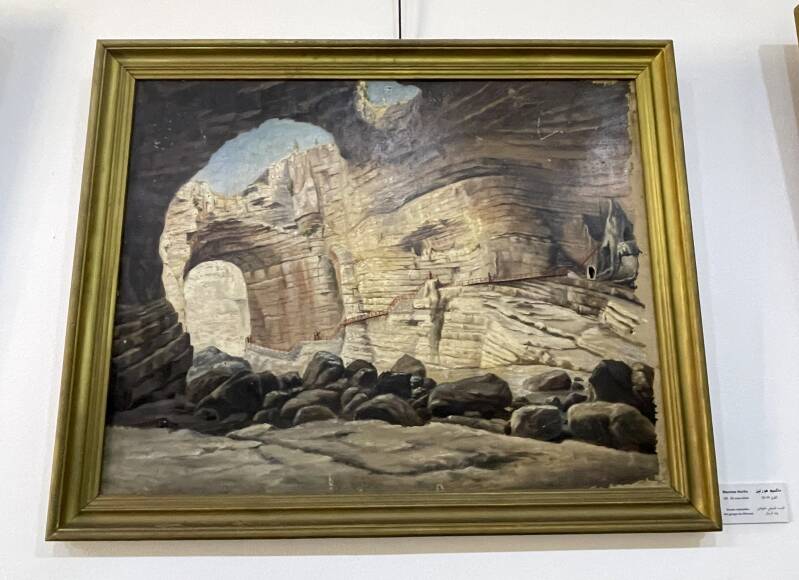
At the bottom of Rhumel Gorge, our view and that of a painting in the Cirte Museum.
The highlight of the day, however, came when we descended into the gorge itself. The path down was steep enough to ensure nobody reached the bottom accidentally, but the effort was richly rewarded. Standing among the trees and rock walls at the canyon floor, it was almost impossible to believe that a bustling city sat directly above us. For a while, it felt as though we had left Constantine entirely and wandered deep into a forest.
Back at the top, we crossed the Sidi Rached Bridge and continued towards the Monument of the Dead, a popular gathering place for locals and another excellent vantage point from which to admire the city and its dramatic setting. We also admired the Pont des Chutes (Falls Bridge) a 5-arch bridge built in 1928, situated at the bottom of the Rhumel Gorge. It spans the Rhumel River directly over a stunning 80-meter waterfall, providing spectacular views of the natural bridge and canyon walls.
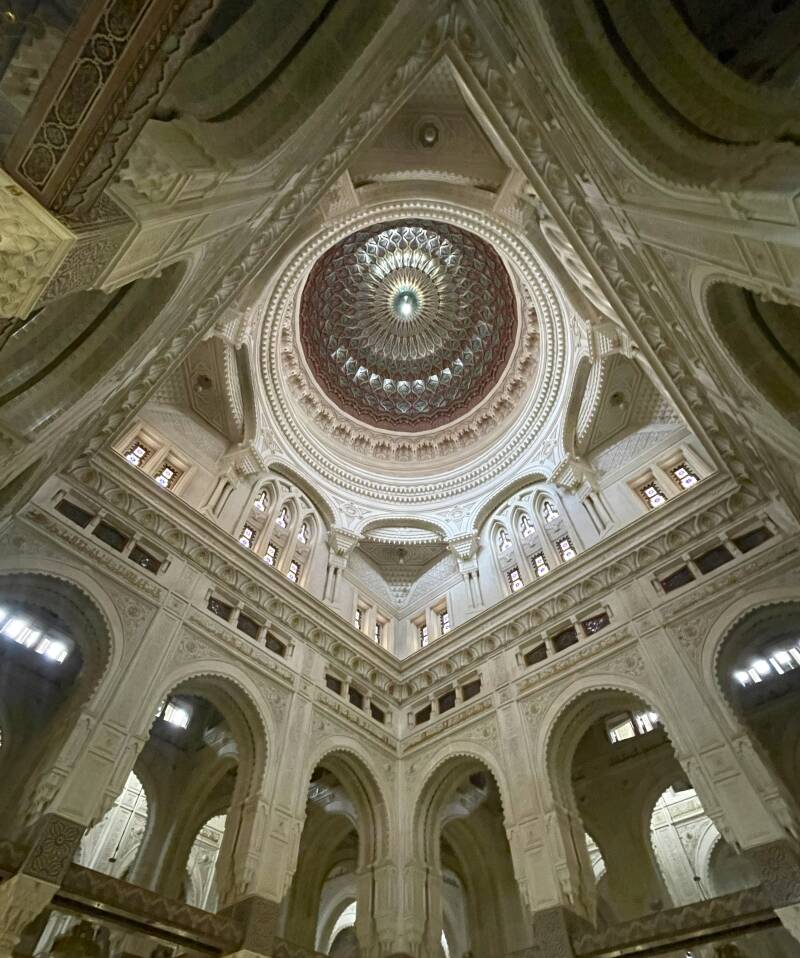
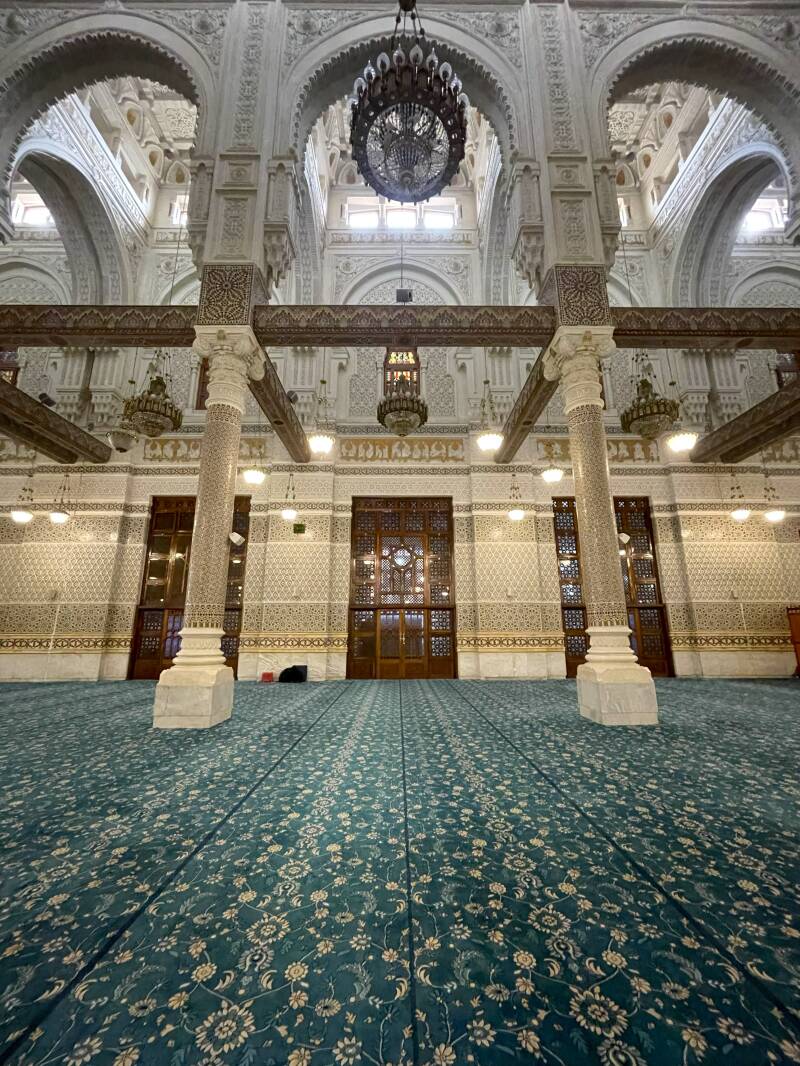
Emir Abdelkader Mosque.
One of the final cultural experiences of the trip came when the women in our group donned abayas before we entered the Emir Abdelkader Mosque. Vast, elegant and serene, it provided a fitting conclusion to our time in Constantine.
From there we began the long drive back to Algiers.
By this stage, many of us were feeling decidedly unwell. I skipped dinner when we stopped at a large local restaurant, instead seeking out some medicinal tea for my throat. Sadly, I also missed the post-tour drinks in Algiers that many of the group attended. Yes, you can drink alcohol in Algeria if you know where to go, but on this occasion sleep seemed the wiser choice.
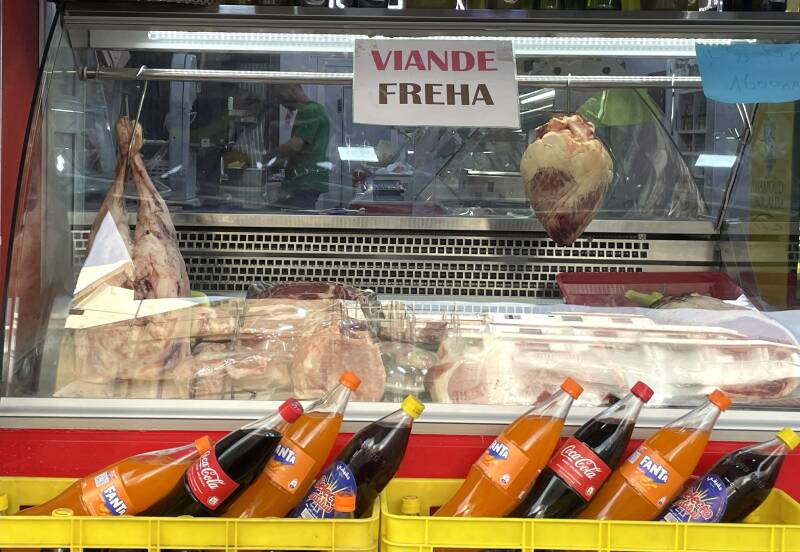
All heart: a butcher store in Algiers.
Before arriving in Algeria, I had formed a mental picture based largely on headlines and assumptions. I imagined a country that might feel remote, difficult and perhaps somewhat intimidating, more akin to the images often associated with places that sit outside mainstream tourism.
The reality was very different. I found myself wandering through palm-lined boulevards that would not have looked out of place in southern France, exploring Roman ruins with few other visitors around, and hiking through mountain landscapes that rivalled some of the best I have seen elsewhere. It seemed remarkable that a country with so much to offer remains so little visited by international tourists. Yet perhaps that is precisely what makes Algeria special: it is a destination that still feels genuinely undiscovered. Yes, Algeria can be challenging to visit. The visa process alone is enough to deter many travellers, and there were moments when I wondered whether the effort would be worth it. Yet almost from the moment I arrived in Algiers, I found myself surprised. The roads were excellent, the public transport modern, the cities vibrant and the infrastructure far more developed than I had expected. In many ways, Algeria felt wealthier and more organised than several countries I had visited recently.
At the same time, it never felt generic. The call to prayer drifting across neighbourhoods, women in colourful hijabs, bustling cafés, mountain villages and the sight of a man casually carrying sheep heads into a restaurant all served as reminders that I was somewhere distinct. Algeria possessed that balance that many travellers seek: enough familiarity to make travel comfortable, but enough difference to make it interesting.
The landscapes were equally memorable. From the snowy peaks of Djurdjura National Park to the astonishing gorges of Constantine, I encountered scenery that rarely features in international travel brochures yet easily rivals more famous destinations. And I have only scratched the surface. Algeria is the largest country in Africa, and during this trip I explored only a tiny corner of it.
I came away with an appreciation not only for the country itself, but also for its people. Whether it was Robert and our local guides sharing their knowledge, museum staff proudly welcoming visitors, or families enjoying a day out among Roman ruins and botanical gardens, there was a warmth that contrasted sharply with the country's somewhat forbidding reputation.
So, would I return?
There are Roman ruins I have not seen, Saharan landscapes I have not crossed, and cities I have not explored. The answer would almost certainly be yes.
The only thing standing in the way is that visa application.
Then again, perhaps part of Algeria's appeal is that it makes you work a little harder to get there.
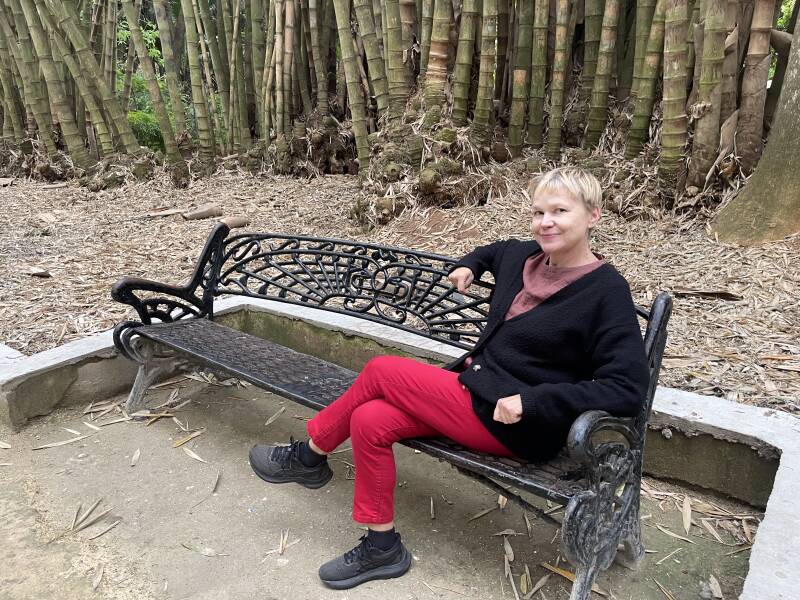
Relaxing on an Art Nouveau seat at Jardin d'Essai du Hamma (Hamma Botanical Garden) in Algiers.
Add comment
Comments