

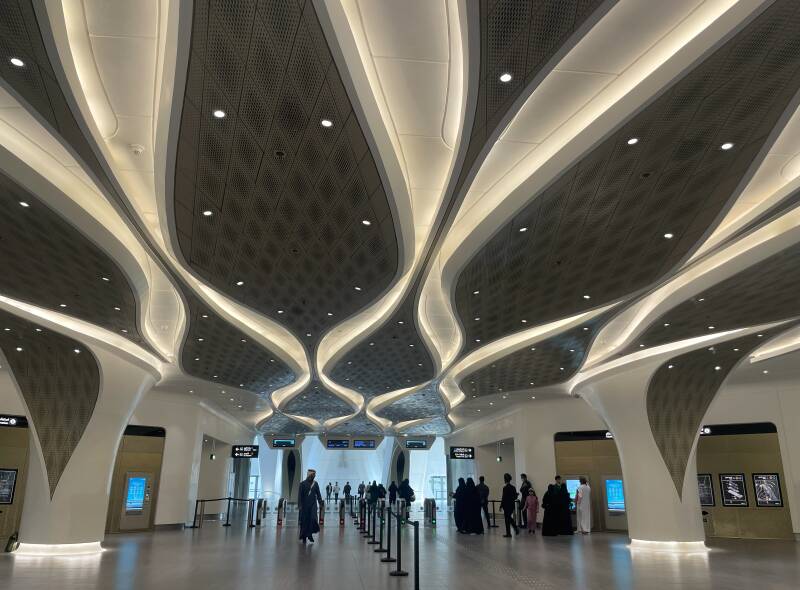
Inside KAFD Metro Station, designed by Zaha Hadid Architects.
Ten or twenty years ago, the only people I knew who travelled to Saudi Arabia were expatriate teachers. As a teacher myself, I remember being genuinely shocked when a woman I knew accepted a job there. At the time, Saudi Arabia was internationally associated with strict gender segregation, the male guardianship system, and severe restrictions on women’s mobility. Women could not drive and tourist visas barely existed. Solo female travel was essentially off the table.
Fast forward to January 2026 and there I was, boarding a flight to Riyadh alone with plans to spend two weeks travelling independently across Saudi Arabia using as much public transport as possible.
Surprisingly, as a solo female traveller, I found Saudi Arabia easier to navigate independently than several other countries I visited on the same trip.
Under Crown Prince Mohammed bin Salman’s Vision 2030 program, Saudi Arabia has undergone a dramatic transformation in recent years. Tourist visas were introduced in 2019, women gained greater freedoms, cinemas and concerts returned, and the Kingdom began investing huge amounts into tourism, infrastructure, sport, and entertainment. Everywhere I travelled, these changes felt visible. During my trip alone, I stumbled across an ultramarathon in AlUla and a music festival in Jeddah complete with a (non-alcoholic) beer sponsor. Saudi Arabia is clearly determined to attract tourists of every variety.
I had quickly realised that Saudi Arabia was much larger and more diverse than I had expected. Ideally, I would have spent longer than two weeks there, but with another fifteen countries still ahead on my trip, I settled for fourteen days and a very ambitious itinerary.
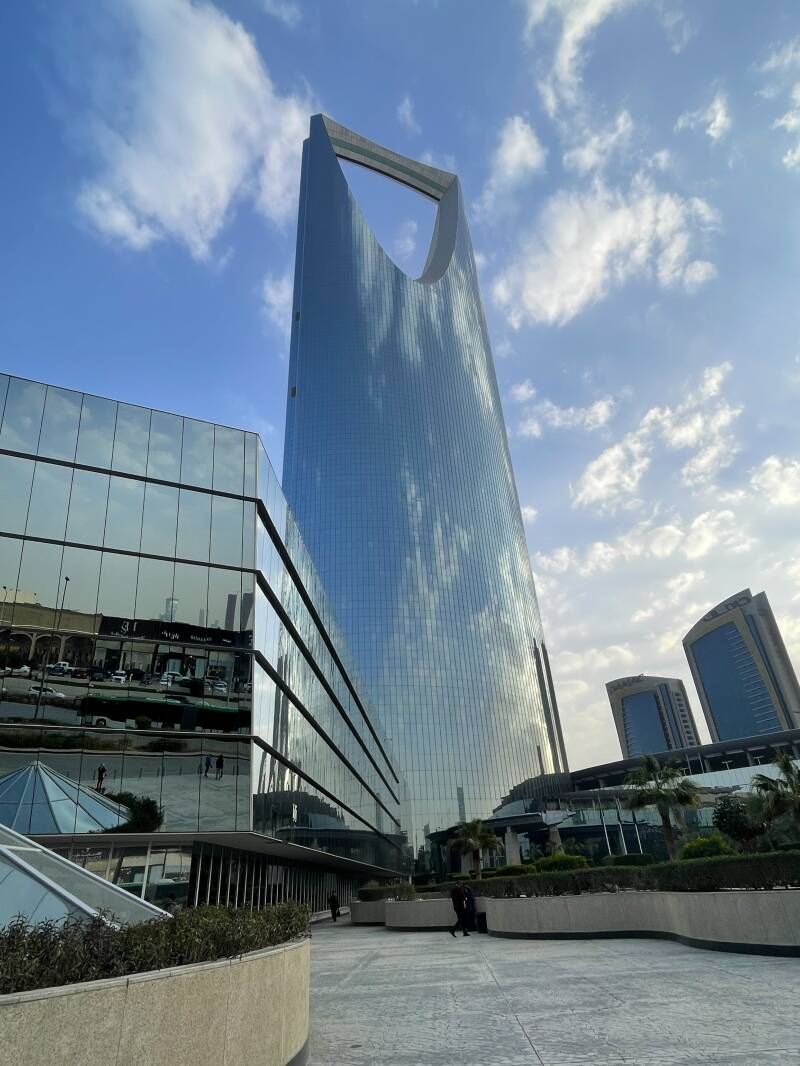
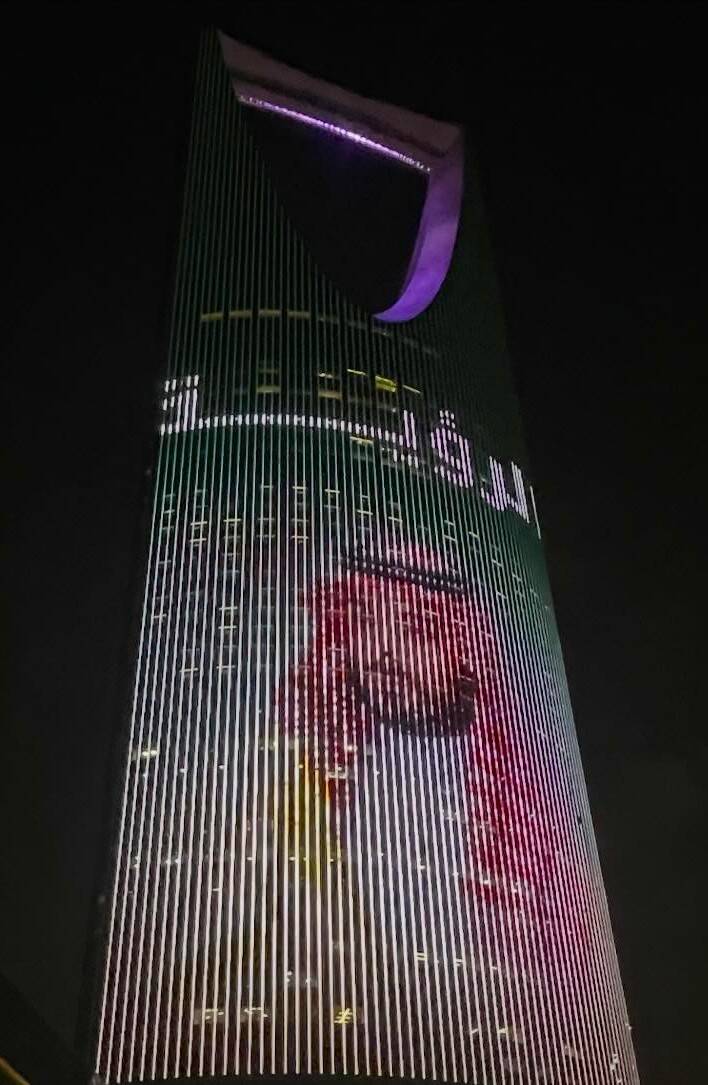
Kingdom Centre Tower, day and night.
Riyadh: The Future Arrives by Metro
I arrived in Riyadh and took a Bolt taxi to my accommodation, a home exchange stay inside the enormous Ishbilia Residential Compound. My hosts, Lucy and Darren, were British and Australian educators working in Saudi Arabia.
From the outside, the compound looked unwelcoming, surrounded by razor wire, security checkpoints and stern 'keep out'signs that made it resemble a detention centre. Inside, however, it felt more like The Truman Show. Perfectly maintained streets, swimming pools, gyms, restaurants and manicured gardens created a self contained suburban bubble where residents barely needed to leave.
From their townhouse, I could walk directly to Riyadh Metro.
Riyadh’s metro system completely stunned me. I had expected highways, traffic and endless cars. Instead, I found spotless driverless trains, beautifully designed stations and one of the most efficient transport systems I had used anywhere in the world. Even the stations themselves felt like architectural attractions.
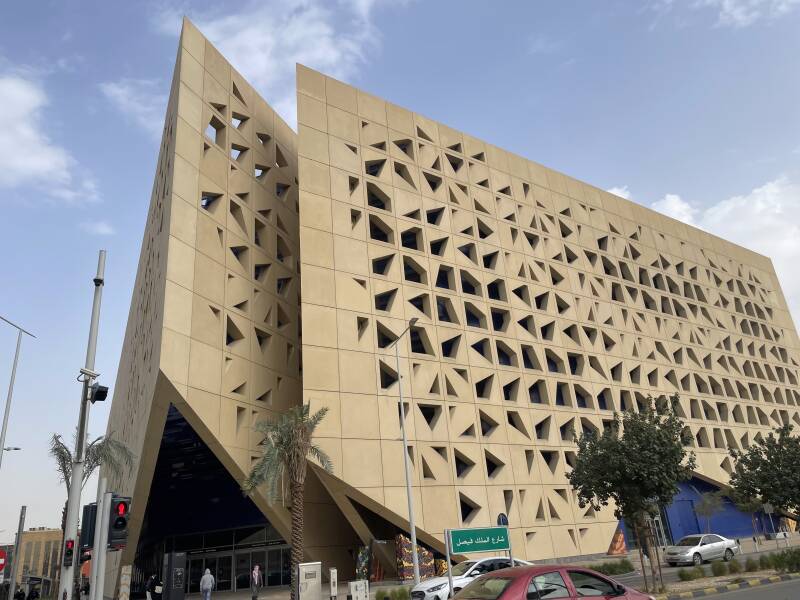
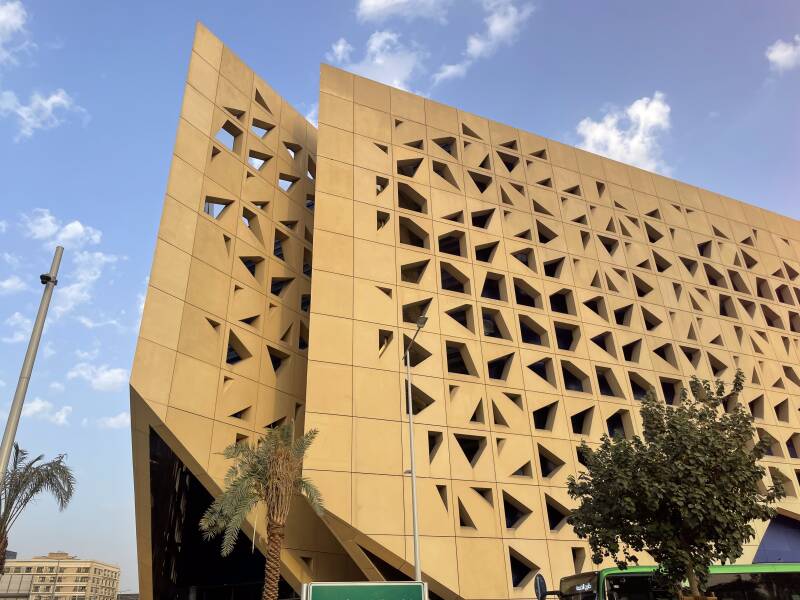
The National Museum Station.
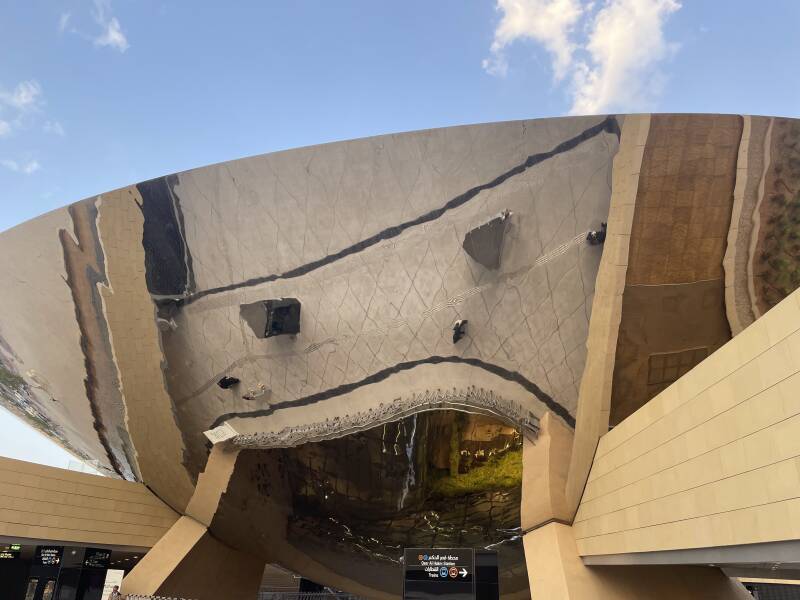
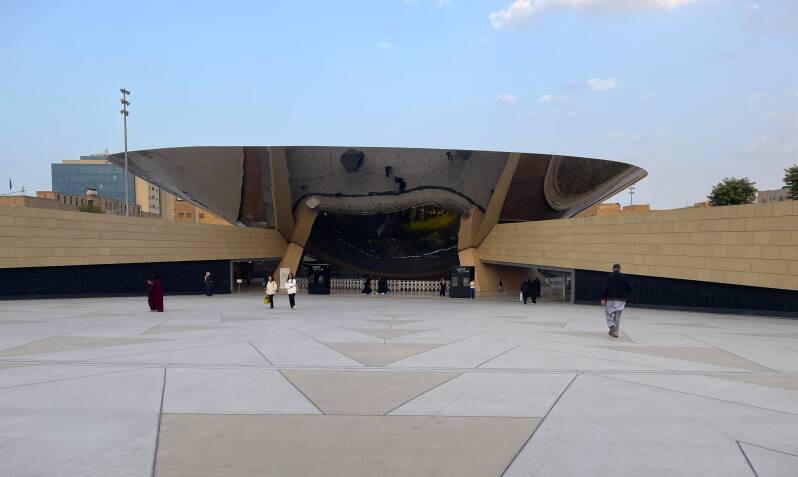
The National Museum Station, connecting the blue and green lines, was designed to resemble Saudi Arabia’s mountainous landscapes with blue internal panels representing the sky and concrete outer panels mimicking rocky terrain. Nearby, the bus terminal was designed to evoke a Bedouin tent.
Qasr Al Hokm Station, designed by Norwegian firm Snohetta, featured a giant stainless steel canopy that looked more like contemporary sculpture than transport infrastructure.
Then there was the King Abdullah Financial District Metro Station, designed by Zaha Hadid Architects. I genuinely felt as though I had wandered into an expensive futuristic airport or modern art museum rather than a train station. The flowing white lattice exterior was inspired by desert dunes and wind patterns, while the surrounding financial district featured climate controlled skywalks, futuristic skyscrapers and carefully designed public spaces.
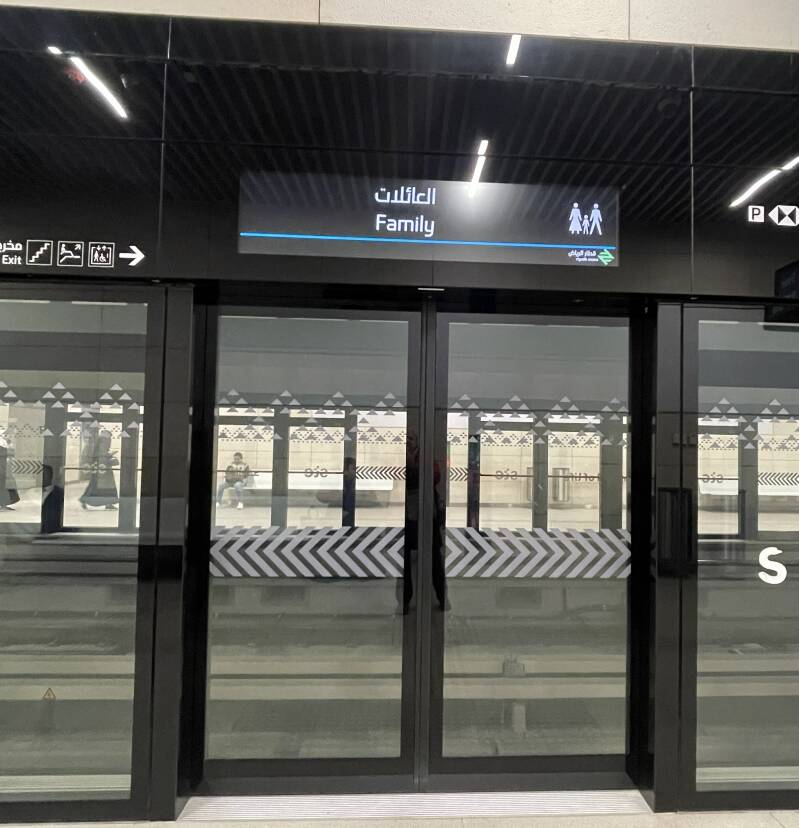
On my very first metro trip, however, I immediately made a cultural mistake. I saw signs for 'Single' and 'Family' carriages and confidently entered the 'Single' carriage, assuming it referred to solo travellers. Wrong. 'Single' meant single men. Women, even travelling alone, belonged in the 'Family' section. I felt envious of the 'Single' men who got to stand at the front of the train with a perfect view of the journey sans driver.
The metro itself also quickly shattered my assumptions about reserved queueing systems. The stations had beautifully organised boarding lanes with signs reminding passengers to allow people to exit first. In practice, the moment the doors opened, groups of women surged inside immediately. If you wanted to disembark, you had to physically push your way out or risk being carried onward to the next station.
Most women wore black abayas and many wore niqabs, while others dressed more loosely with uncovered hair. Saudi Arabia still felt socially conservative, but far more varied and nuanced than the outside world often imagines.
What struck me was that the black clothing was not nearly as visually uniform as I had expected. In a strange way, it almost reminded me of Melbourne, where black dominates wardrobes for entirely different cultural reasons. Once I started paying attention, I noticed endless variations in fabrics, textures, stitching, layering and subtle embellishments. Some abayas flowed like matte silk while others featured intricate patterns, embroidery or carefully structured tailoring. You can do a lot with black.
One of my first sightseeing days centred around Riyadh’s National Museum and the nearby Murabba Palace. I was surprised to find contemporary international art exhibitions alongside archaeological artefacts. From outside the Murabba Palace, I spotted vintage cars belonging to King Abdulaziz including a Rolls Royce reportedly gifted by Winston Churchill.
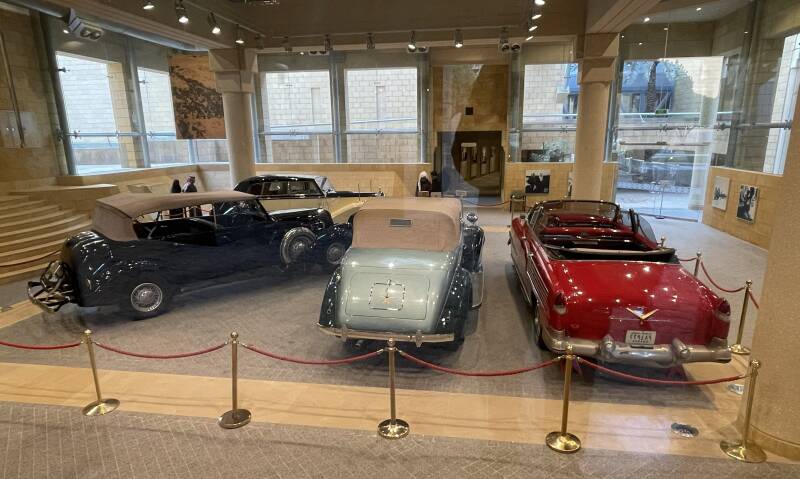
Inside the Murabba Palace, vintage cars belonging to King Abdulaziz.
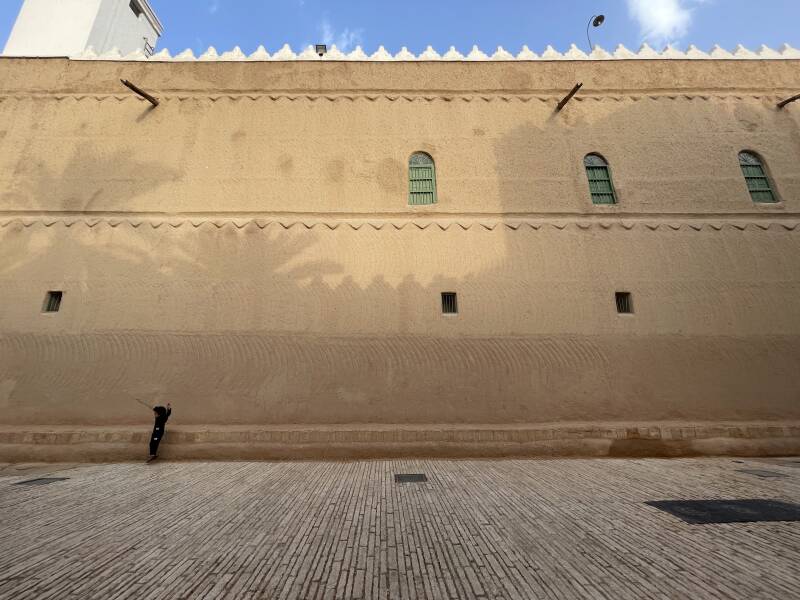
A child playing in front of the the Murabba Palace wall.
Nearby was Souk Al Zal, one of Riyadh’s oldest traditional markets, packed with narrow alleyways and tiny shops selling carpets, antiques and traditional goods. It felt worlds away from the polished metro stations and futuristic financial district.
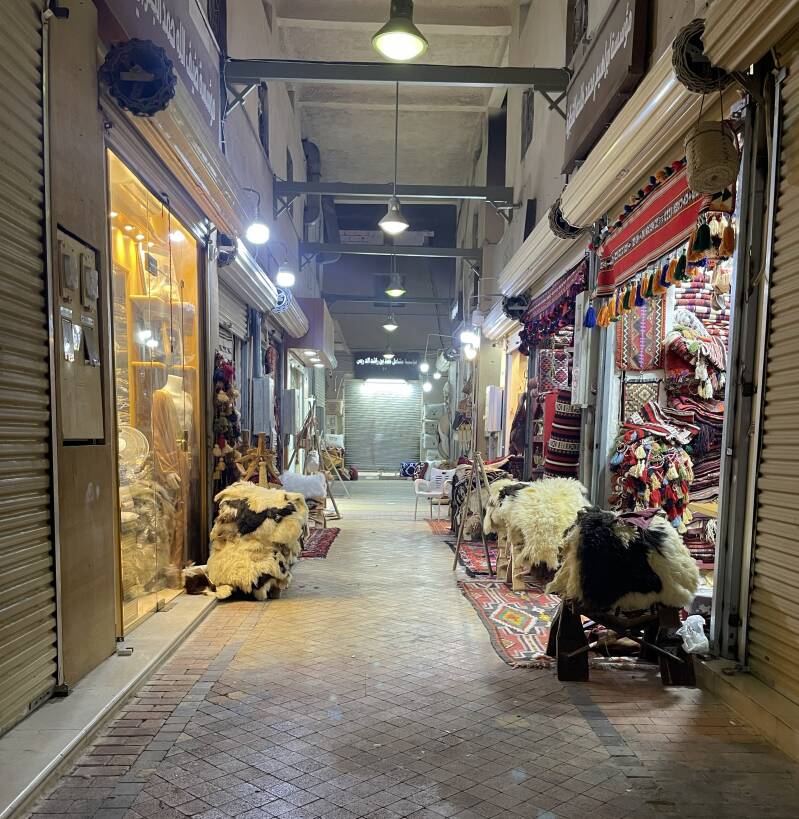
Souk Al Zal, partially empty as it was evening prayer time.
Diriyah and the Saudi Sense of Time
The following day I visited Diriyah, the ancestral home of the Saudi royal family and birthplace of the first Saudi state.
Getting there involved taking the metro to the end of the line followed by a Bolt ride. I quickly learned another important Saudi travel lesson. Even outside Ramadan and in the middle of winter, things do not start early here.
I arrived far too early. The beautifully restored mudbrick architecture, pedestrian laneways and cafes were technically open, but the atmosphere remained strangely quiet until around 5 pm when the entire place suddenly came alive.
Fortunately, I had time for a very expensive lunch before wandering through the restored streets and historical buildings. At one point, a group of men dressed in traditional Saudi clothing emerged to perform singing and dancing, creating one of the most memorable cultural moments of my time in Riyadh.
Saudi Arabia often felt like a country operating on an entirely different clock.
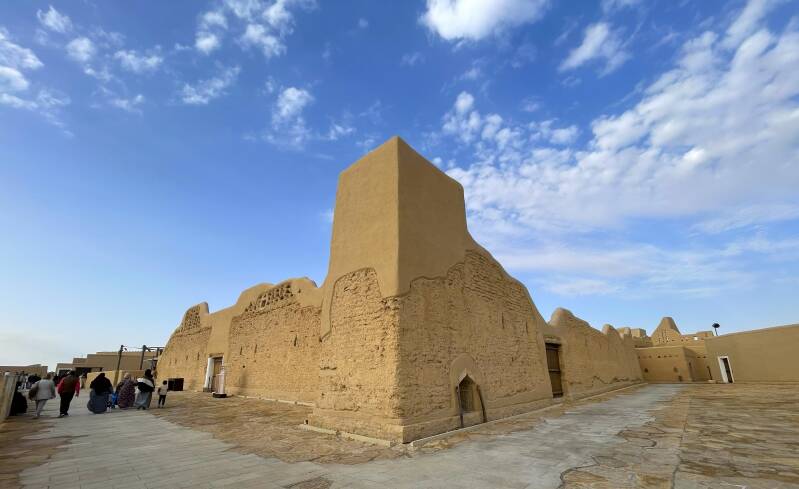
Diriyah
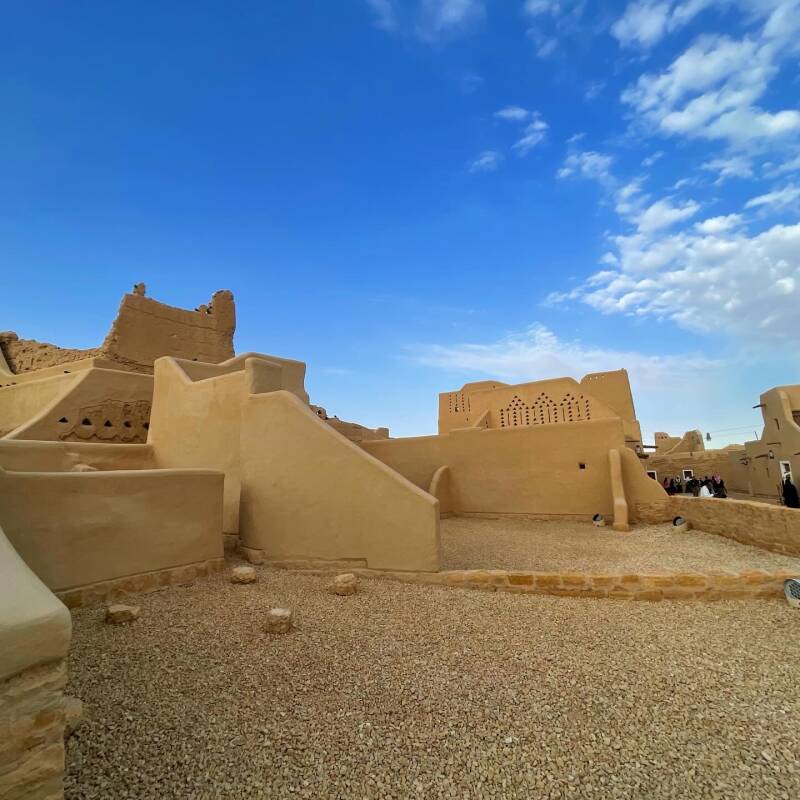
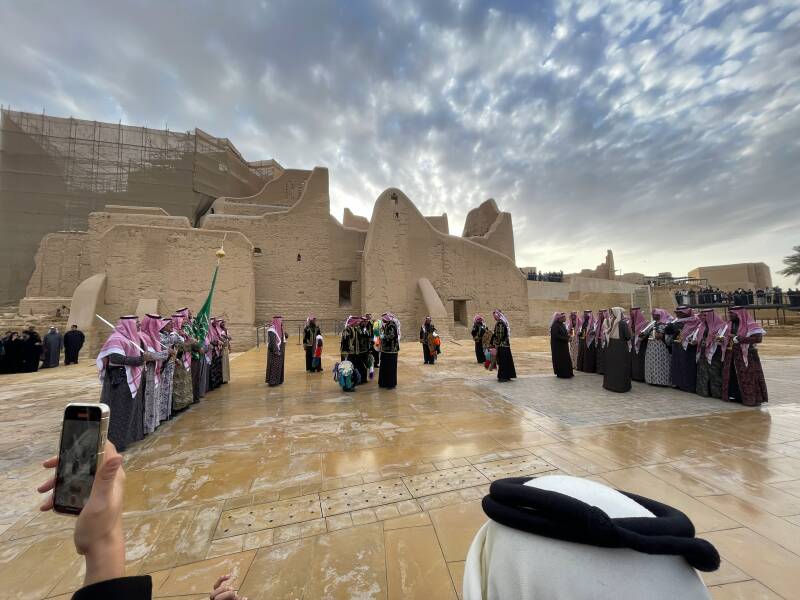
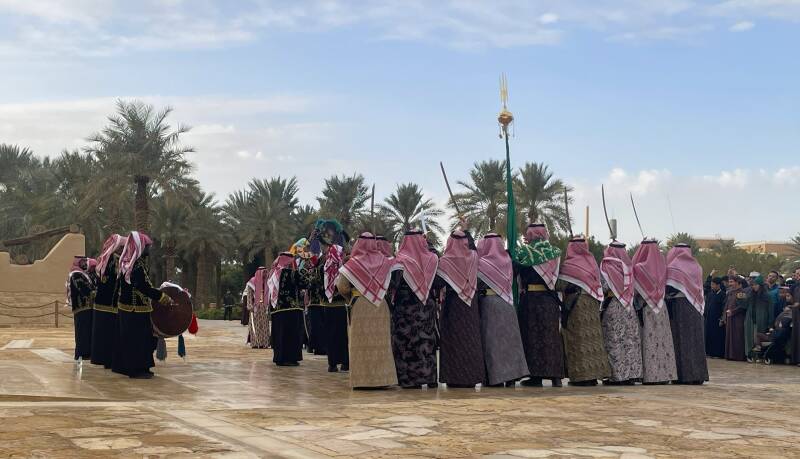
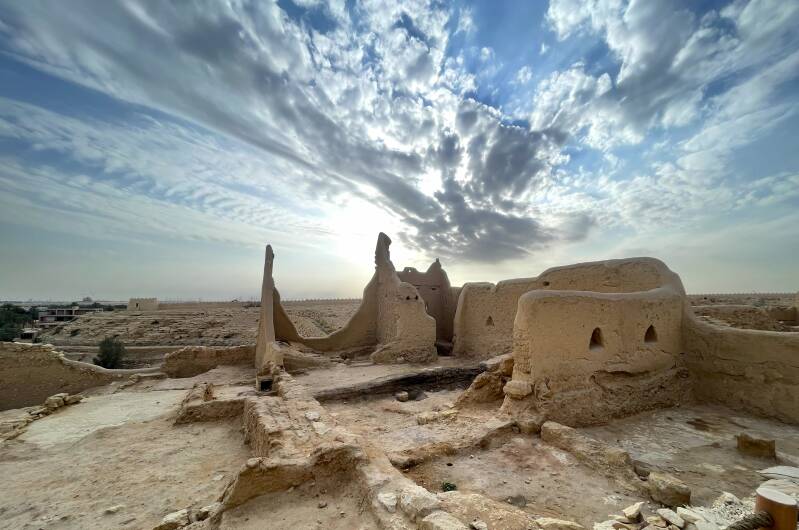
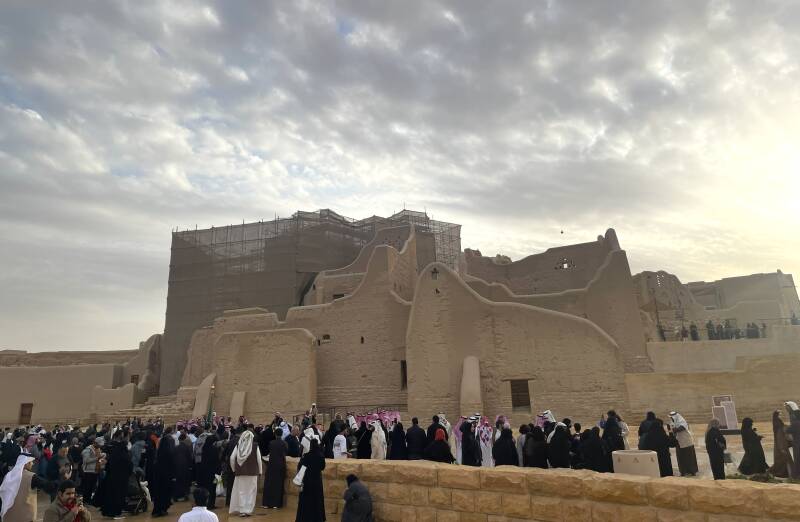
Various views of Diriyah.
Edge of the World
One day I joined an organised tour to the famous Edge of the World, a dramatic escarpment roughly ninety kilometres outside Riyadh. The Edge of the World (Jebel Fihrayn) is a 300-meter-high cliff forming part of the 800km-long Tuwaiq Escarpment northwest of Riyadh, Saudi Arabia. Formed by tectonic shifts over 150 million years ago, it was once a Jurassic-era sea floor. It is famously characterized by its dramatic drop, marine fossils, and historical status as an ancient caravan route.
The tour company proudly advertised its “fully loaded safe 4WD vehicle unlike unsafe old cars used elsewhere” which sounded oddly specific, but the trip itself was excellent. We drove through desert landscapes, spotted Arabian gazelles and eventually reached towering cliffs overlooking endless desert plains and ancient seabeds.
At the canyons, we gathered for Saudi snacks (mostly dates) and Arabic coffee while watching the sunset over the cliffs, and I pondered as to why this canyon is not as renowned as other similar ones in the world.
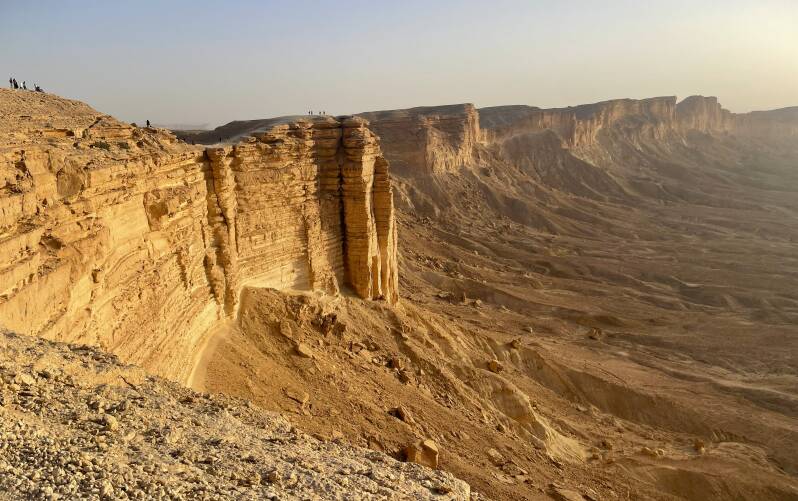
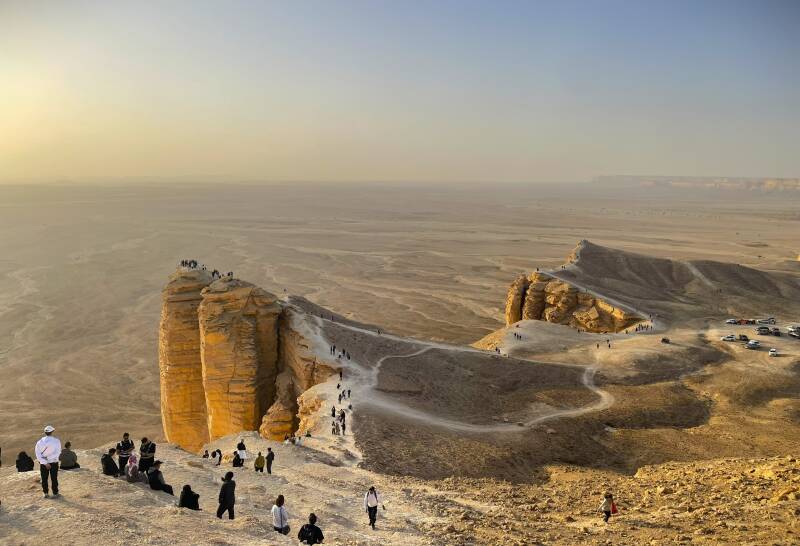
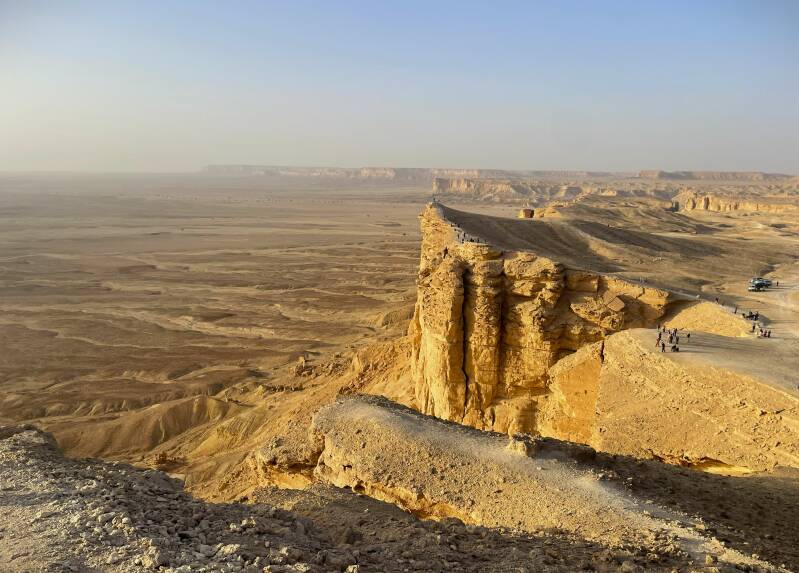
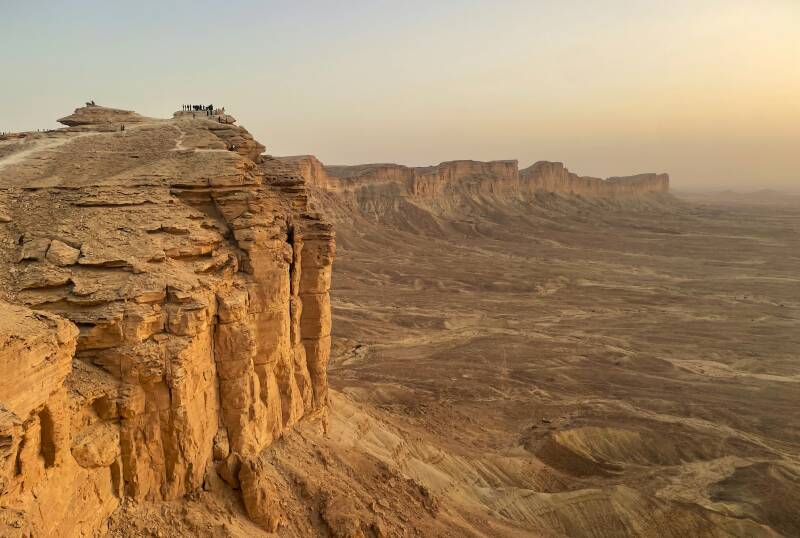
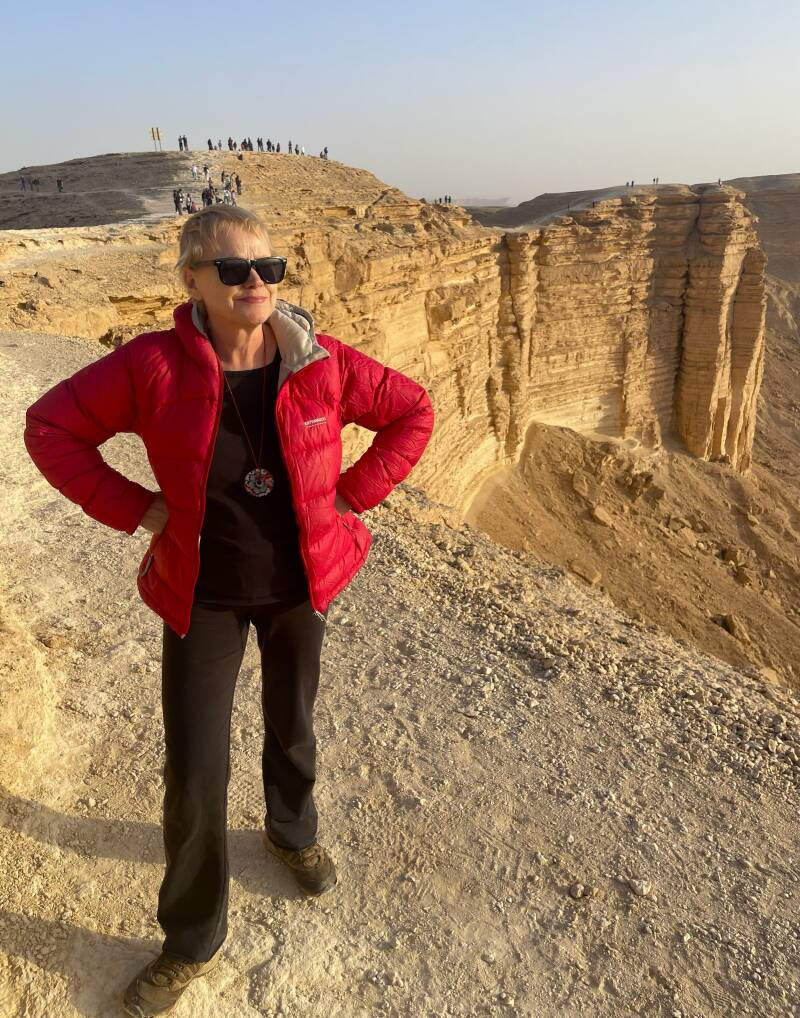
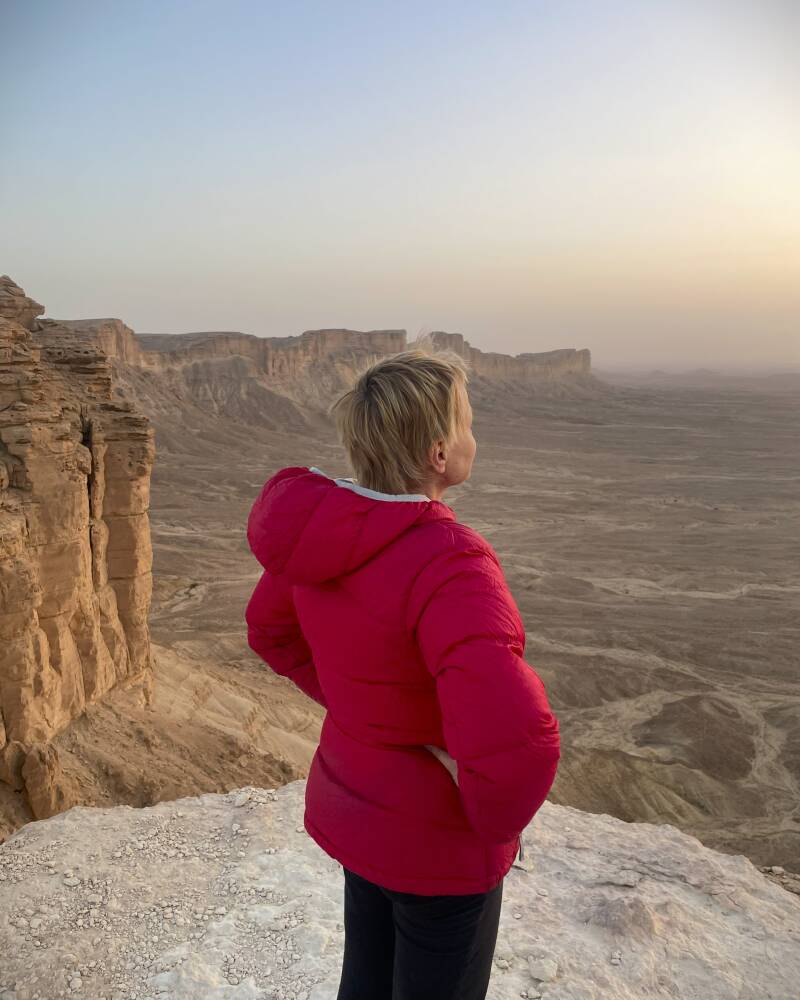
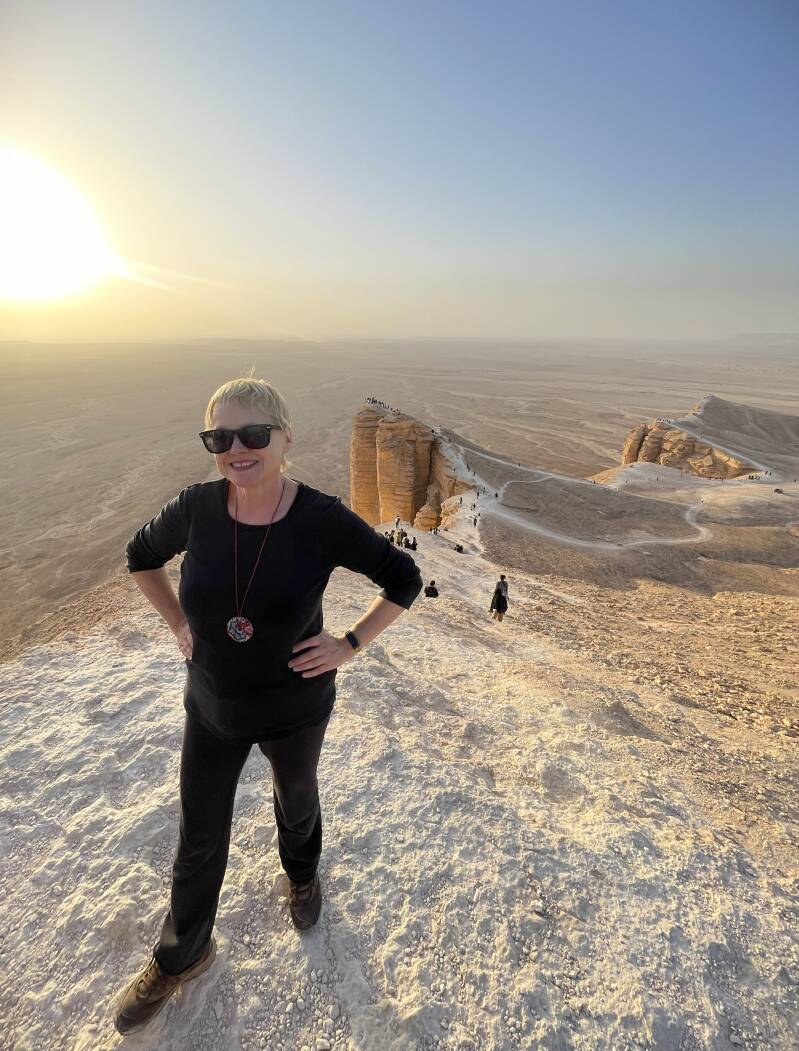
Edge of the world, various views.
Riyadh After Dark
Riyadh truly transformed at night.
For my final night, I visited the Kingdom Centre Tower, famous for its sky bridge suspended high above the city. During the day, the tower was impressive enough, but after dark the skyline exploded into colour and giant LED displays illuminated the building itself, often featuring images of the Crown Prince.
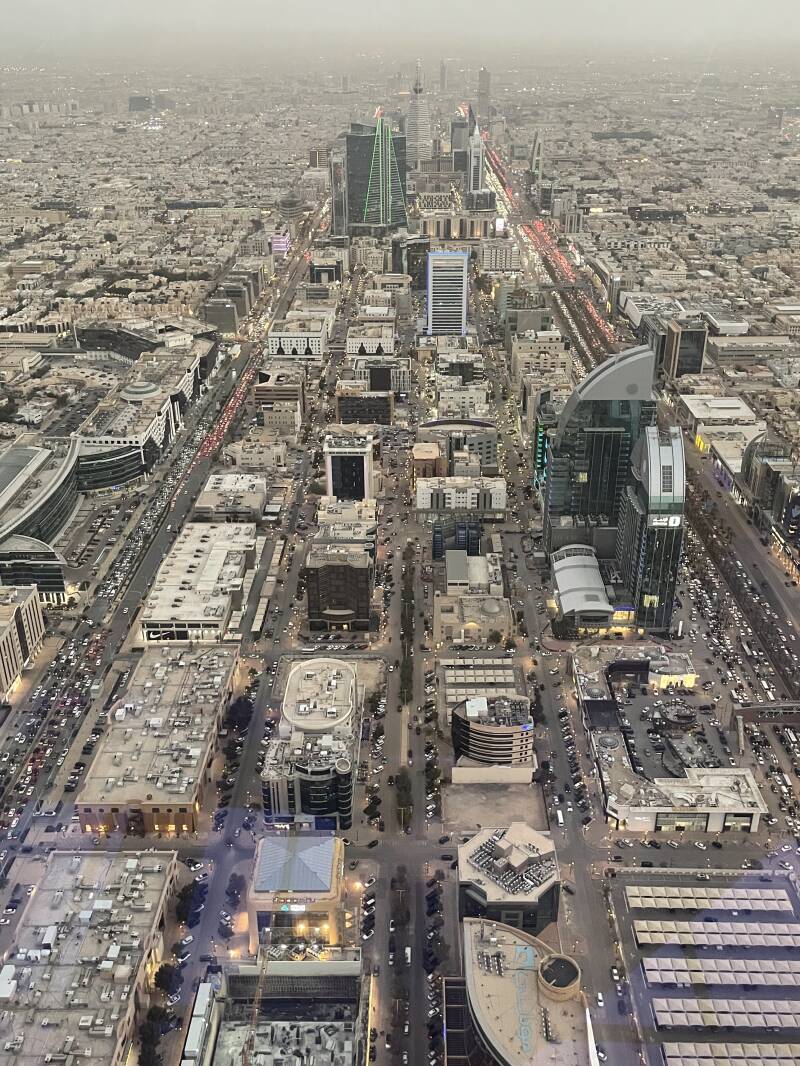
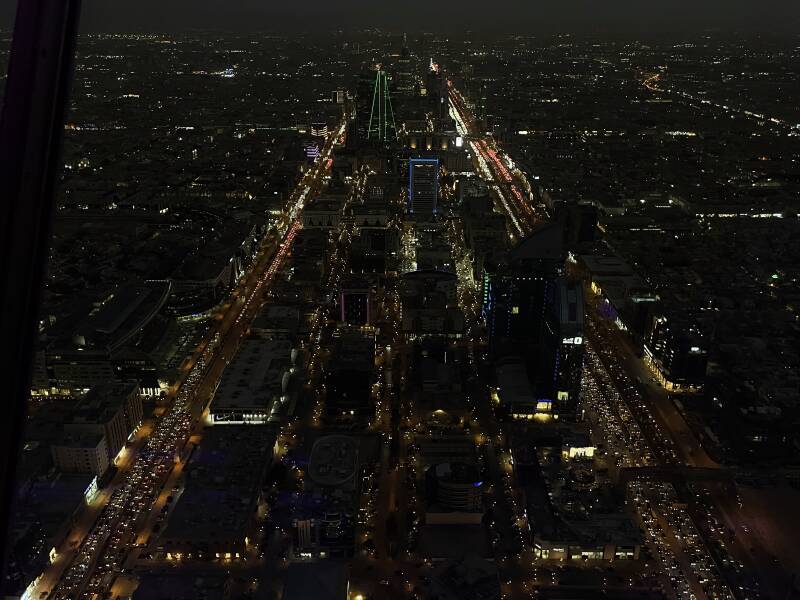
Before and after: views of Riyahd from Kingdom Centre Tower.
Earlier that day, I visited the King Abdullah Financial District, known as KAFD, which was unlike any financial district I had previously visited.
Often, business districts feel cold, corporate and designed purely for efficiency. KAFD instead felt theatrical, futuristic and intensely planned, as though someone had attempted to redesign the concept of a city from scratch.
The district’s centrepiece was the Financial Plaza, designed by Henning Larsen Architects and framed by six enormous skyscrapers, including the PIF Tower, currently the tallest building in Riyadh. Designed by HOK in collaboration with Omrania, the eighty storey tower dominated the skyline with a sharp angular form that seemed to rise endlessly into the desert haze. Inside were offices, restaurants, a fitness centre, a swimming pool and even a 450 seat auditorium, turning the building into a kind of vertical city.
At ground level, however, what caught my attention most were the gigantic fan structures anchoring the plaza. They looked almost like spacecraft engines or the cooling systems of some futuristic machine. Beyond their dramatic appearance, they also reflected a deeper obsession running through the entire district: how to make urban life possible in extreme desert heat.
The whole area had been carefully designed around airflow, shade and cooling. Much of the inspiration came from Riyadh’s historical neighbourhoods, where streets were traditionally oriented to capture wind and create natural ventilation. In KAFD, those older ideas had been reimagined through glass, steel and contemporary engineering.
One of the most impressive features was the elevated pedestrian skywalk network connecting the district. Stretching for more than fifteen kilometres through forty two climate controlled walkways, the system links ninety five buildings and the metro station above the streets below. Constructed using thousands of tonnes of steel and vast expanses of glass, the skywalks incorporated traditional Najdi patterns interpreted through the modern Salmani architectural style.
Even the mosque within the district felt architecturally integrated into this futuristic vision. Rather than standing apart from the surrounding buildings, it blended seamlessly into the modern landscape while still retaining its spiritual presence.
Combined with Zaha Hadid’s flowing metro station nearby, the entire district felt less like a conventional city centre and more like an experiment in how future cities might function in some of the world’s harshest climates.
What fascinated me most was that despite all the futuristic ambition, KAFD still felt distinctly Saudi rather than simply copying Dubai, Singapore or the West. Traditional desert urban planning principles, Islamic geometric motifs and local architectural influences were woven throughout the district’s design.
That evening I headed to the Kingdom Centre Tower, famous for its sky bridge suspended high above the city.
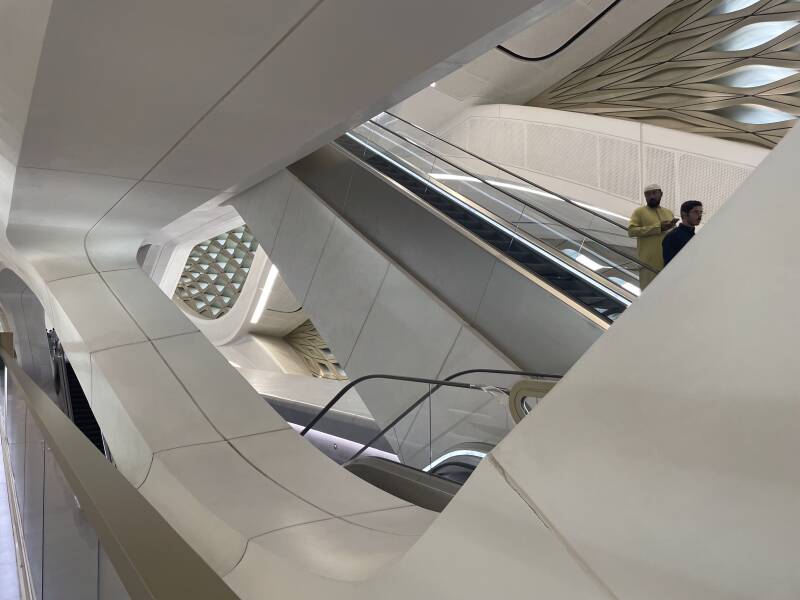
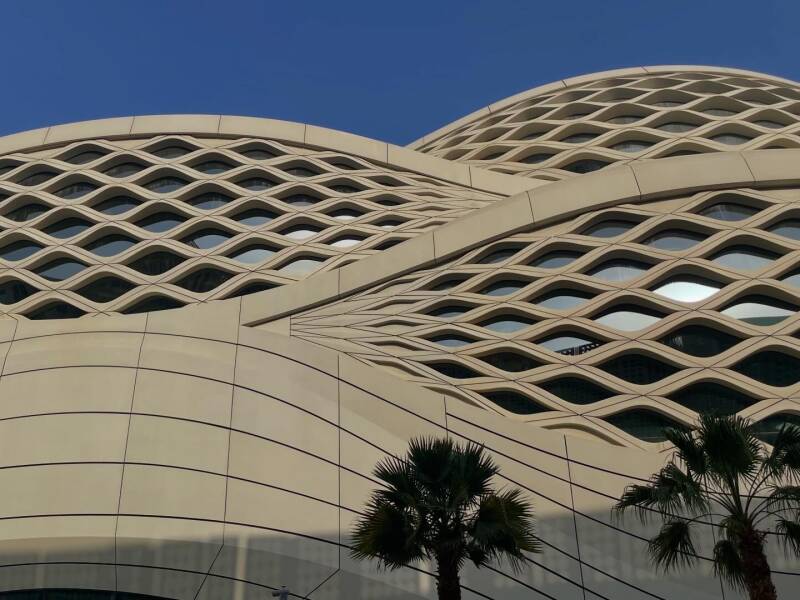
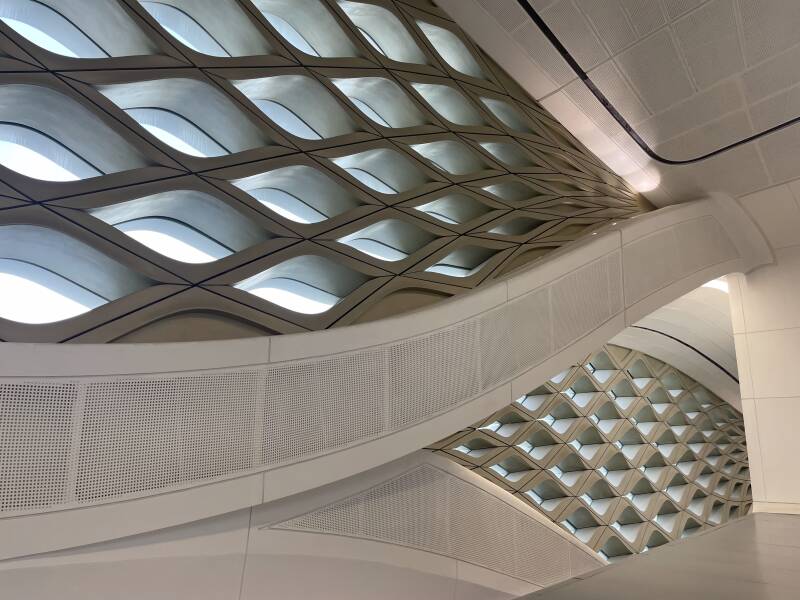
Various views of the KAFD Metro Station.
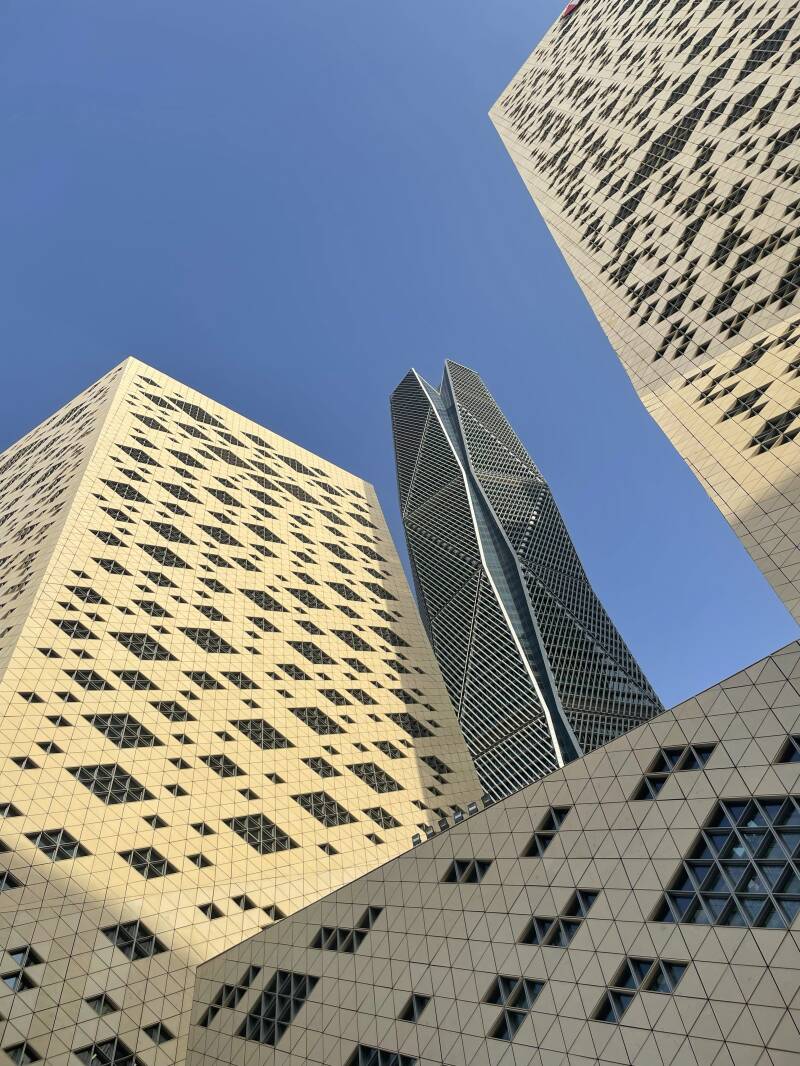
PIF (Public Investment Fund) tower in the background at the KAFD Financial District.
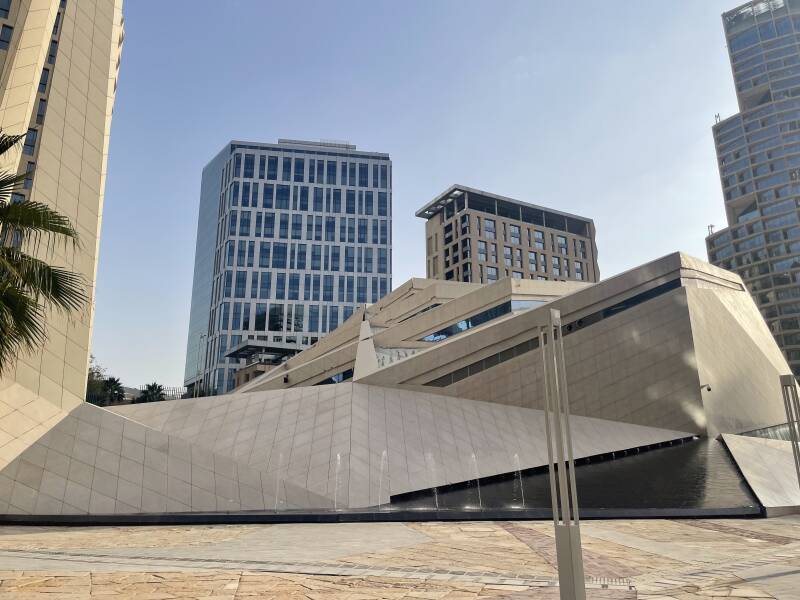
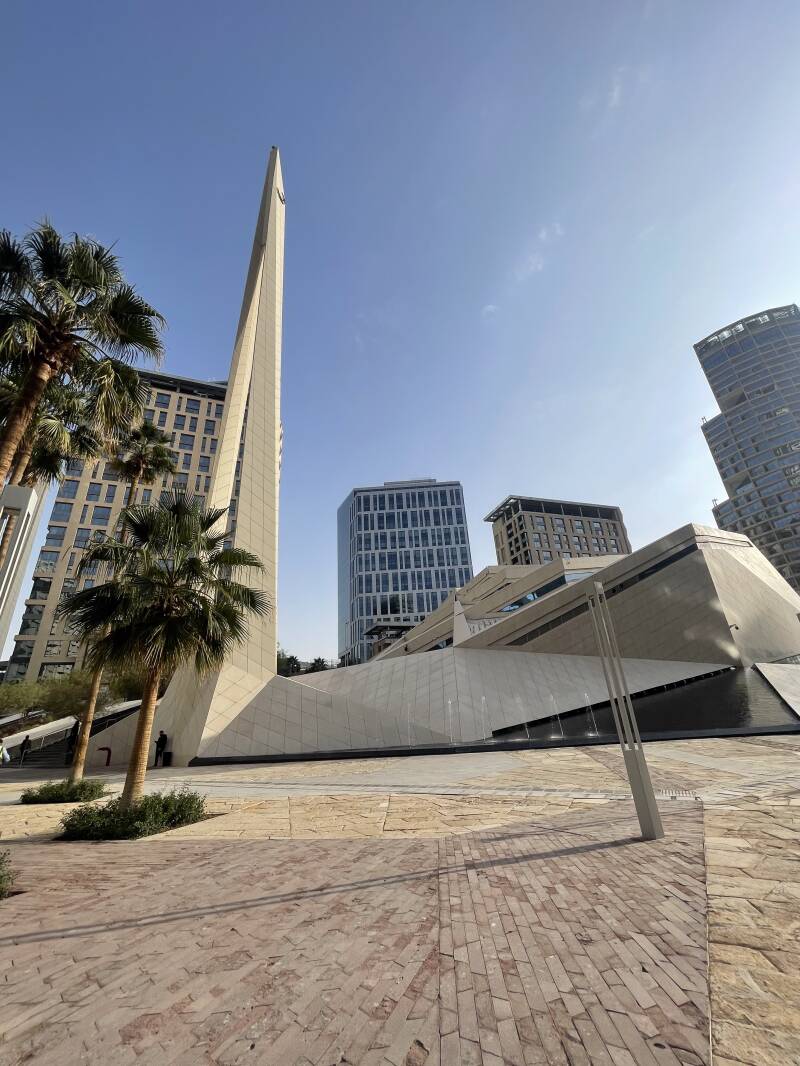
KAFD Grand Mosque.
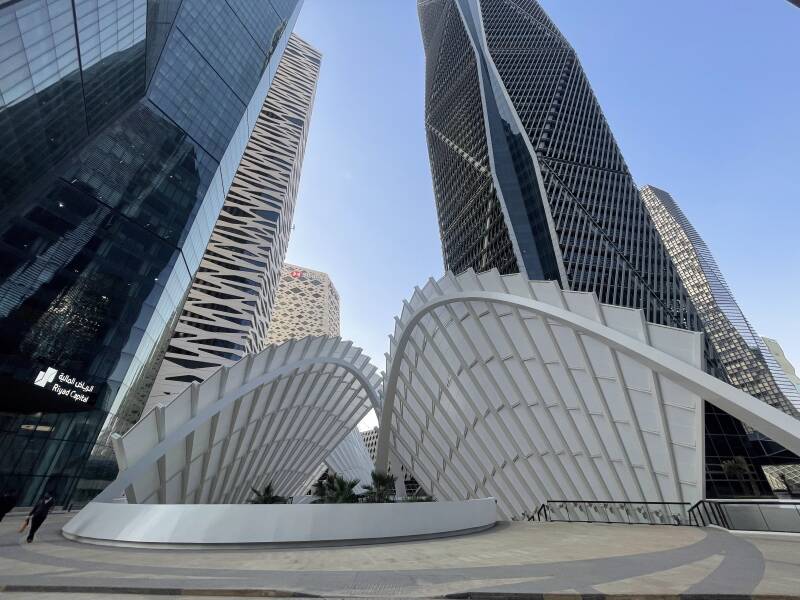
At the ground level, the Plaza’s four enormous fans have become a signature feature.
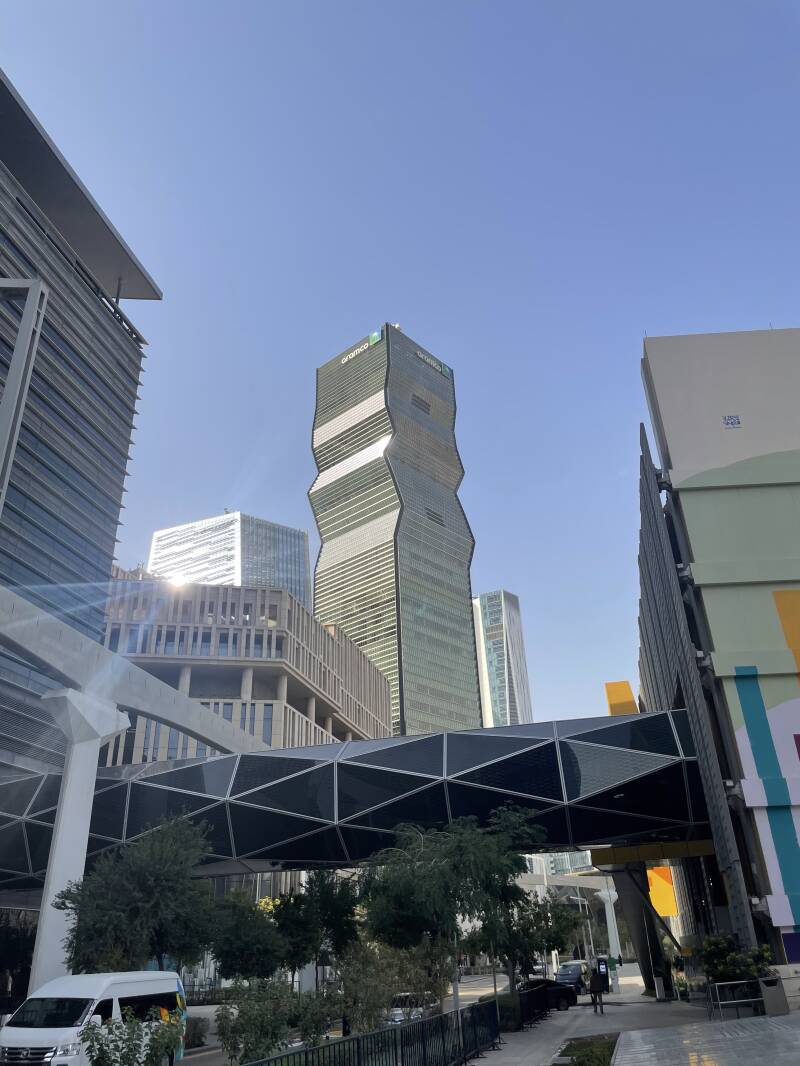
One of the skywalks.
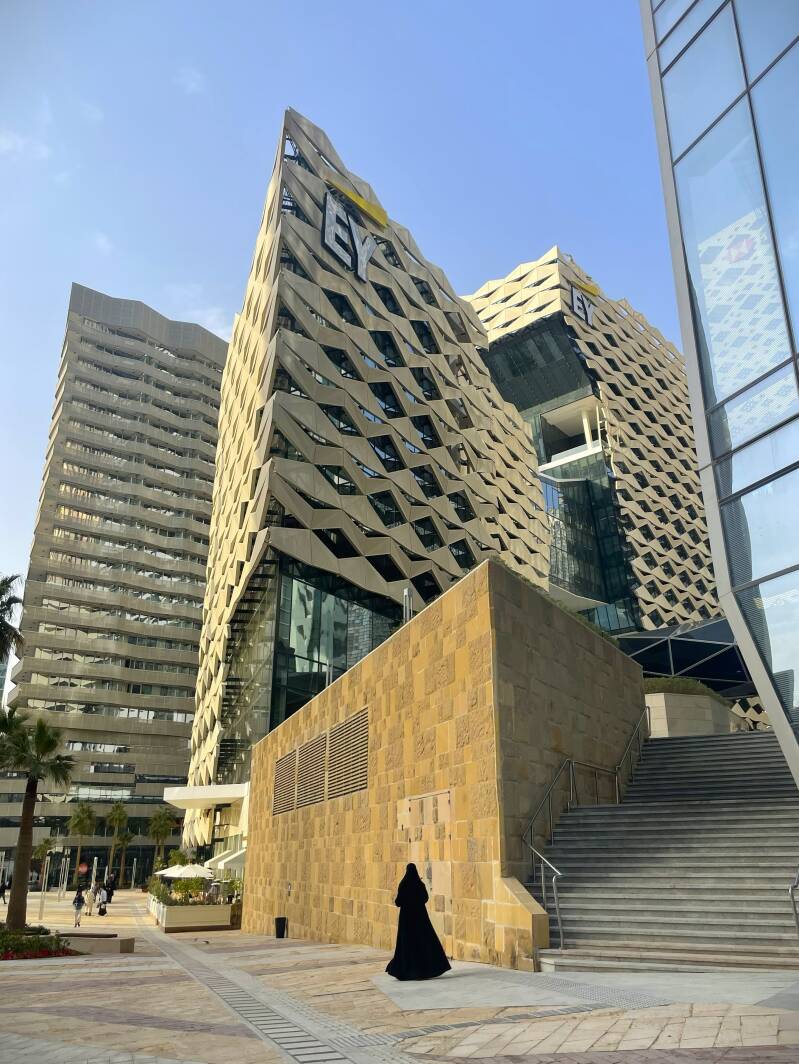
The EY Consulting Agency Headquarters.
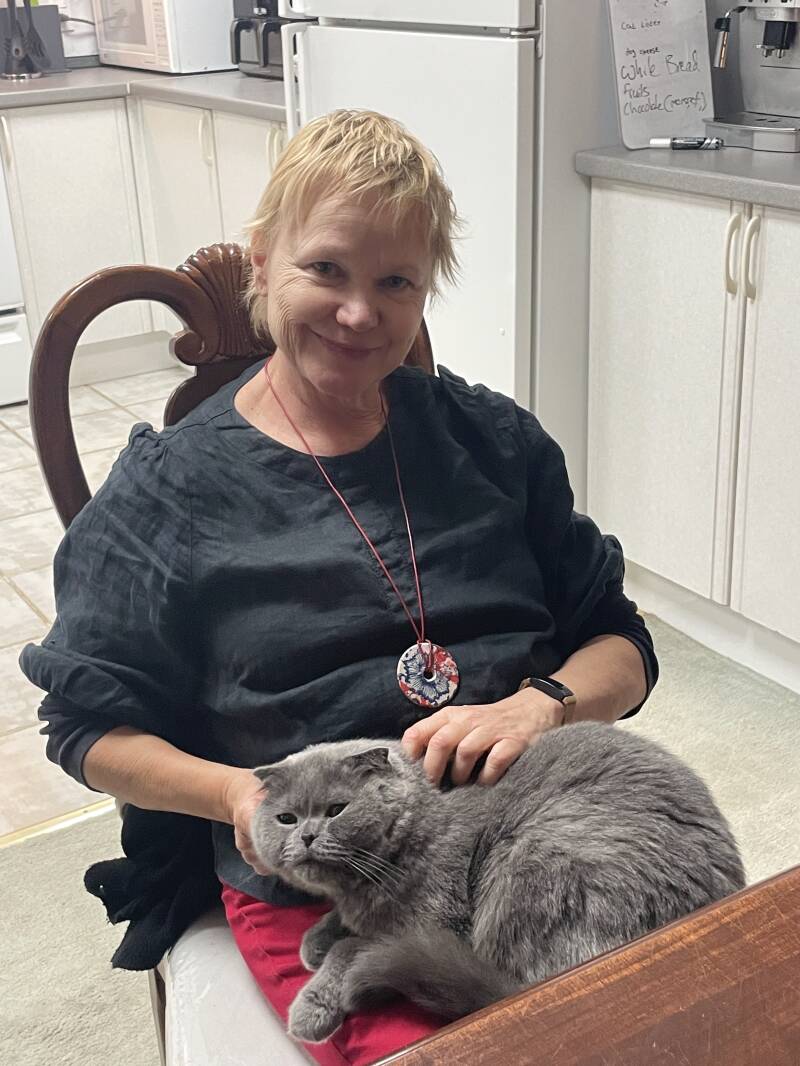
Advantages of a homestay: getting to cuddle one of their fifteen rescue cats!
Back at the compound that evening, Lucy and Darren casually offered me a drink. In Saudi Arabia.
Apparently, certain non Muslim expatriates are allowed access to alcohol under specific circumstances. Saudi Arabia was proving full of surprises.
People often say there is nothing to do in Riyadh, by the end of four days, I still felt there was more to explore.
When it came time to leave Riyadh, I caught three connecting metro lines to the airport during rush hour. The entire trip took less than an hour and cost roughly AUD $1.61 using my credit card to tap on and off directly at the gates.
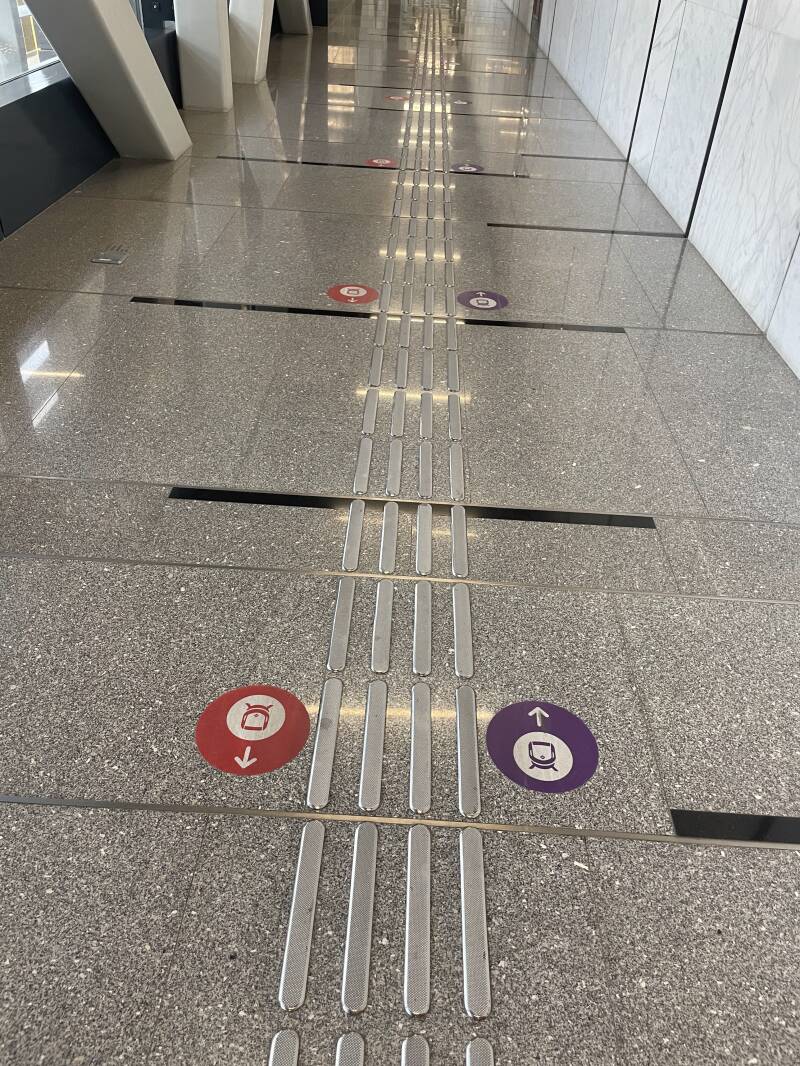

The Riyadh Metro, clever signage and clean train carriages. Even the seats are colour coded.
AlUla: Desert Landscapes and Nabataean Tombs
Flying into AlUla was spectacular. Mountains rose dramatically from the desert landscape as the plane descended toward one of the most visually striking airports I had ever arrived in.
Even the airport itself felt curated.
Outside the terminal stood Clio Dorada by Spanish artist Manolo Valdés, a monumental sculpture positioned at the entrance plaza as part of AlUla’s carefully designed arrival experience. Rising from a base of desert sand, the sculpture immediately signalled what Saudi Arabia was trying to create in AlUla: not simply a historical destination, but a blend of heritage, luxury tourism, landscape and contemporary art.
Inside the terminal, art installations and polished design elements continued the effect. It felt less like arriving at a regional airport and more like entering a gallery or museum exhibition built in the middle of the desert.
From there, my Uber drove through extraordinary mountain scenery toward town.
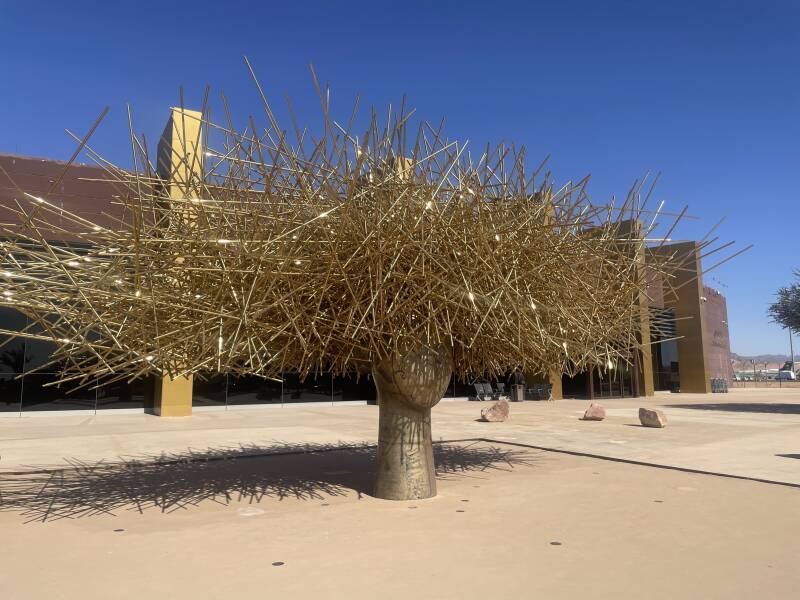
Clio Dorada by Spanish artist Manolo Valdés. Installed in 2022, the gold-coloured metallic artwork is inspired by Clio, the Greek muse of history, and is designed to reflect the surrounding landscape and the intersection of art and time.
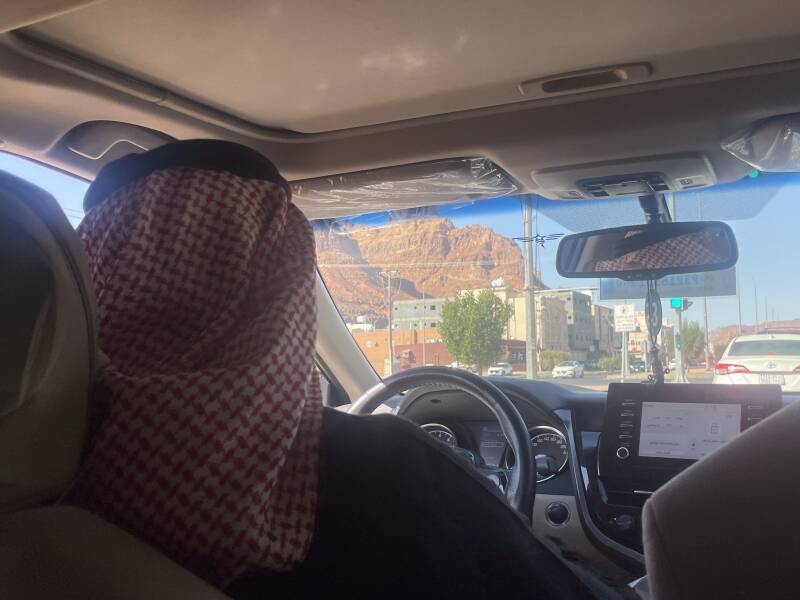
My first Uber ride in Al Ula. Look at those rocks!
I explored AlUla Old Town and the beautiful Oasis Heritage Trail mostly alone during the daytime while everyone else seemed to be visiting Hegra.
At first, AlUla Old Town almost felt too clean and carefully restored to be real. The laneways were lined with cafes, boutiques and glowing lights, with families and tourists wandering through the mudbrick alleyways late into the evening. But that quickly became part of what fascinated me about Saudi Arabia. The country is investing enormous effort into tourism and heritage preservation, and AlUla is one of its showcase projects.
Known historically as Al Dirah, the Old Town was established around the twelfth century in the narrowest section of the AlUla Valley and served as an important trade and pilgrimage hub for centuries. Travellers moving along the ancient Incense Route and pilgrims journeying between Damascus and Makkah once passed through this oasis settlement.
Behind the polished restoration was a remarkably dense and defensive mudbrick town made up of nearly nine hundred interconnected homes, hundreds of shops and winding maze like laneways designed for both protection and shade. Overlooking the settlement was the old citadel, Musa bin Nusayr Castle, which had guarded the oasis since at least the tenth century.
The more I wandered through the quieter sections, the easier it became to imagine what life here might once have looked like before residents gradually abandoned the town in the 1980s in search of modern housing. Now, through large scale restoration projects, AlUla Old Town is being brought back to life as both a historical site and a major tourism destination.
Later I discovered there was a free shuttle bus connecting Old Town with my neighbourhood. This was useful because although Uber worked well in AlUla, it could sometimes take a while to secure a ride.
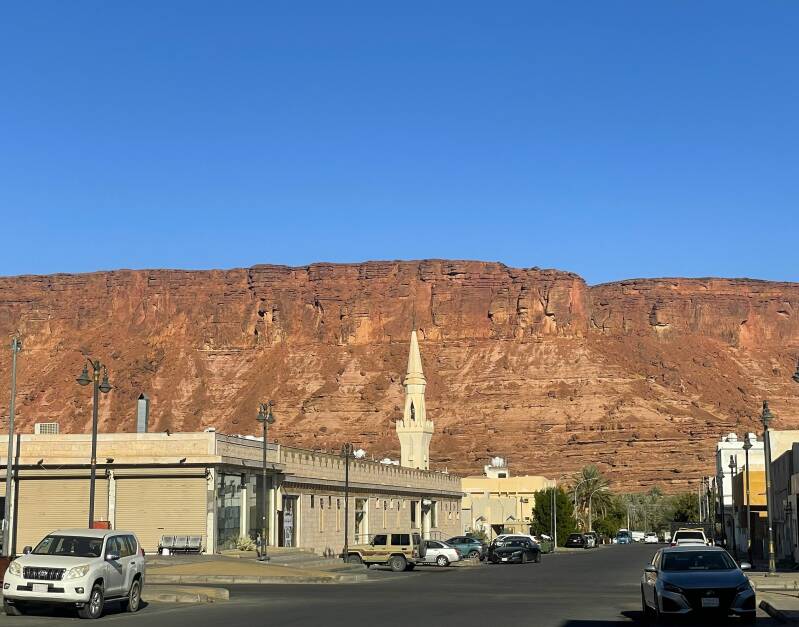
Landscape and a mosque, viewed during my walk to Old Town, Al Ula.
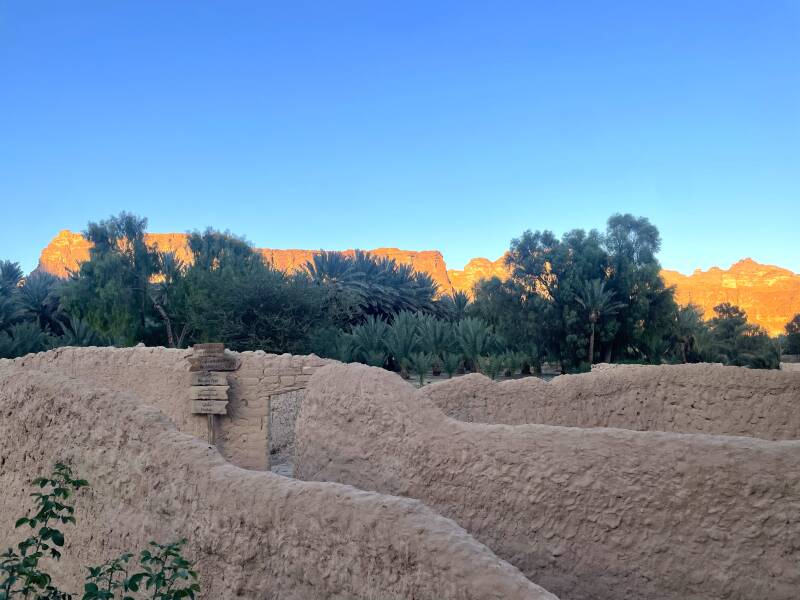
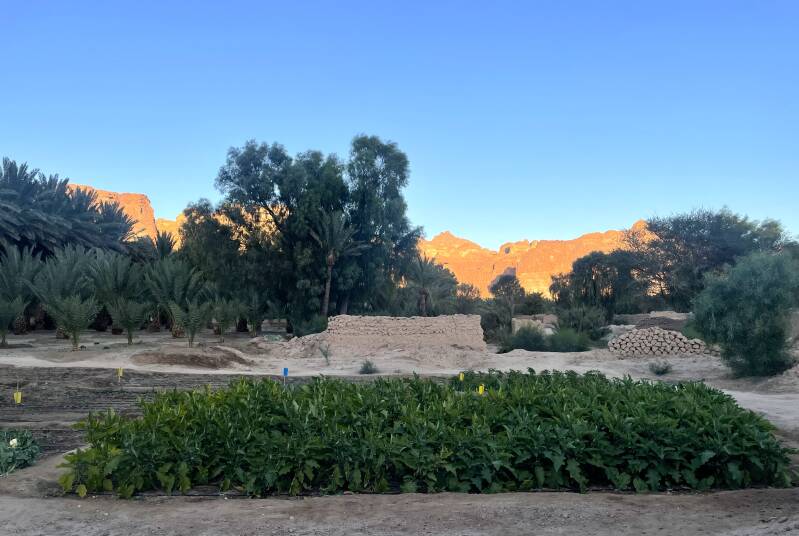
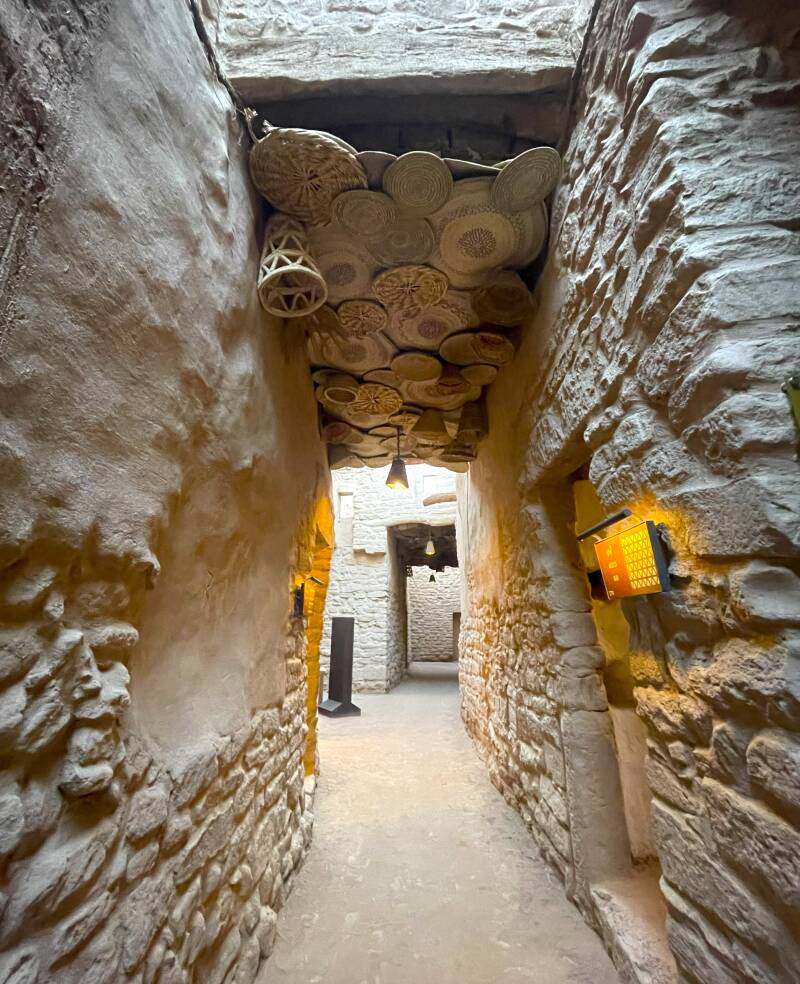
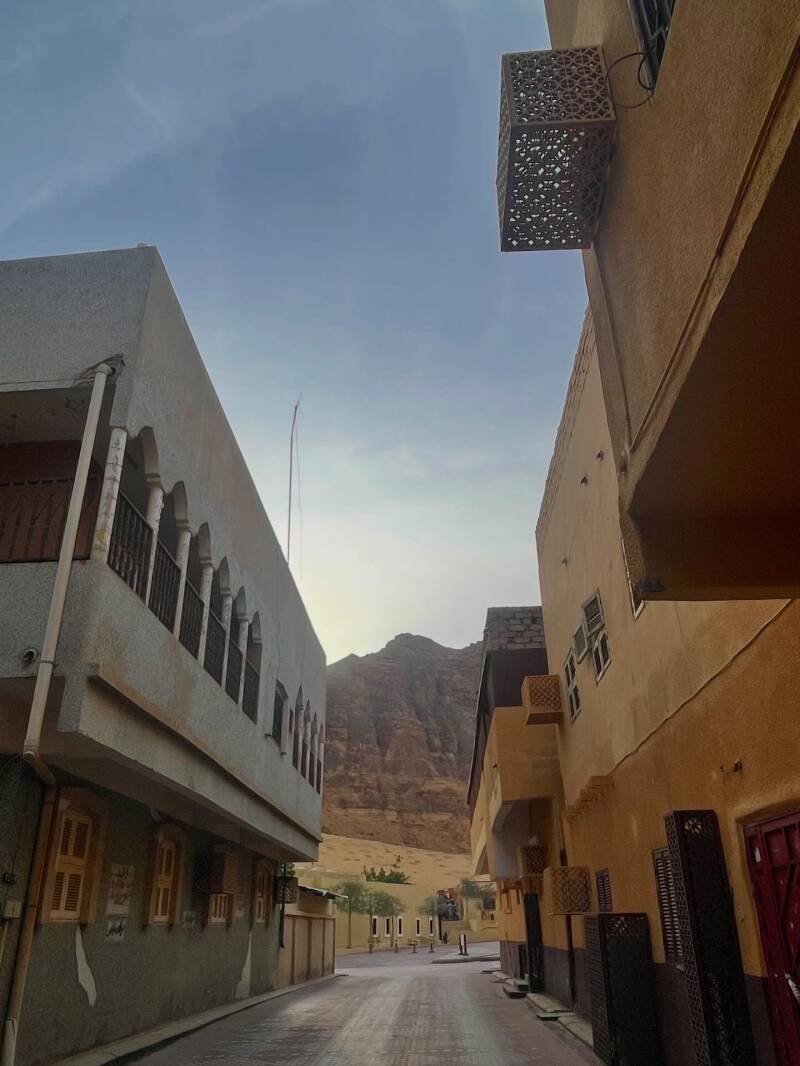
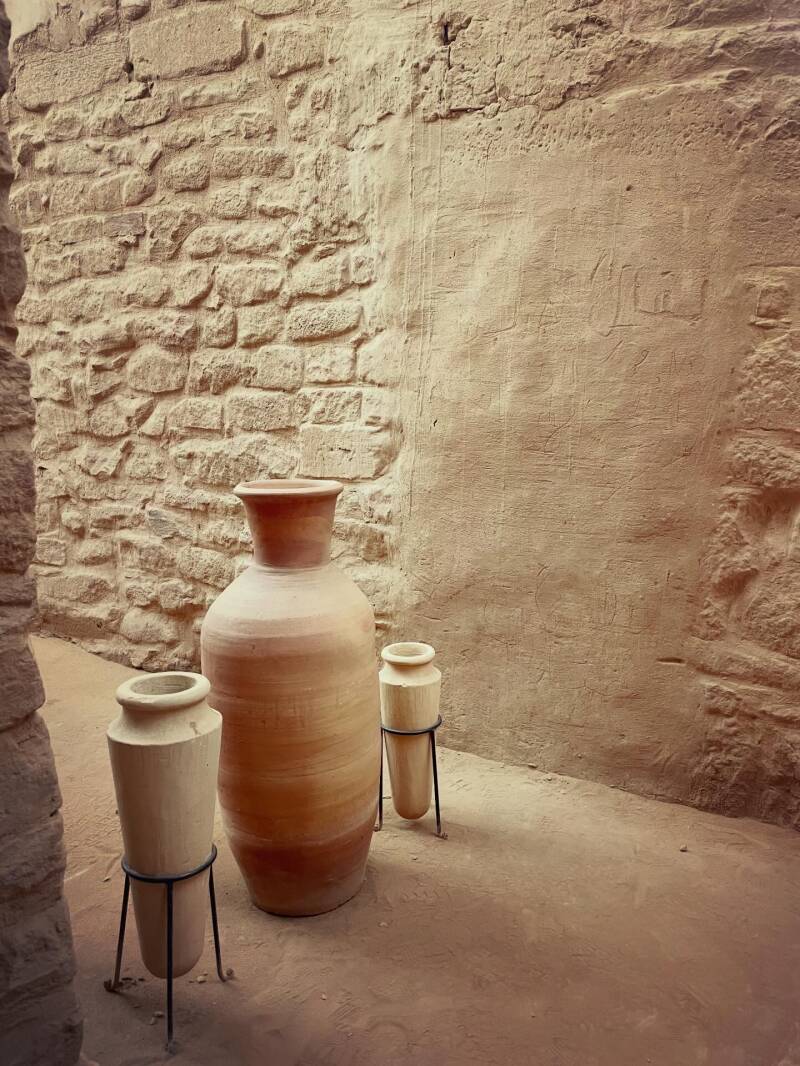

Views of Old Town.
My neighbourhood, Al Sukayrat, again remained almost completely quiet until evening. Around 6 pm, however, the streets suddenly filled with people, cafes and families strolling through the area.
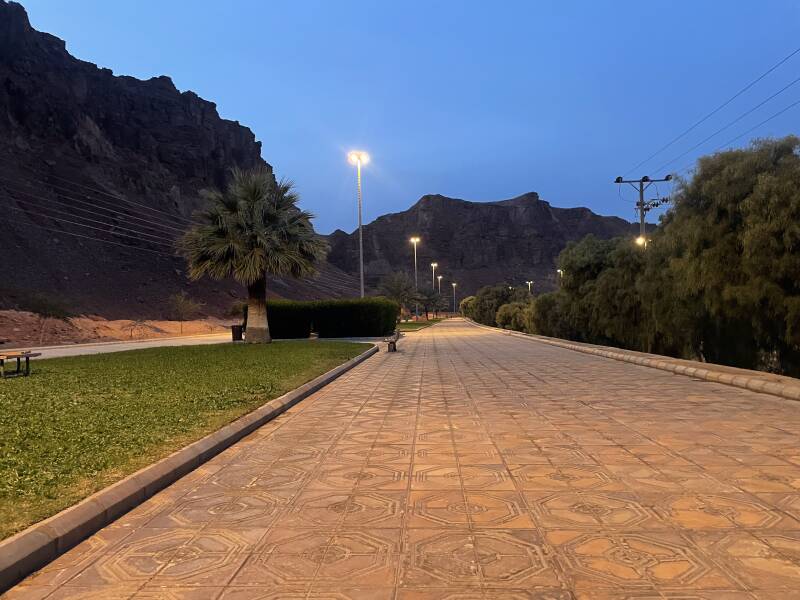
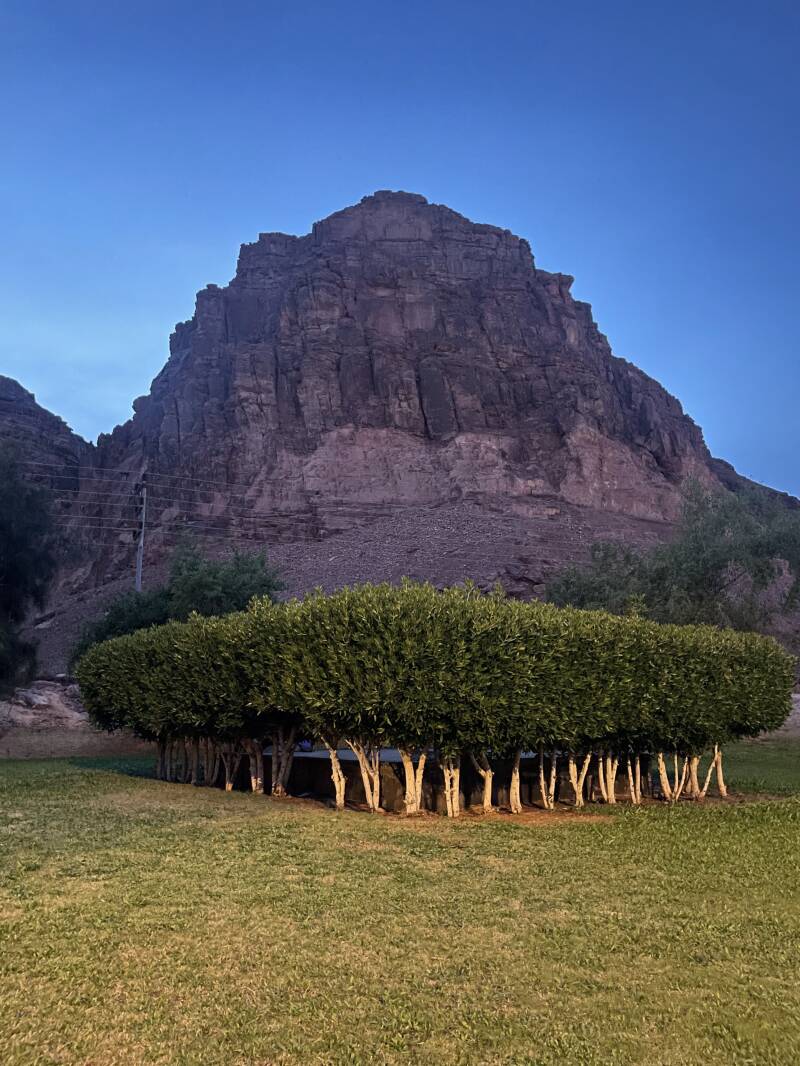
A park behind my guest house.
The following day I visited Hegra, Saudi Arabia’s first UNESCO World Heritage Site. Independent wandering is not allowed there, so rather than booking a full tour, I bought a ticket for the hop on hop off bus system.
The tombs carved into sandstone cliffs were astonishing and strongly resembled Petra in Jordan, except with barely any tourists.
At Jabal Ithlib, once a Nabataean place of worship, I wandered among towering rock formations while at Jabal Banat I saw clusters of tombs believed to belong largely to women. The unfinished Tomb of Lihyan stood towering above the desert, frozen mid construction for reasons historians still debate. (Jabal or Jebel means 'mountain' in English)
Eventually, after a long wait, I secured an Uber back into town.
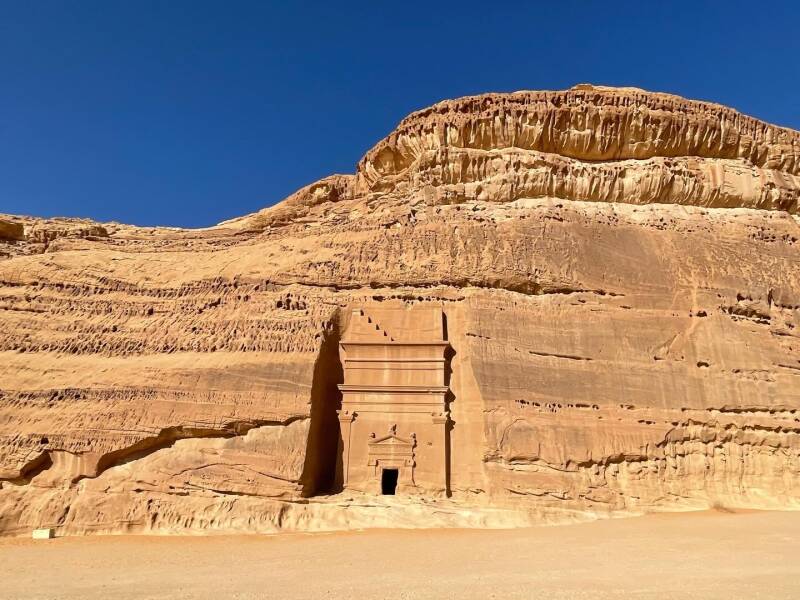
Jabal Banat
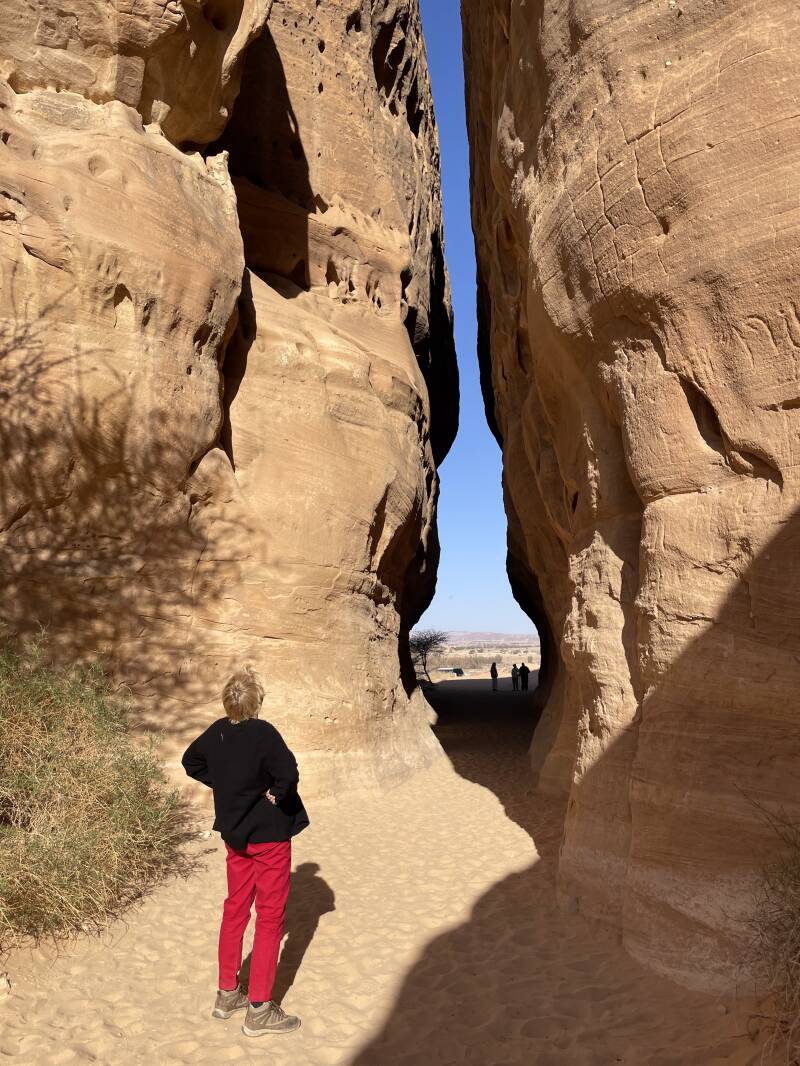
Jabal Ithlib
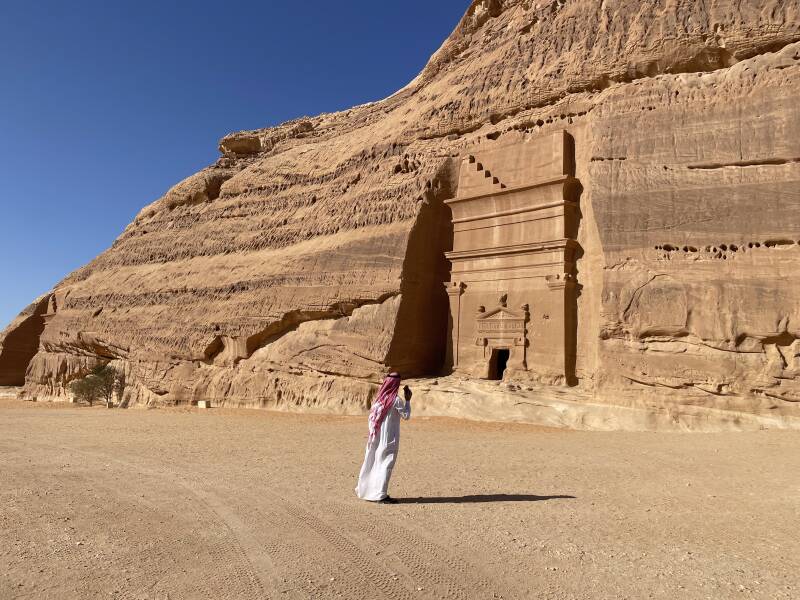
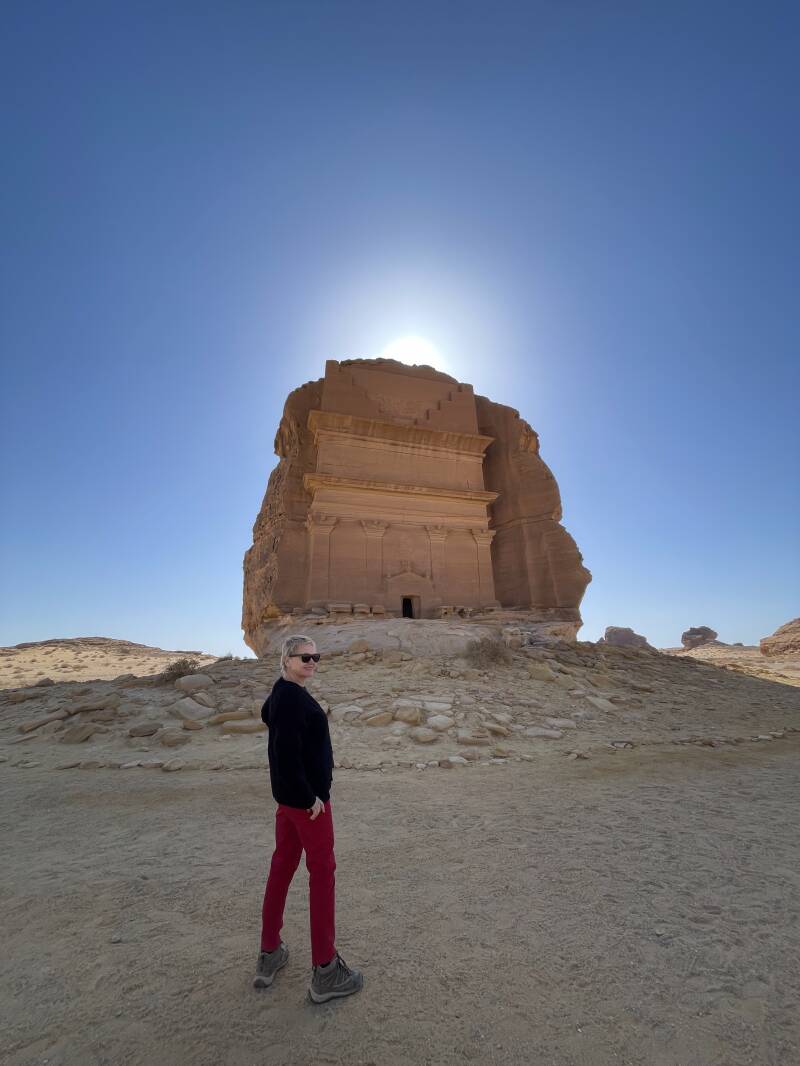
Tomb of Lihyan
That evening I headed to Elephant Rock, one of AlUla’s most famous landmarks. Massive floodlit sandstone formations surrounded outdoor cafes and seating areas. Most visitors drove themselves, but thankfully I managed to secure Ubers for both directions.
My Uber driver and I spent much of the trip communicating through Google Translate. Another driver proudly explained that he had ten siblings because his father had four wives.
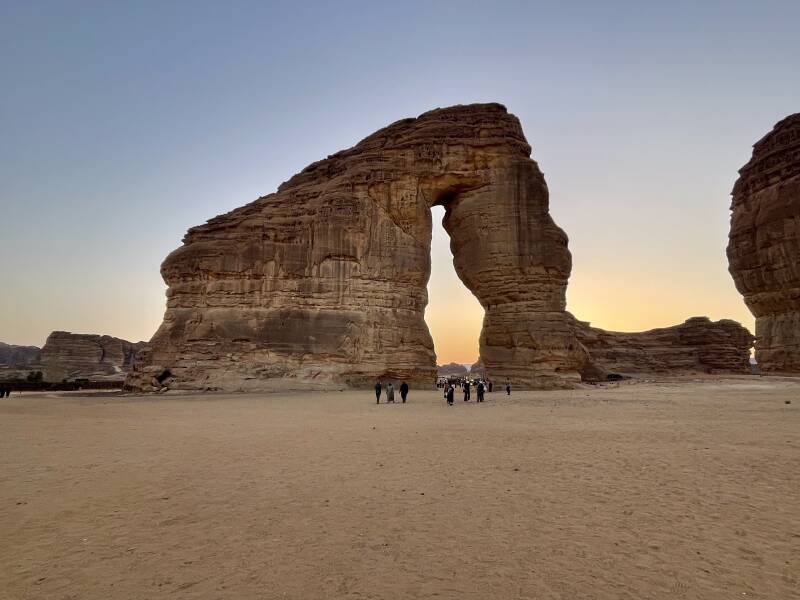
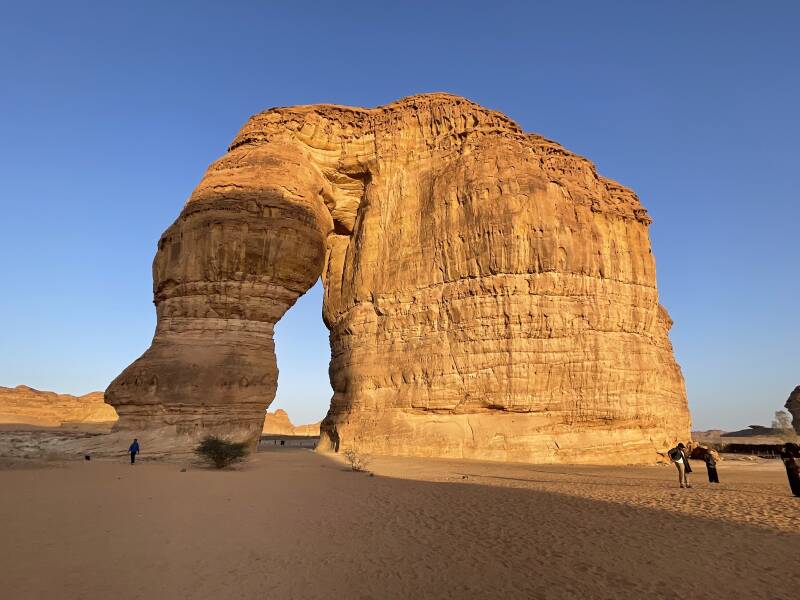
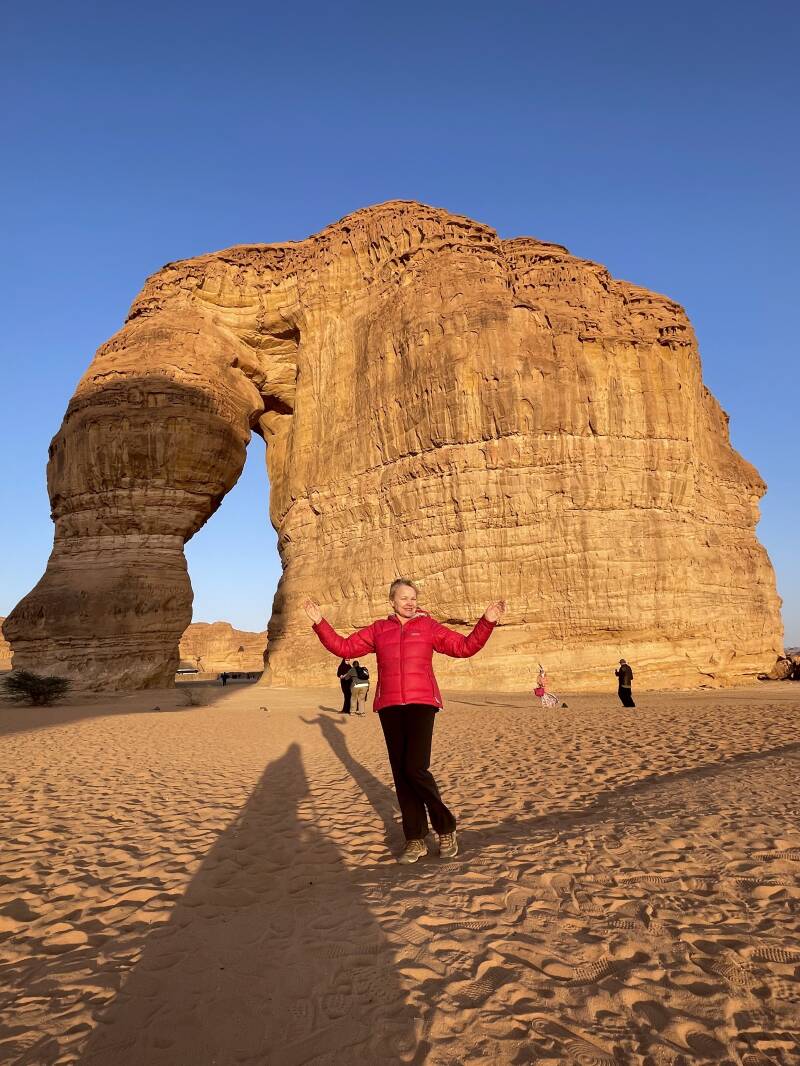
Completely unedited views of Elephant Rock at dusk.
The Accidental Tour Guide
The next morning, just as I was preparing to leave AlUla, an elderly American couple in their eighties arrived at my hotel looking utterly overwhelmed. They had no idea how to get around, how Uber worked or where to start exploring. Before long, I had accidentally become their unofficial tour guide. I took them into Old Town, showed them the best walking routes and helped them learn how to use Uber. Later I introduced them to my favourite falafel shop in Al Sukayrat, where I had previously relied on Google Translate camera mode to decipher the entirely Arabic menu. The falafel pockets stuffed with vegetables cost around AUD $1.60 each and were delicious. After dinner, I discovered two beautiful parks hidden behind my hotel, framed by canyon walls and accompanied by a constant ambient soundtrack of calls to prayer echoing across the valley. Meanwhile, Old Town was filling with signage for an ultramarathon taking place the following day. We even met a Syrian runner preparing for the race. Saudi Arabia seemed determined to host every conceivable international event.
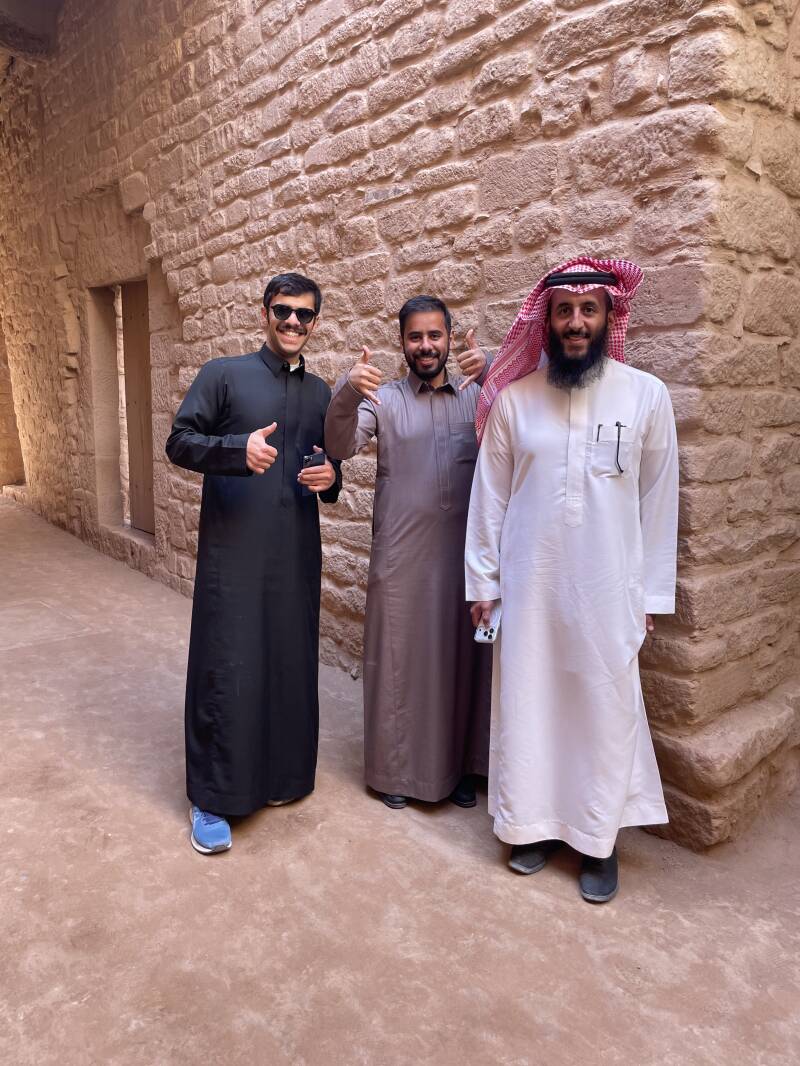
Friendly Saudis in Old Town.
The Bus to Medina
Instead of flying onward, I decided to take a local bus from AlUla to Medina.
This ended up being the most frustrating transport booking of my entire Saudi trip. The online booking system stubbornly refused to function properly in English. Eventually I resorted to booking by phone while desperately hoping I had selected the correct number of female passengers. At one point, I accidentally appeared to be booking tickets for seven or eight women as I stabbed at my phone hoping it would register a booking.
Eventually, success. I arrived at the 'bus stop' which was in an unnamed block of land which appeared to double as a car park. I only knew it was the official bus stop because of the presence of the bus.
On board, men and women were segregated unless travelling together as families. The women occupied the front section while the single men were packed into the back half of the bus.
As a result, we women actually ended up with the better seats.
Unexpectedly, the same Syrian ultramarathon runner I had met in AlUla was also on the bus after deciding not to compete. He became incredibly useful throughout the journey, translating Arabic announcements and explaining what was happening.
The bus stopped only once at a mosque featuring an extremely fly infested squat toilet. I have experienced much worse during my travels and and that was genuinely the worst thing I encountered in Saudi Arabia.
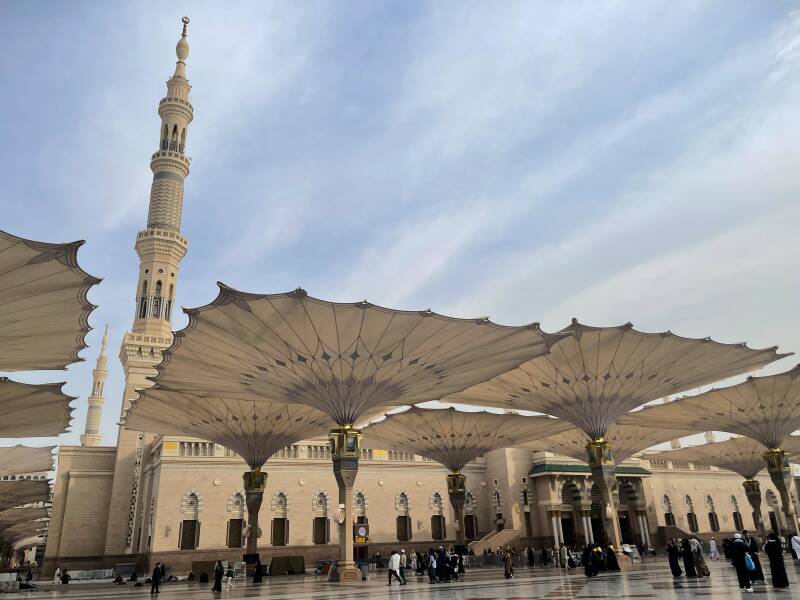
Al-Masjid an-Nabawī (Arabic: ٱلْمَسْجِد ٱلنَّبَوِي), which translates to 'Mosque of the Prophet'
Medina: Pilgrims and High Speed Rail
Some people incorrectly believe non Muslims are banned from Medina entirely. This is not true. Non Muslims can visit the city itself, though restrictions apply to certain religious sites.
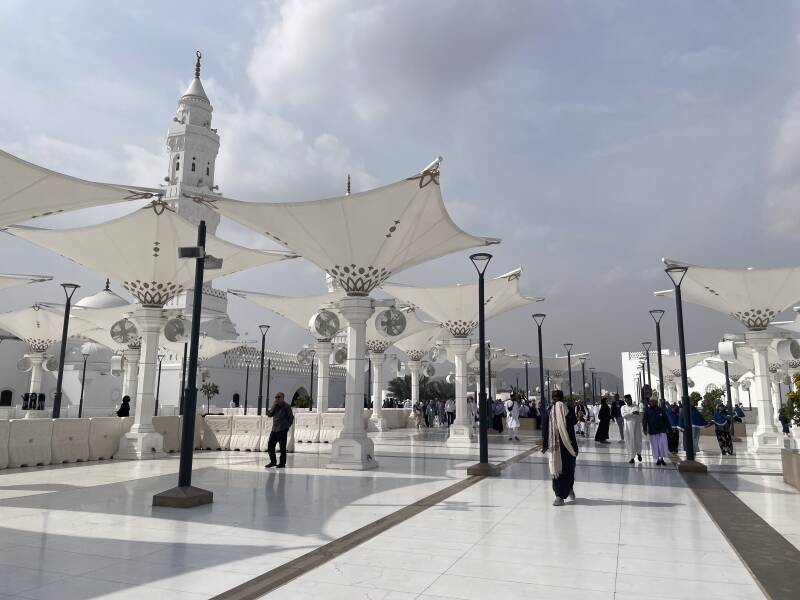
I dressed modestly and wore a scarf while visiting the area around the Prophet’s Mosque. I did not enter the mosque itself, although many Muslim pilgrims could not enter either due to the sheer number of worshippers overflowing into surrounding prayer areas. The scale of the complex was extraordinary. Giant retractable umbrellas spread across the courtyards surrounding the mosque, opening and closing automatically to provide shade for enormous crowds of worshippers. Installed as part of a sophisticated climate control system, the umbrellas can reportedly reduce surrounding temperatures significantly during Medina’s brutal summer heat through built in misting systems and carefully engineered airflow. Because I visited in winter, the misting fans were not operating, but even then the vast shaded courtyards felt calm and remarkably comfortable despite the huge numbers of people moving through them.
To explore the rest of the city, I boarded Medina’s hop on hop off sightseeing bus which wound its way between some of Islam’s most important historical and religious sites.
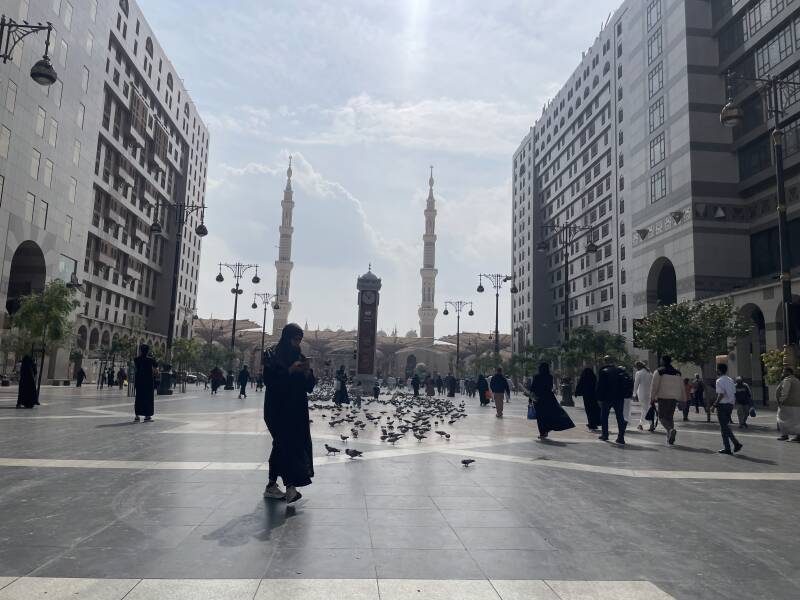
Area surrounding the Prophet's Mosque
One of the most significant stops was the Uhud battlefield, where the famous Battle of Uhud took place in 625 CE between the early Muslim community led by the Prophet Muhammad and the Quraysh forces from Makkah. The surrounding mountain still loomed dramatically behind the site, and despite the large crowds of pilgrims and visitors, the atmosphere felt unexpectedly calm and reflective. Standing there, it was striking to think how events that took place on this quiet stretch of land over fourteen centuries ago still shape the beliefs and movements of millions of people today.
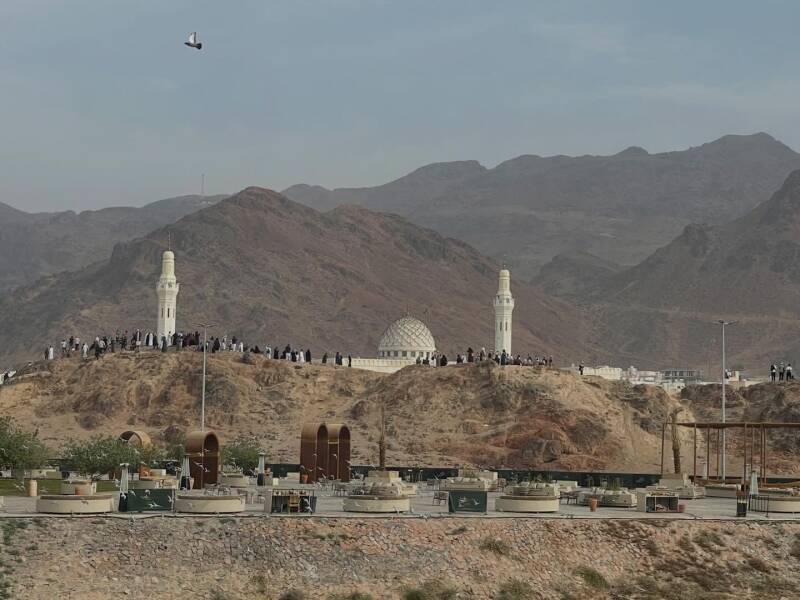
The Uhud Battlefield, flanked by a Masjid al-Fash and an outdoor restaurant.
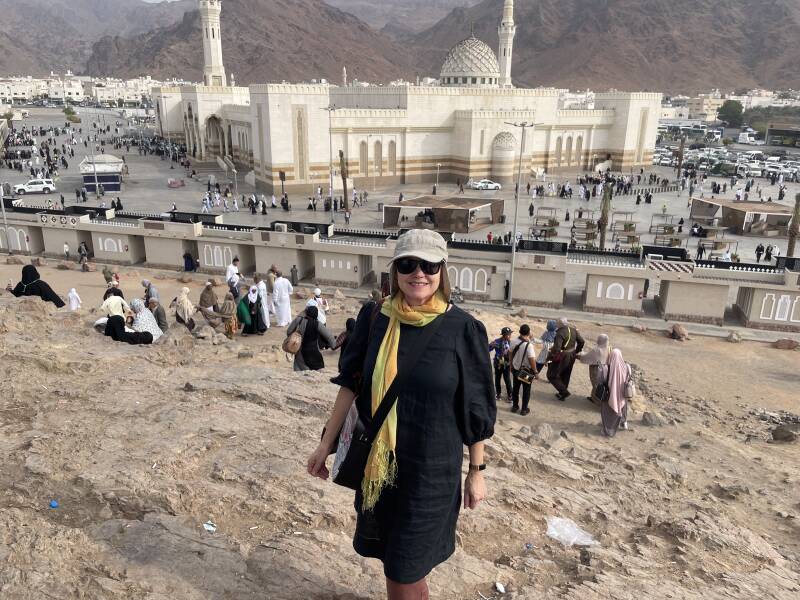
Another memorable stop was Qiblatain Mosque, instantly recognisable by its brilliant white exterior and elegant domes rising against the blue sky. The mosque is famous as the site where the direction of Islamic prayer is believed to have changed from Jerusalem toward Makkah, making it one of the most historically significant mosques in Islam.
At one point, while following the flow of visitors, I inadvertently got swept along with a large group of women heading toward the prayer area and suddenly found myself far deeper inside the mosque complex than I had intended. Nobody seemed remotely concerned and I quietly followed the crowd back out again a few minutes later.
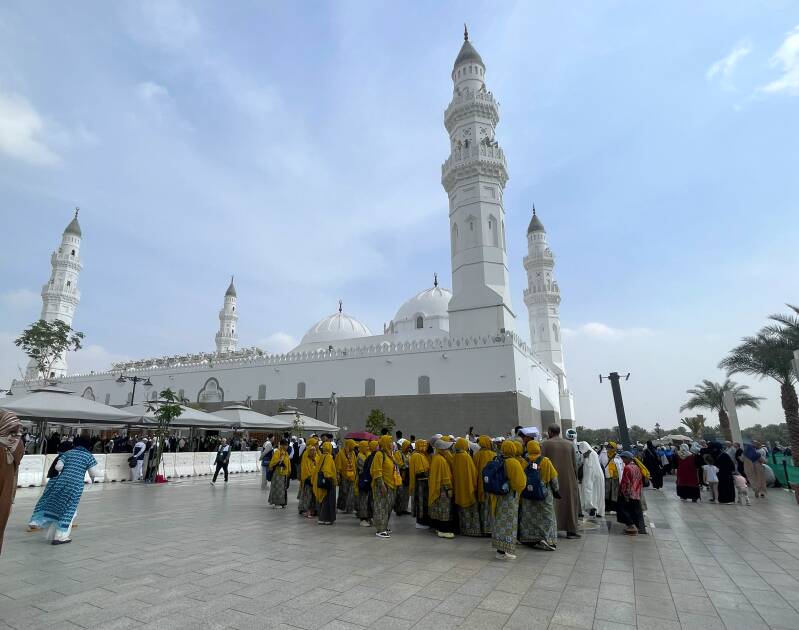
Pilgrims gather to visit Qiblatain Mosque.
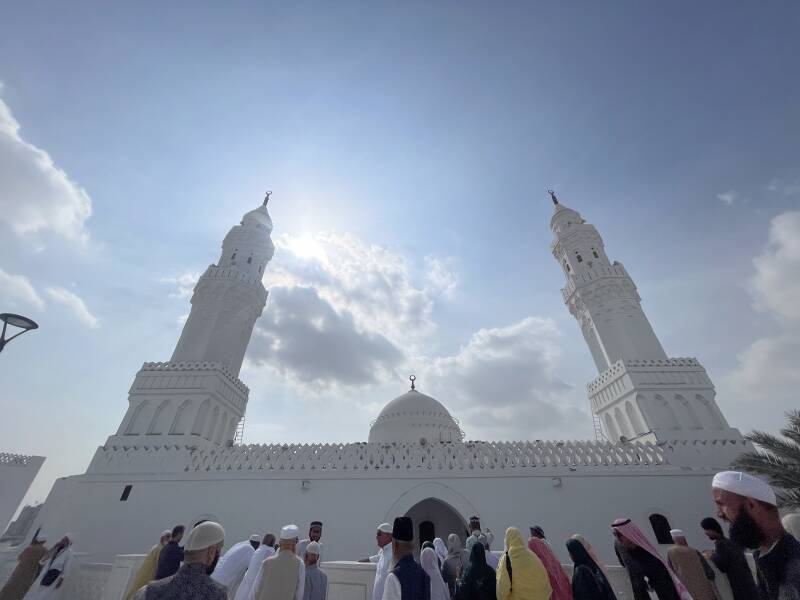
Views of Qiblatain Mosque.
The atmosphere felt entirely different from Riyadh or AlUla. Medina revolved around pilgrimage. Everywhere I looked, groups of pilgrims moved through the city following guides holding coloured flags, creating almost a festival like atmosphere. Many pilgrims appeared to be from Indonesia and travelled in large organised groups, often dressed in coordinated colours such as bright yellow, green or red perhaps so they could easily stay together in the enormous crowds. The city felt deeply spiritual but also vibrant, social and constantly in motion.
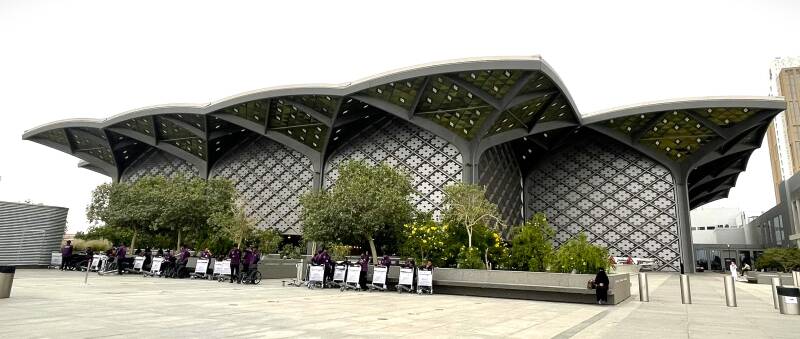
Entrance to the Medina Train station.
Later that day I headed to Medina’s sleek train station to board the high speed train to Jeddah. The contrast with the earlier bus journey could not have been greater. No squat toilets. No chaotic booking systems. Just spotless stations and modern trains filled with pilgrims heading between Saudi Arabia’s holy cities.
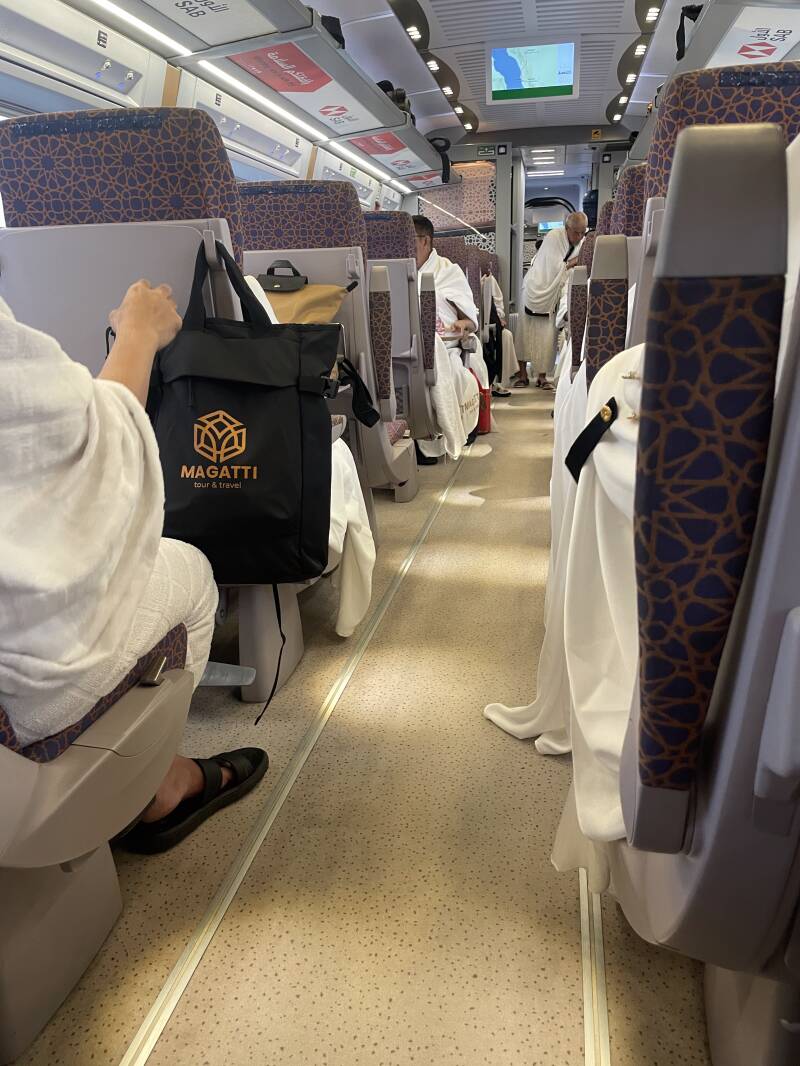
I didn't get the memo about wearing white: the fast train from Medinah to Jeddah.
Jeddah: Coral Houses and Contemporary Art
Jeddah immediately felt different again.
Where Riyadh was futuristic and inland, Jeddah felt coastal, historical and outward looking. I stayed in a hotel within walking distance of Al Balad, the UNESCO listed historic district. Again, very little happened before evening. During the daytime, many streets remained quiet while museums unpredictably opened and closed. After unsuccessfully finding two museums shut, I stumbled upon the newly opened Red Sea Museum housed inside Bab Al Bunt, a beautifully restored historic building once used as a port entry point for pilgrims arriving by sea.
The museum blended Red Sea history, pilgrimage culture and contemporary art in ways I had not expected.
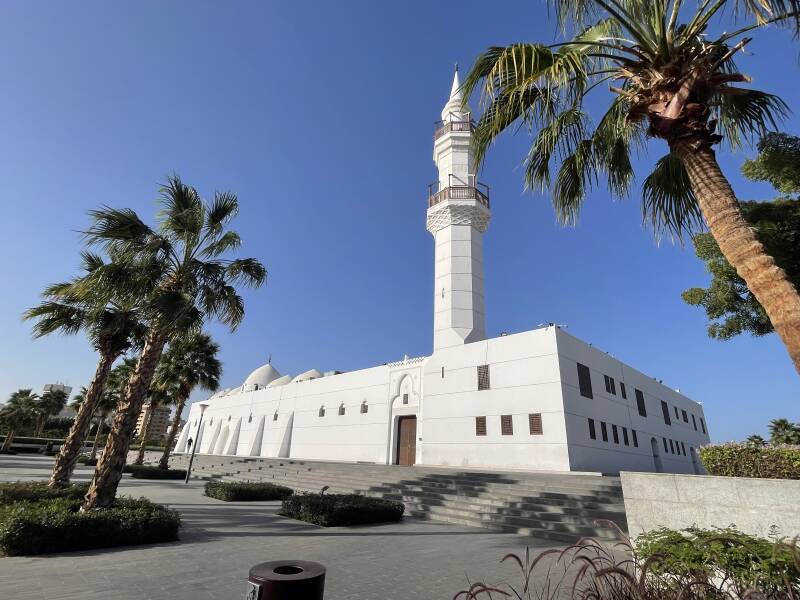
Al Jaffa’s mosque is situated close to the old town Al Balad district of Jeddah. It was built in 1987 and is situated adjacent to Retribution Square. The mosque is easily identifiable through its 20 domes.
Al Balad itself was stunning. Historic coral stone merchant houses lined narrow laneways while ornate wooden balconies known as rawasheen projected above the streets. Known as Hijazi architecture (7th-19th centuries) this traditional design utilizes natural materials and passive cooling techniques, such as thick walls and wind towers, to provide shade and comfort in the hot, humid climate. The architecture reflected centuries of Red Sea trade connections linking Arabia with Africa and beyond.
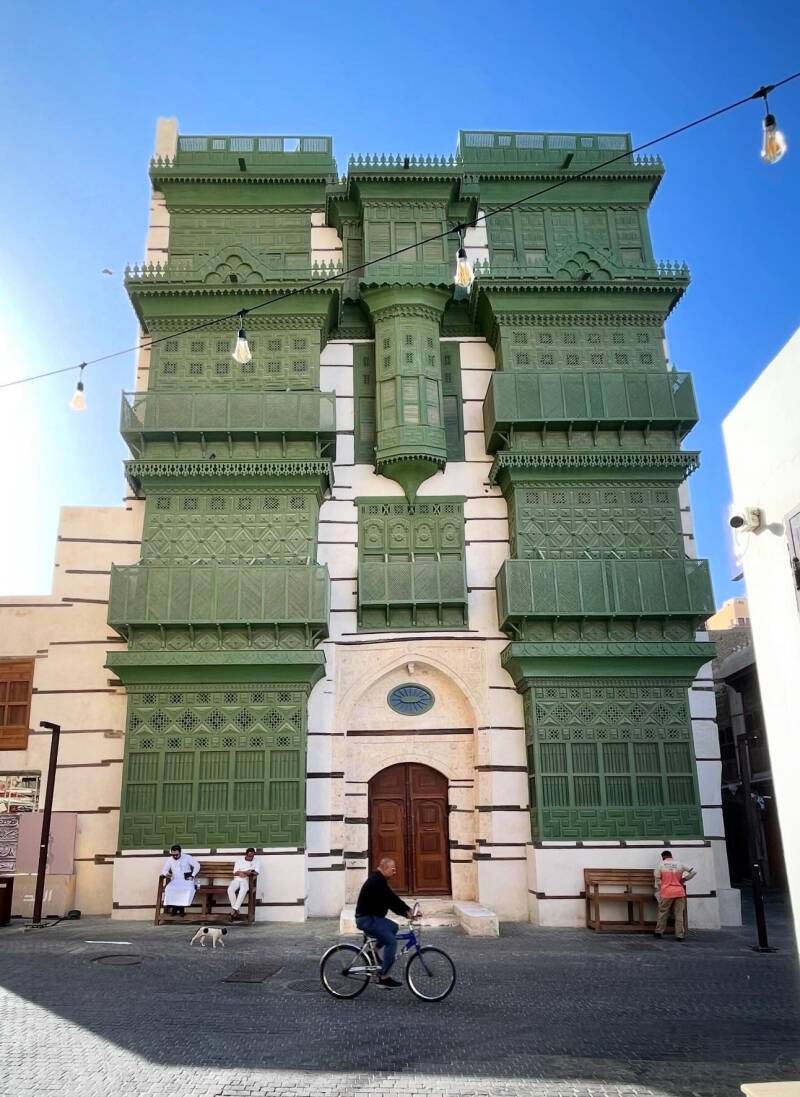
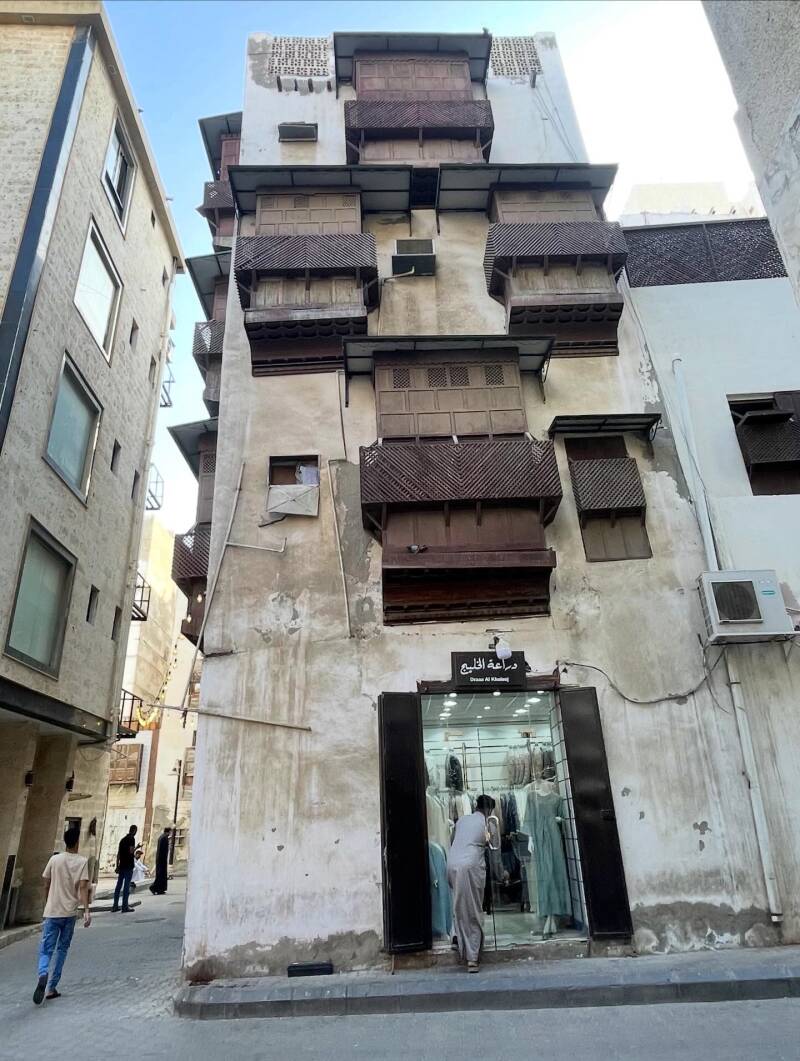
Architecture in Al Balad.
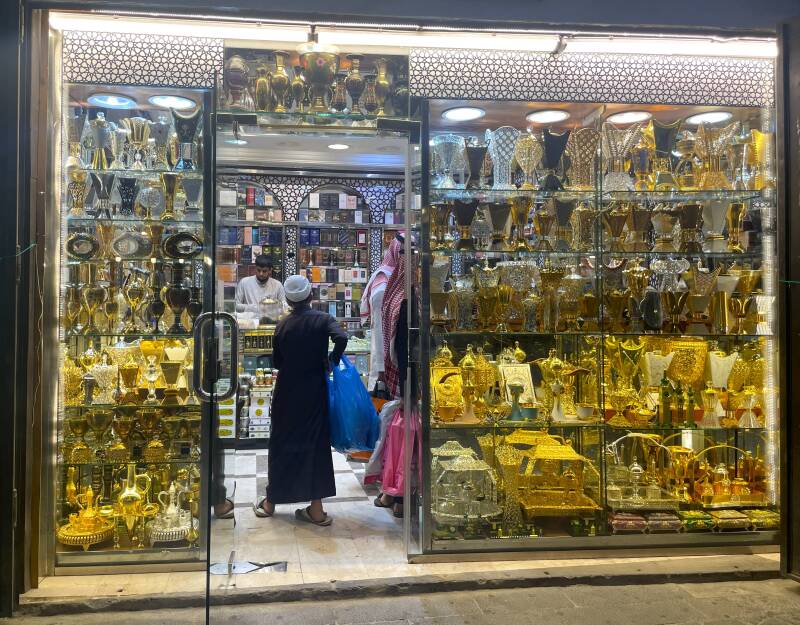
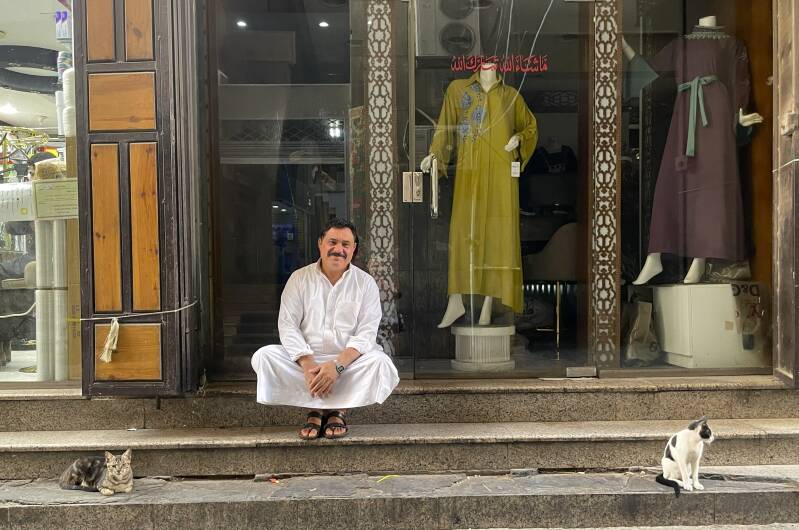
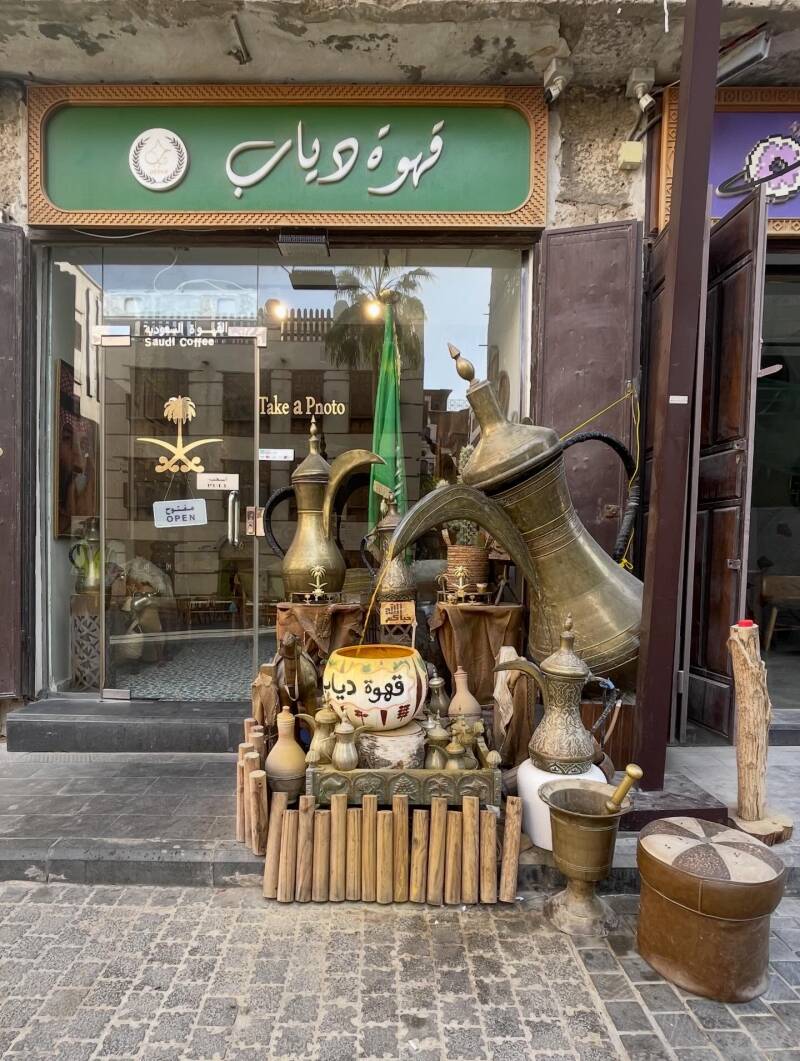
It was always fascinating checking out the shops at Al Balad.
One day I visited the Tariq Abdulhakim Centre, dedicated to one of Saudi Arabia’s most famous musicians and oud players.
A female guide accompanied me through the entire museum and enthusiastically encouraged me to try the instruments myself, including a bizarre futuristic laser instrument. Abdulhakim had toured internationally during the 1980s including performances at the White House. It felt strangely poignant hearing about that era given today’s political climate.
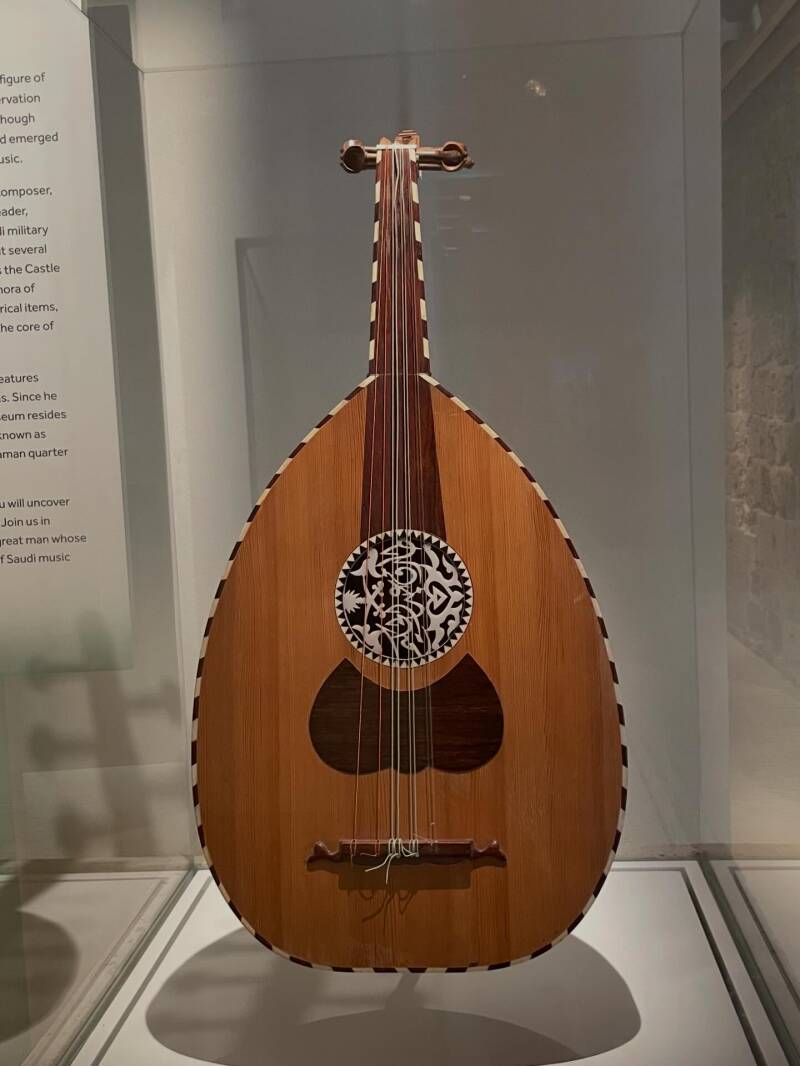
An oud at the Tariq Abdulhakim Centre.
Another day I ventured uptown by bus toward a museum complex located on top of a shopping centre. Eventually I needed to combine the bus ride with an Uber, but it was absolutely worth the effort.
The House of Islamic Arts, located inside Cenomi Jeddah Park Mall, contained over a thousand artefacts presented through beautifully curated modern displays.
Saudi Arabia consistently surprised me with how heavily it was investing not only in tourism infrastructure but also in museums, arts and cultural institutions.
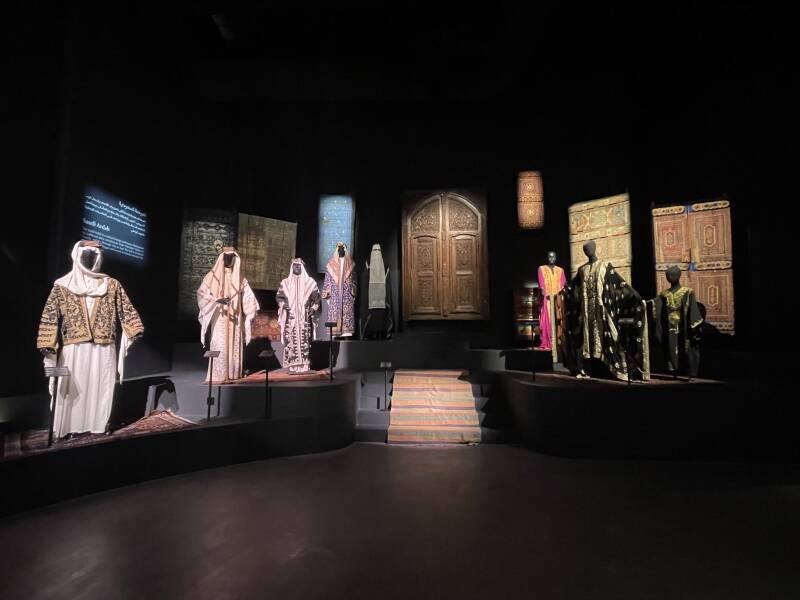
Costumes at The House of Islamic Arts, Jeddah.
An Unexpected Return to Saudi Arabia
After Jeddah, I flew onward to Eritrea. But Saudi Arabia was not quite finished with me yet. Due to tensions and border complications between countries in the Horn of Africa, travelling from Eritrea to Djibouti required an absurd flight routing via Jeddah and Addis Ababa. What should geographically be a short overland journey instead became an international aviation puzzle.
I booked an overnight airport hotel in Jeddah complete with a free shuttle to Terminal 1. With no Saudi currency remaining, I carefully planned every detail to maximise sleep before my early morning flight. Everything seemed perfect until I entered the terminal and could not find my flight listed anywhere. I approached a staff member.
“Show me your flight,” he said.
I handed him my booking.
“That’s North Terminal,” he replied. “Different airport.”
Different airport?
My boarding pass clearly stated “Terminal 1 North Terminal” which apparently referred not to a section within Terminal 1 but an entirely separate building somewhere else.
Panic.
I rushed outside and grabbed a taxi, carefully asking beforehand whether he accepted card payments.
“Yes,” he assured me.
Instead, he promptly drove me to an ATM so I could withdraw cash for him. Not what I was expecting but I stayed patient.
By the time I finally reached the correct terminal, I was among the final passengers checking in. The airport was packed with large pilgrimage groups, many seemingly unfamiliar with air travel and were aggressively pushing through queues in every direction.
Eventually I reached immigration where the officer examined my passport. “How many times have you visited Saudi Arabia?” he asked. “Actually, this is my second time,” I replied. “Have you drunk camel milk?” “No,” I admitted, speaking with an upward inflection to show I was interested. “Well,” he smiled while stamping my passport, “next time you must try some.”
And with that, I boarded my flight to Djibouti carrying warm memories of two fascinating weeks travelling independently through Saudi Arabia.
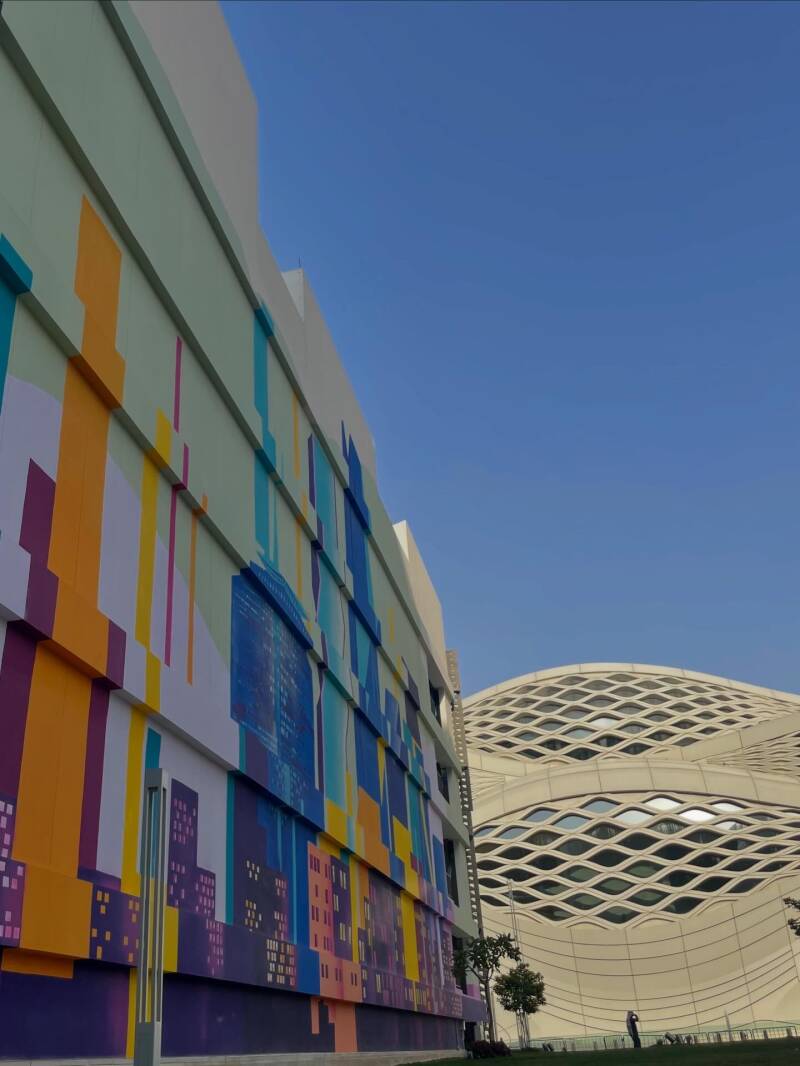
A city themed mural near the KFD station in Riyadh.
Create Your Own Website With Webador