


Upstairs at the Tagliaro Fiat building in Asmara.
Arrival in Asmara
Asmara’s airport is disarmingly confusing on arrival, but a bit of instinct proved useful. I guessed, correctly, that I would need to wait at the visa office, a small and informal room with three messy desks, clutching my letter of introduction while waiting outside with two fellow passengers from the flight: a Russian and an American woman travelling together. During our brief conversations, I passed on my admiration at their ability to travel the world with only a small bag each and before long, our visas were approved and we emerged into the arrivals area, where I immediately recognised Philemon, my local fixer and CEO of Eritreavisit tour company. A quick Google search before departure had ensured I knew exactly who I was looking for. Philemon was able to curate a nine day program for me as a private tour for roughly the same price as the group tour from an international company which was cancelled due to insufficient bookings. During my stay I met visitors who stayed in Eritrea for far shorter times than me, but with nine days, Philemon was able to provide me a more immersive stay and numerous returns to Asmara so that I really started to 'feel' the city.
I stayed at the Crystal Hotel in Asmara, which, along with a handful of other hotels, seems to host most foreign visitors. We are a particular kind of traveller, those willing to embrace a country with virtually no internet and architecture that appears frozen in time. Many buildings in the city remain exactly as they were when constructed during Italian rule in the 1930s, an era that left Eritrea with one of the most intact collections of modernist architecture in the world. That charm, however, comes with realities: temperamental plumbing, power limitations and cold showers. Fortunately, Crystal Hotel's plumbing was good (showers were warm and toilets flushed without too much effort) and the restaurant provided excellent meals and, fortunately something Eritrea is renowned for: great coffee.
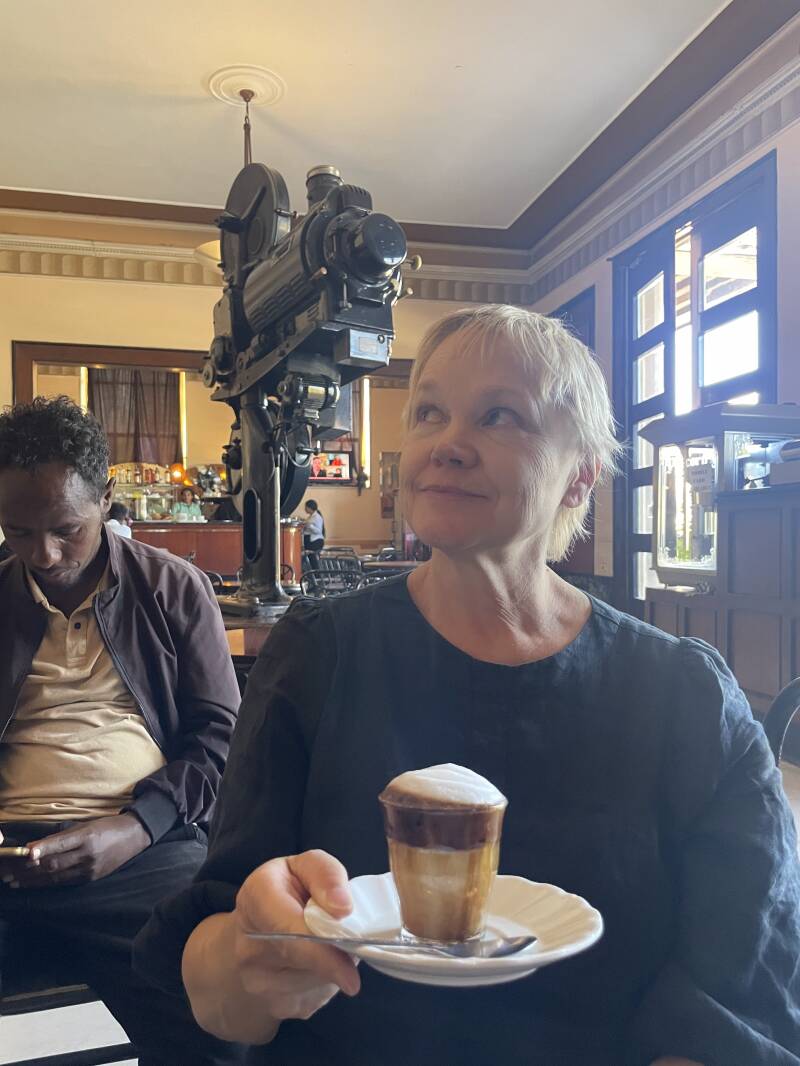
Enjoying Eritrea's version of macchiato whilst admiring the cinema paraphernalia at Cinema Roma.
28 February: Asmara City Tour
Asmara is unlike any other African capital I have visited. In 2017 it was designated a UNESCO World Heritage Site, recognised for its remarkably intact collection of modernist and Art Deco architecture, much of it dating from the Italian colonial period of the 1930s. Walking through the city often feels like stepping into a carefully preserved time capsule.
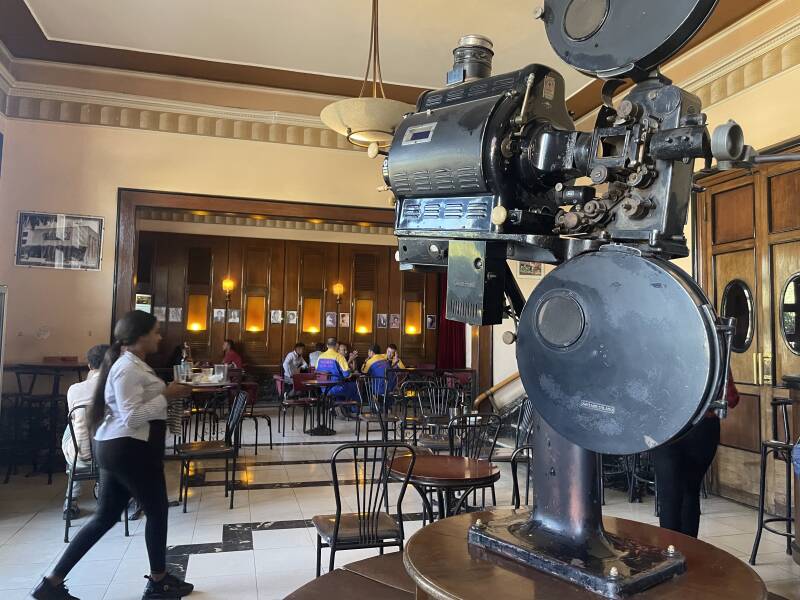
A typical morning at Cinema Roma where coffee and cafe culture are the norm.
My early flight meant we could begin the day with a coffee stop which we did at the famous Cinema Roma. The space was filled mostly with men drinking coffee, a serious and social ritual in Asmara. Coffee culture here is exceptional, and the macchiato, slightly different from the Australian version is consistently excellent. Built in 1937 as the Cinema Excelsior, Cinema Roma's elegant façade of polished marble still hints at the glamour of the city’s Italian colonial past. Renamed Cinema Roma during the Fascist occupation and later restored to its 1940s appearance in 2005, the cinema today is less a movie palace and more a living relic of another time. My guide Simon brought me here for coffee, and as we sat beneath the old posters and beside a retired Sorani 35-mm projector displayed in the café, I explored the auditorium itself. Rows of old cinema seats still face the screen, but in a twist I found strangely ironic, this grand historic theatre is no longer used for films at all; these days locals gather here mainly to watch European football matches. Sitting there with my coffee, surrounded by the faded atmosphere of classic cinema, it was hard not to imagine what the place must once have felt like on a bustling movie night in Asmara’s heyday.
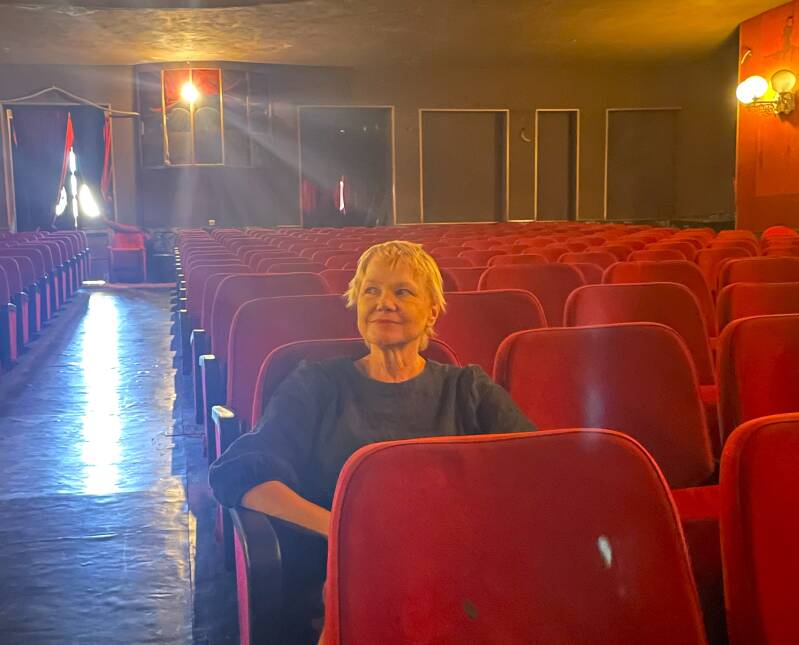
Ready for my close-up: the theatre at Cinema Roma, which is now only used for showing football games.
From there, Simon, took me to Medeber Market, Asmara’s famed recycling and upcycling hub. The air was thick with the smell of burning metal and spices, and the atmosphere was intense rather than theatrical. Piles of discarded metal, rubber, wood, and plastic surrounded us as men worked in rhythmic coordination, hammering and welding in near synchrony. Medeber was once a caravan trade post in pre-colonial times and later became part of Asmara’s redesign under Italian architect Odoardo Cavagnari in the early 1900s. From the outset, it functioned as a centre of reinvention. High import costs during the colonial era meant that local craftspeople turned scrap into ovens, tools, bicycles, furniture, and kitchenware. That tradition continues today: oil drums become stoves, car frames become shovels, melted containers become cooking pots.
The welders themselves are iconic, wearing handmade protective masks constructed from cardboard, plastic, and whatever materials are available. One of the most recognisable products of the market is the shida, sandals made from old tyres (sounds a bit like the 'treads' of 1970s Australia, I thought). These were so important during the war for independence that a large statue dedicated to them stands elsewhere in the city.
Tucked into one section of the market is a spice area, where electric mills grind ingredients into fragrant blends, including berbere, the backbone of Eritrean cuisine. Artists sell scarves, bags, clay coffee pots, and religious icons, reinforcing the sense that Medeber is not merely a tourist attraction but a living, working ecosystem.
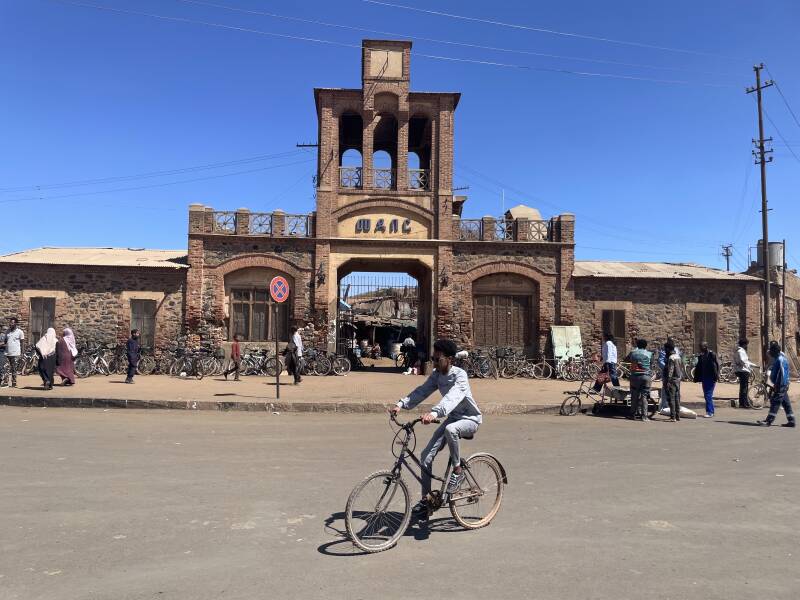
The entrance to the Medeber Market. Bicycles are the most common means of travel in Asmara, as evidenced by those parked outside.
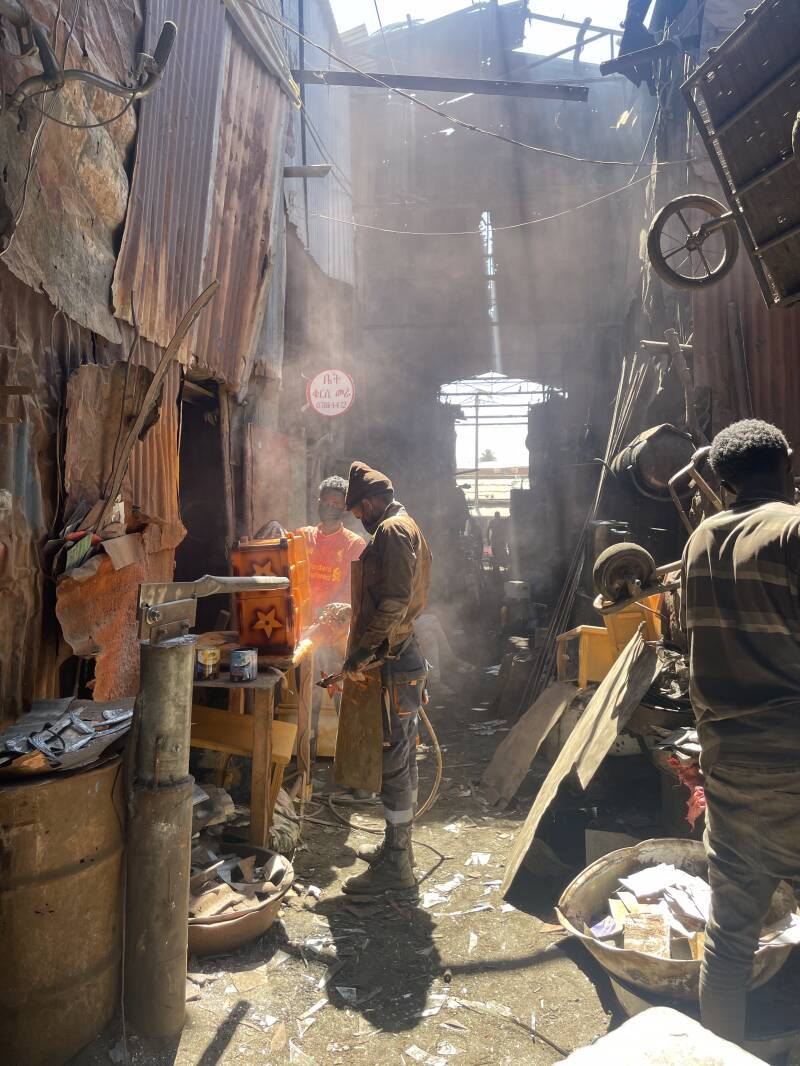
The welding section of Medeber Market.
We also visited Enda Mariam Orthodox Cathedral, notable for its beautiful stained-glass windows and a particularly intriguing feature: a pair of large stones suspended by ropes, once used as bells before metal bells became common. It was a simple but evocative reminder of how traditions adapt to available materials. Enda Mariam Orthodox Cathedral is the primary, iconic Eritrean Orthodox Tewahedo church in Asmara, constructed between 1938 and 1939, it features a unique blend of Italian modernist, Art Deco, and traditional Tigrinya architecture, often noted for its "tukul" style towers and 1950s mosaics.
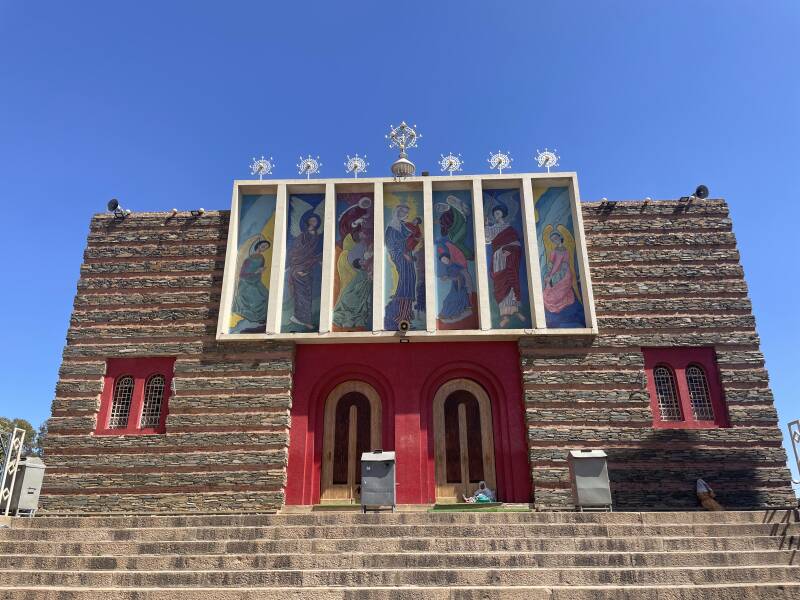
The entrance to Enda Mariam Orthodox Cathedral.

Traditional 'church bells' at Enda Mariam Orthodox Cathedral.
You really can't say you've done Asmara without visiting the extraordinary Fiat Tagliero Building, one of the city’s most iconic reminders of its Italian colonial past. Completed in 1938 and designed by Italian architect Giuseppe Pettazzi, the Futurist-style service station looks more like a concrete aircraft preparing for take-off than a petrol station. Named after Dr. Tagliero, the local Fiat concessionary who owned the business, the building’s dramatic reinforced concrete wings stretch some 15 metres from the central tower without visible supports, an engineering feat that still feels daring nearly a century later.
When we arrived, the building was locked behind a wire fence, but after a few moments some sort of caretaker emerged and, after a brief conversation with Simon, kindly let us inside. We climbed the staircase winding through the central tower, once home to the offices, cashier’s desk and shop, and eventually reached the upper levels where we could look out across Asmara from above. Standing there beside the famous concrete wings, with the city spread out below us in the afternoon light, it was easy to imagine the optimism and ambition that surrounded the building when it was first constructed at a strategic crossroads of Italy’s so-called “new Roman Empire” in Africa.
The Fiat Tagliero’s most famous story surrounds the construction of those unsupported wings. Local authorities reportedly insisted they be reinforced with support pillars, and original plans later discovered in 2001 even showed the proposed struts. Pettazzi, convinced they were unnecessary, refused to compromise. According to local legend, he dramatically produced a gun during the inauguration, either threatening to shoot himself if the structure failed or threatening the hesitant builder who refused to remove the supports. Whatever the truth, the props came away, the wings held firm, and Pettazzi’s bold design was spectacularly vindicated.
Remarkably, the building still stands almost exactly as intended. Although partially hit during British bombing in the Second World War, the structure survived with little damage and the famous wings never collapsed. Today, the Fiat Tagliero remains one of more than 400 remarkable modernist and Art Deco buildings that make Asmara one of Africa’s most fascinating architectural cities.

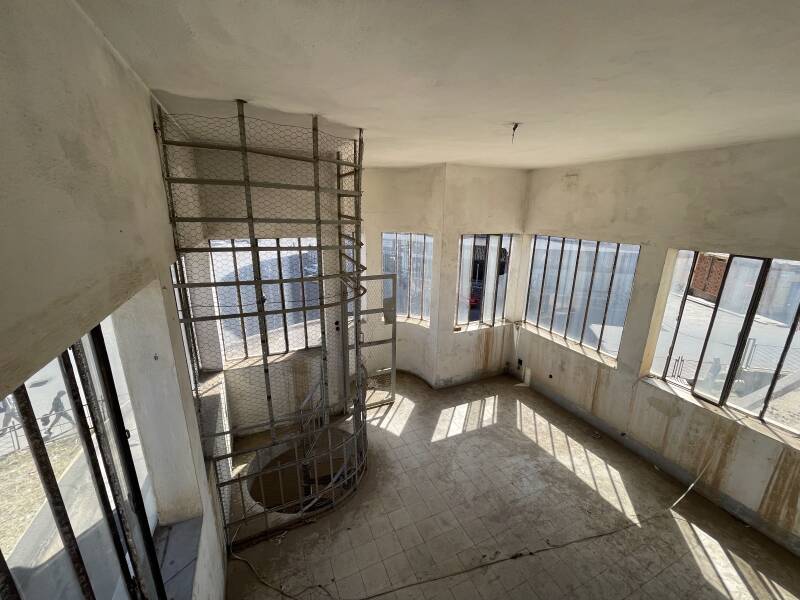
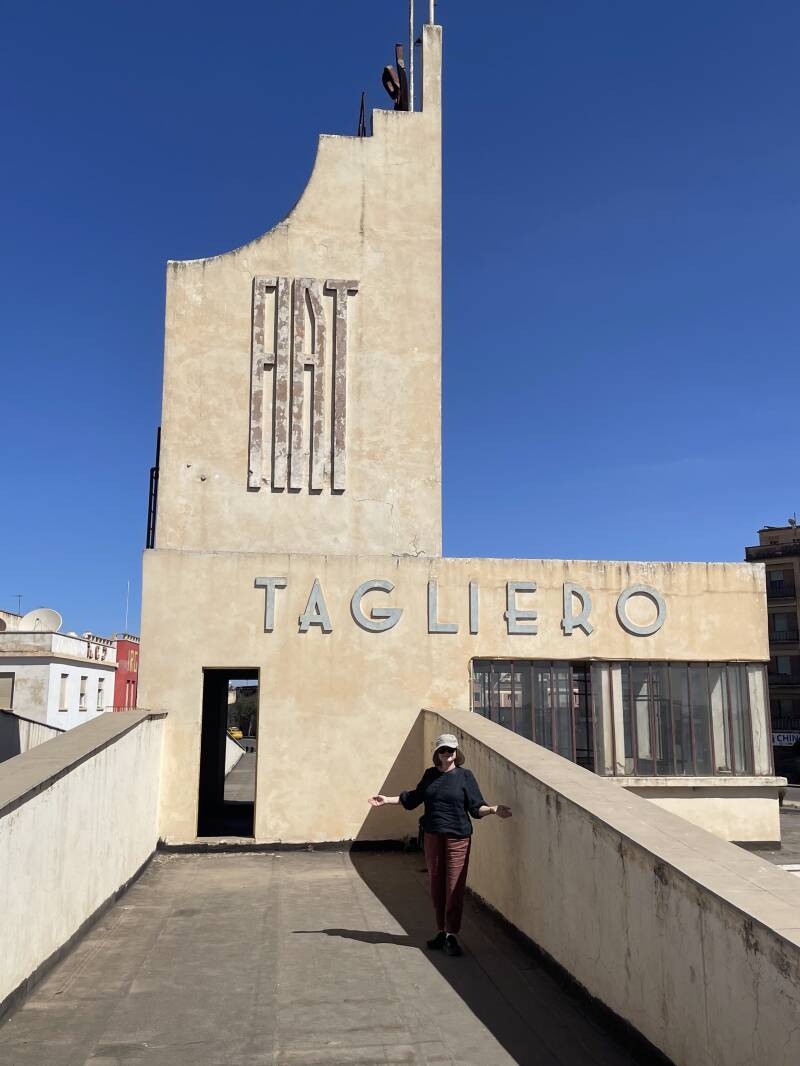
The Fiat Tagliero Building from the front, inside and on top.
Then, from history to popular culture, we stopped at a bowling alley, where locals not only bowl but also gather to play PlayStation games against one another. In Australia, this kind of gaming would usually happen at home; in Eritrea, it is a social activity, done collectively and in public spaces. This seemed emblematic of the broader culture, communal, outward-facing, and relational.

We visited another café, La Dolce Vita, a name echoed across many buildings in Eritrea, a lingering trace of Italian influence. There, we met Deanna, a friend of Simon’s who runs an internet café, yes, they are very much still a thing here. With limited personal internet access, these cafés remain important social and practical hubs.
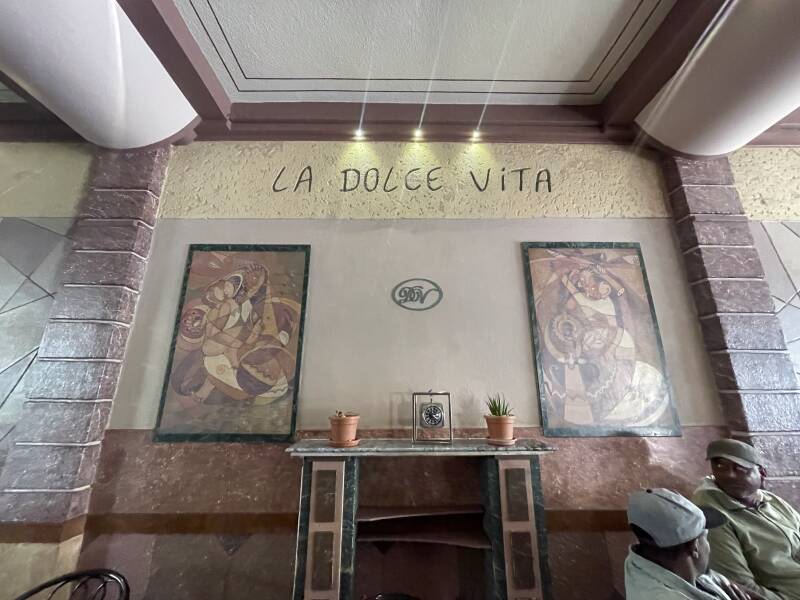
La Dolce Vita, now an internet cafe.
We also visited Africa Pension, what was once a grand 1930s hotel, not to sleep but to visit the interior and the manicured gardens outside with a statue of what looked like a Roman emperor. Later, while reading more about Africa Pension, I discovered that the statue in the garden was not, as I had first assumed, some generic Roman emperor, but a bronze figure of Augustus. The surreal presence of Caesar standing among the manicured gardens suddenly made much more sense in the context of Asmara’s colonial history. During the 1930s, Italian authorities deliberately cultivated the image of Asmara as a kind of “Little Rome” in Africa, part of Mussolini’s dream of constructing a new Roman Empire on the continent. Sitting in the garden beneath the palms beside the statue, it had all felt faintly absurd at the time; only later did I realise that this strange atmosphere was entirely intentional.
The building itself is another striking example of Asmara’s remarkably preserved Italian colonial architecture, with subtle Cubist influences woven into its design. Over the decades the villa has lived many lives, serving not only as a private residence, but later as a High Court during the Ethiopian period and even, at one stage, as a bar for the Ethiopian Navy before eventually becoming the guesthouse known today as Africa Pension.
There we met a German man, obviously more than a regular tourist as he was reading a book about Asmara (in German language) who was staying there for the architectural ambience rather than functionality. (When I enquired as to what it was like to stay there, he indicated that there was hardly ever hot water.) At least Crystal Hotel trumped Africa Pension in that regard. That man, Christopher Kugler-Niklas was a writer and, it was not the last we would see of him. At this point, Deanna had joined us and we posed together for a selfie in front of the gradiose red curtains, likely Christmas decorations still remaining.
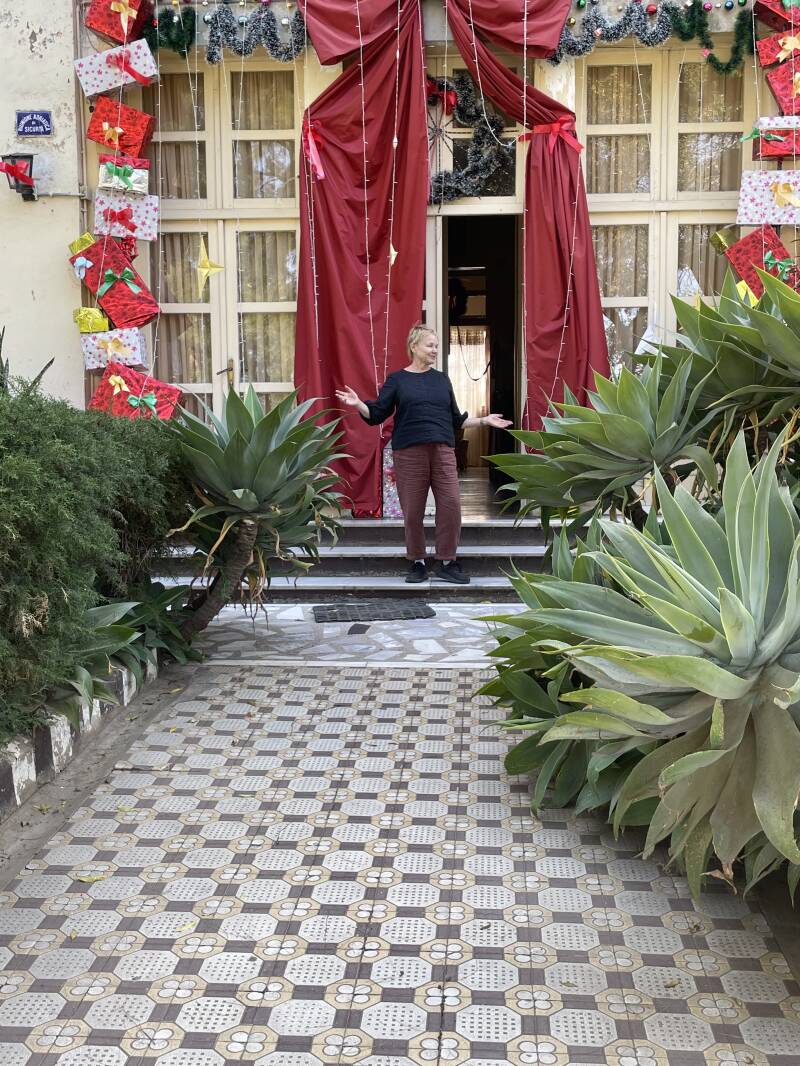
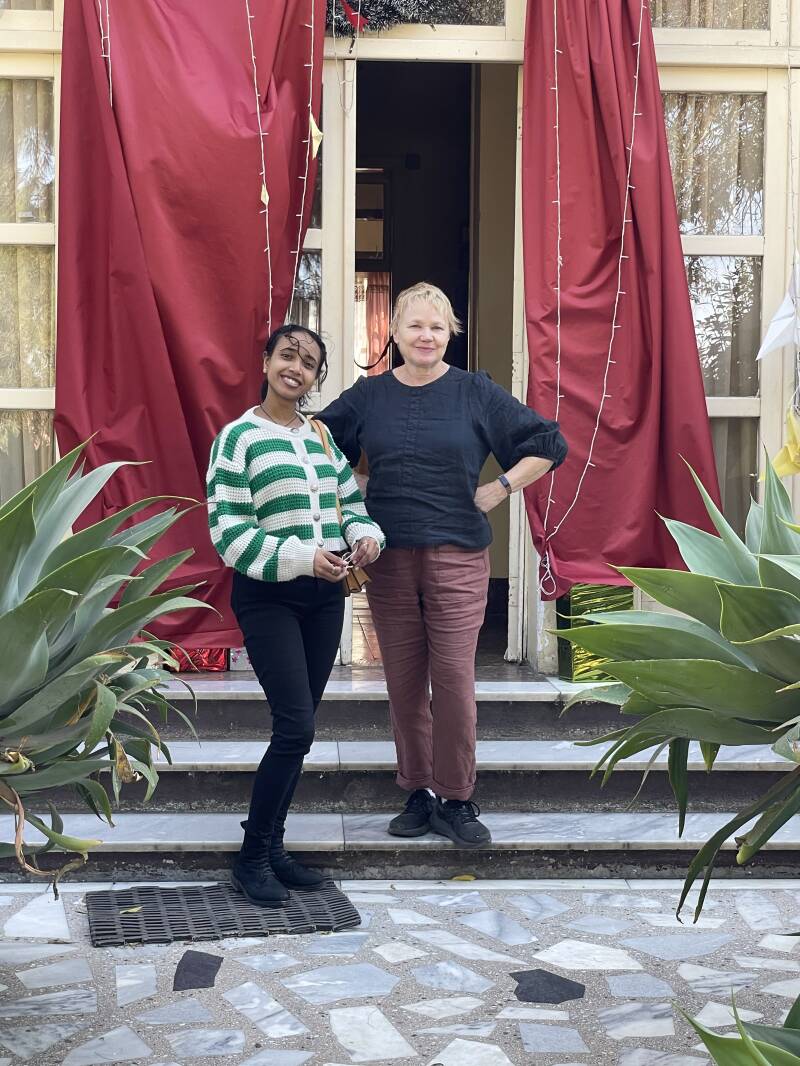
The Entrance to Africa Pension.
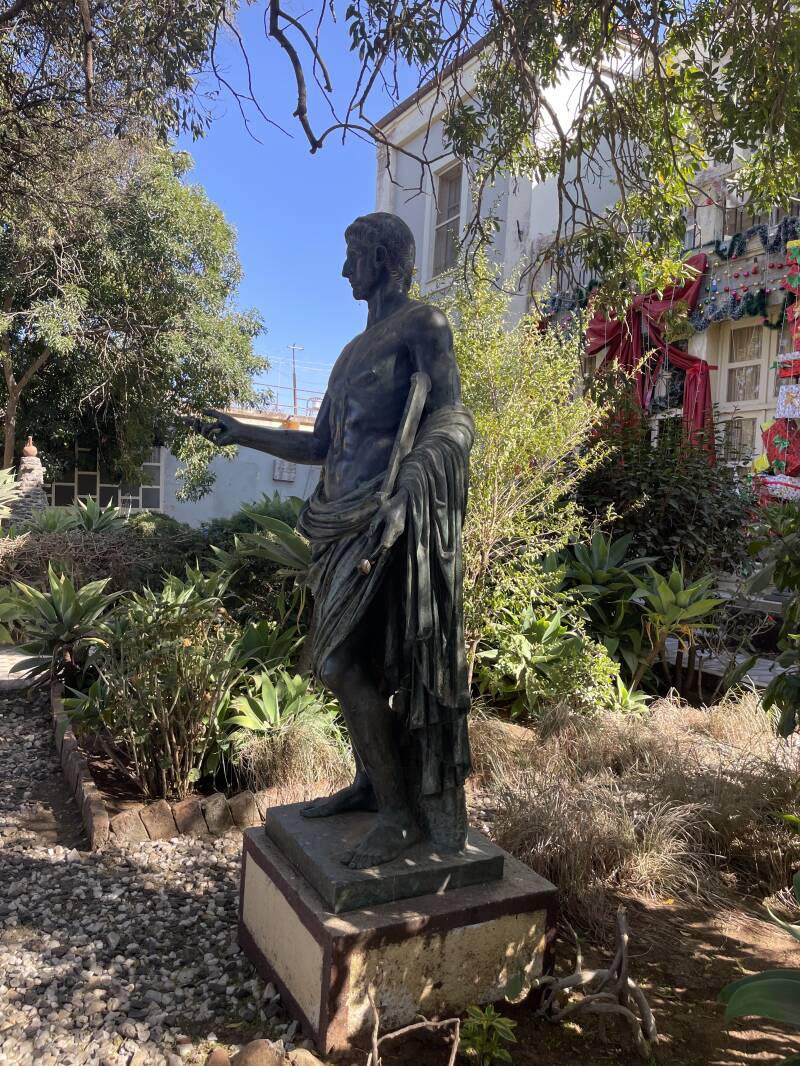
Augustus Caesar in the garden of Africa Pension.
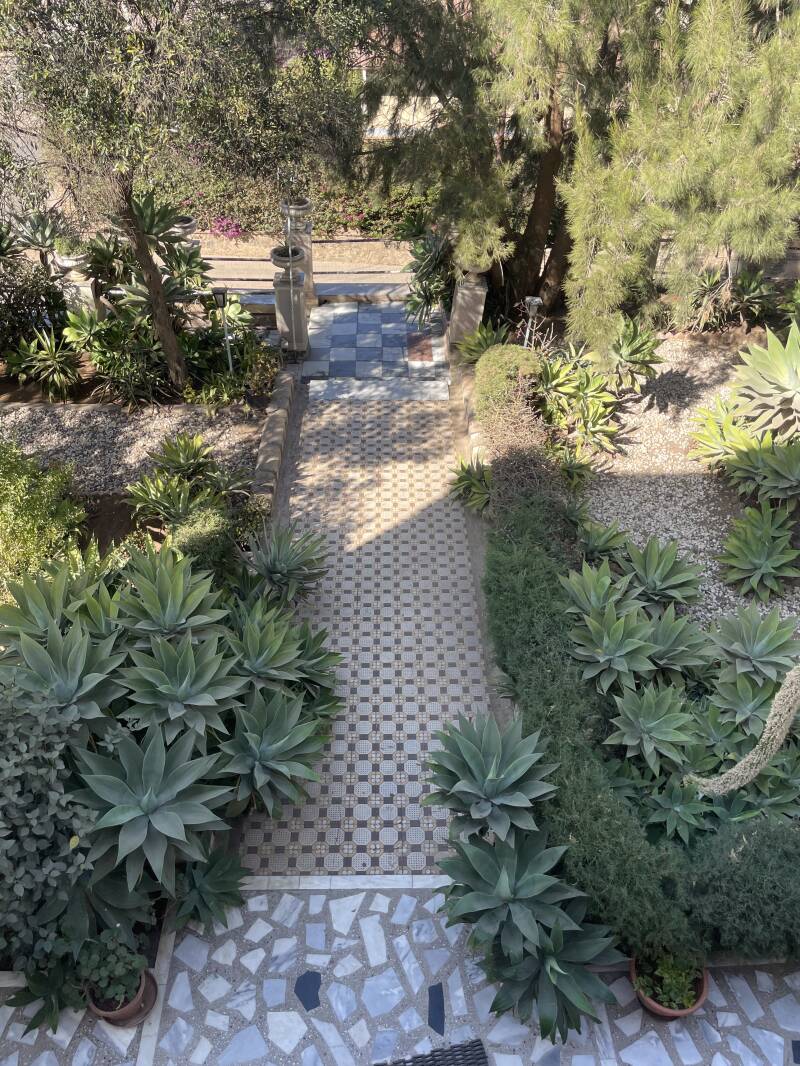
Gorgeous crazy paving and tiles, viewed from a balcony above.
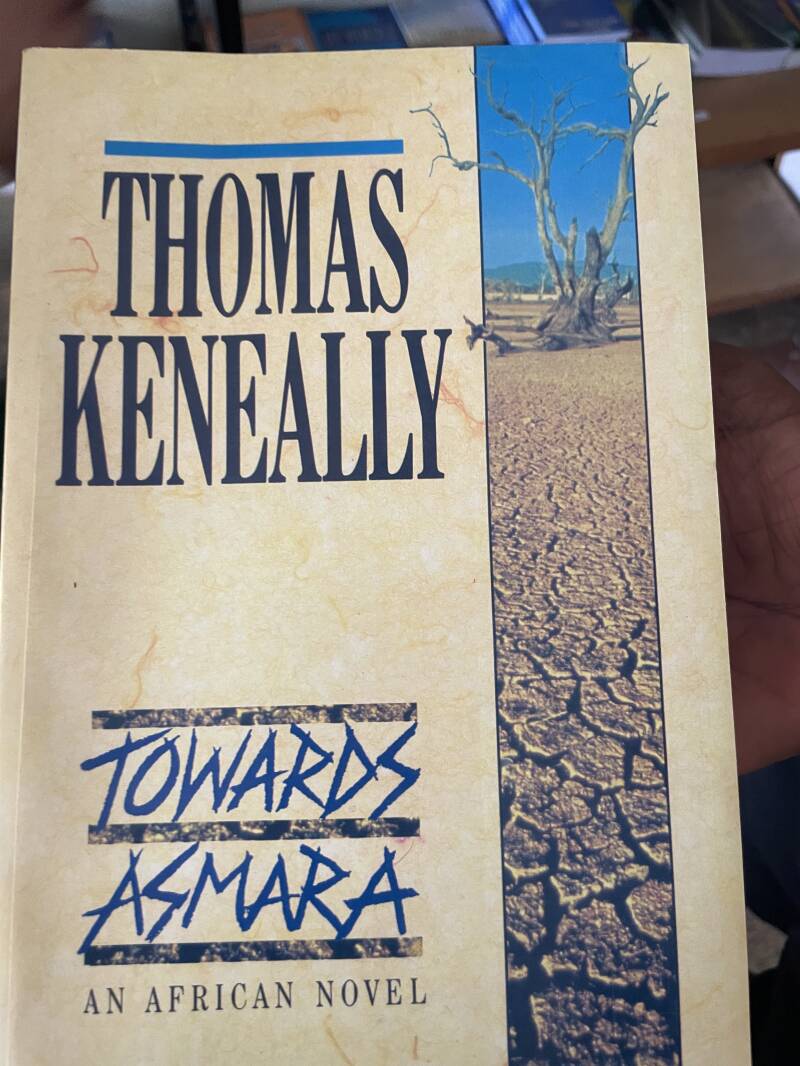
Through my discussions with my guide Simon and others, I had discovered that many Eritreans are very well read, and well educated. Education is free, which meant that most people I met had degrees, and of course, there's not much else to do with limited internet and screens. So whilst it wasn't entirely surprising that the next stop was a book shop, I was surprised at how many books were published in and about Eritrea history, politics, memoirs, and fiction. Even Australian author Thomas Keneally has written about the country; his novel Towards Asmara sat quietly among the collection. In a place often described as isolated, the literary output felt quietly defiant.
That evening, I dined with Simon, Millionaire (his cousin and, without question, the superior driver), and Philemon. Here, I learned the art of eating injera, the teff-based flatbread used to scoop up lentils, vegetables, and sauces with the right hand. Teff is a tiny, ancient gluten-free grain originating from Ethiopia and Eritrea, often recognized as the world's smallest cereal grain (roughly the size of a poppy seed). Known for its high protein, fiber, and iron content, it is a staple crop with an earthy, nutty flavor. Teff is versatile, used in flour for injera bread, but also in porridge, or as a porridge-like porridge, and it comes in white to red-brown varieties.Simon and Milllionaire seemed surprised that I enjoyed it and managed using my hand deftly to eat it. The tart taste suited my taste buds and I enjoyed being able to eat vegetables again.
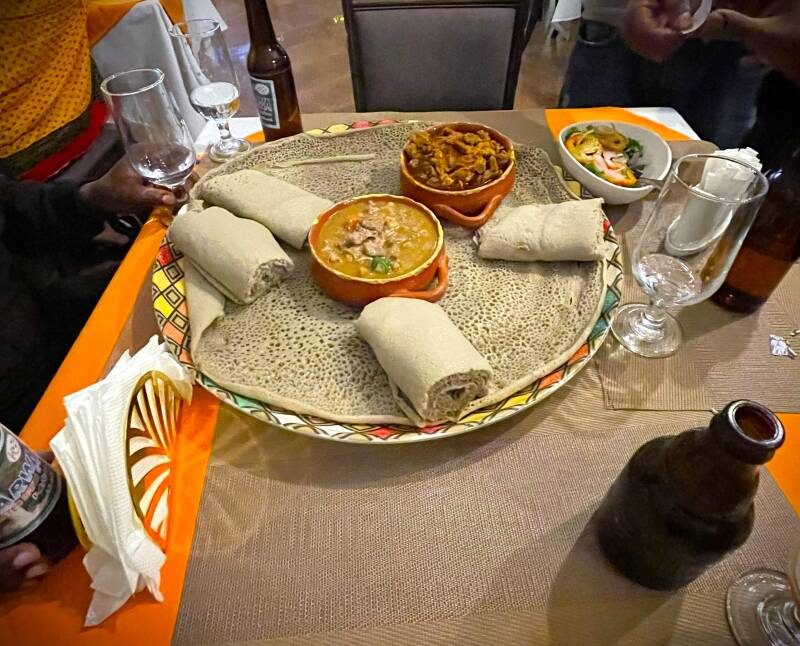
Our Ingera food about to be shared.
Asmara, for all its architectural beauty, is not frozen in time. It is lived in, negotiated daily, and shaped by necessity. Its charm lies not just in its buildings, but in how people continue to gather, create, read, drink coffee, and make meaning together.
29–30 February – Massawa and the Red Sea
We travelled from Asmara down to Massawa along a winding mountain road that roughly parallels the now-disused railway line descending to the coast. Once, steam trains carried Asmara’s residents down to the Red Sea for weekends by the water, a glamorous era still preserved in faded tourism posters hanging in old hotel corridors. The road journey today feels slower and more deliberate. Whether because of the condition of the roads or the constant need to watch for roaming animals, cyclists and pedestrians, Millionaire drove carefully at around 40 kilometres per hour; I quickly realised I was in very safe hands. Perhaps he had also been instructed to pace the trip differently, as I had allowed nine days to visit four main locations, something many tourists compress into just three or four frantic days. In truth, I was grateful for the slower pace because it allowed the journey itself to become part of the experience.
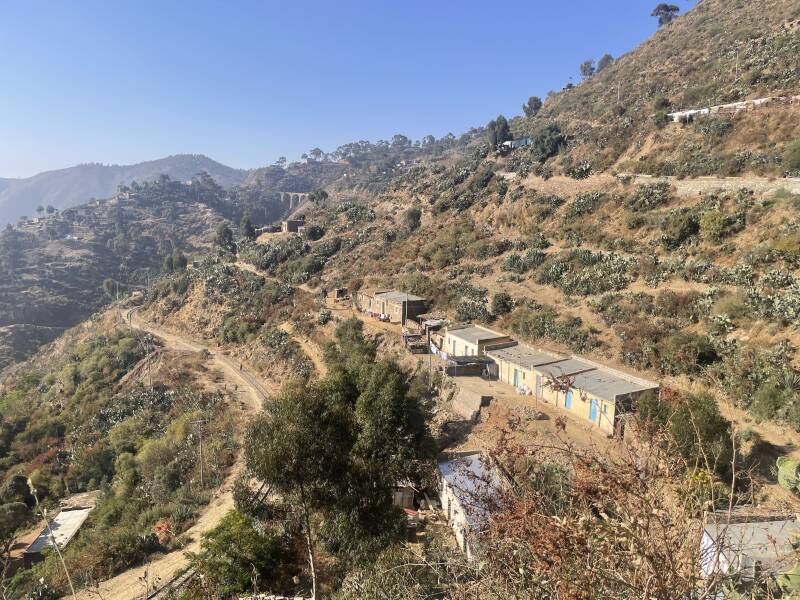
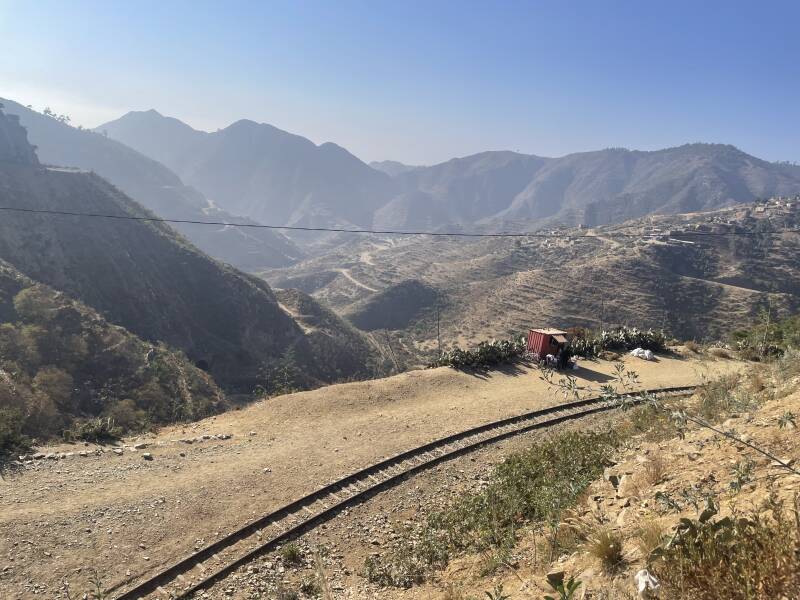
Views of the road and disused railway line between Asmara and Massawa.
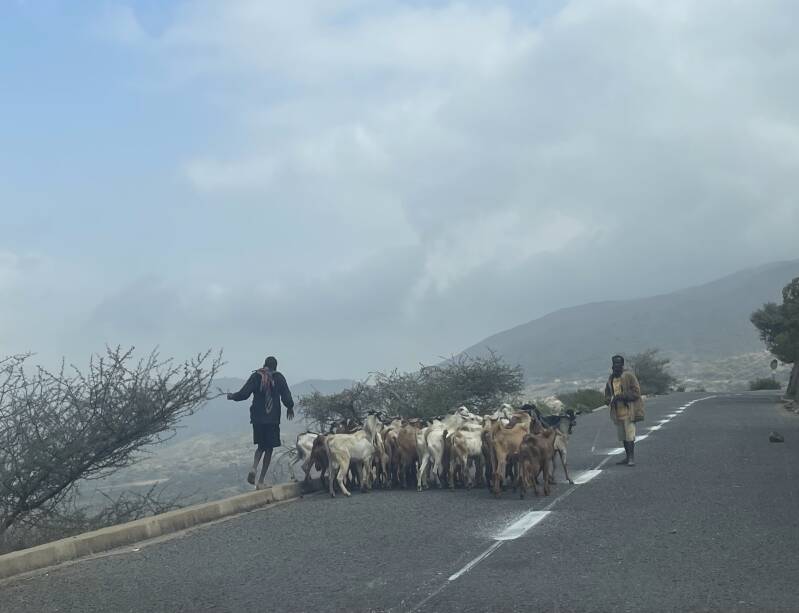
Shepherds herding goats.
At one point we unexpectedly encountered a bicycle race in progress. It felt almost surreal: competitive cyclists in bright lycra, race numbers pinned neatly to their backs, pedalling furiously along a narrow road shared with cars, trucks, goats, camels and the occasional donkey cart. By any normal standard it looked chaotic, even dangerous, yet somehow Eritrea made it work. The contrast was striking and oddly poetic; modern sport unfolding against a backdrop of timeless rural life. It became just another layer of a journey that already felt unlike anywhere else I had travelled.
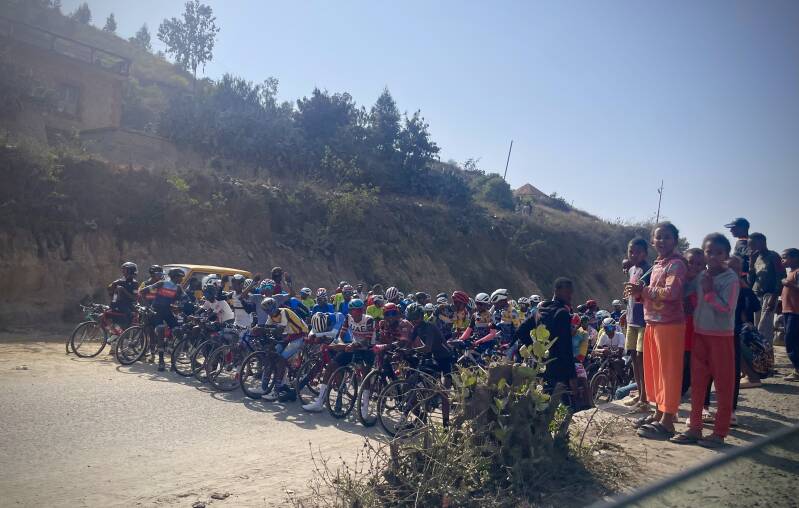
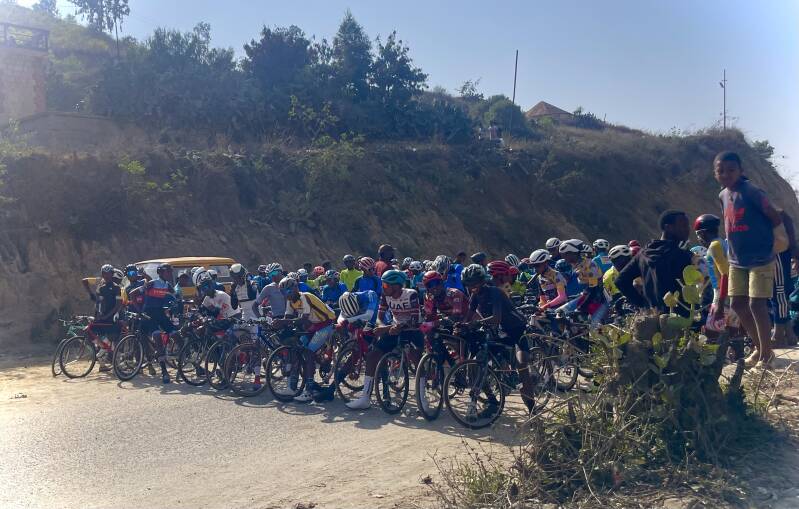
Enthusiastic cyclists and curious children on the road to Massawa.
Upon arrival in Massawa, St Mariam Cathedral immediately stood out as one of the city’s focal points. Built in 1953 during the period of Ethiopian federation and administration following the end of Italian colonial rule, the cathedral reflects one of the many layers of Eritrea’s complicated twentieth-century history. Italian, Ottoman, British and Ethiopian influences all overlap in Massawa, and somehow the cathedral seemed to embody the historical transition between empire, federation and eventual independence.
Massawa itself felt divided into two distinct worlds linked by a bridge stretching across the water: the weathered old city with its Ottoman and Italian architecture on one side, and the newer mainland districts on the other. The cathedral sat within this crossroads of histories, its exterior decorated with a large colourful mural that gave the building a warm and welcoming atmosphere.
When we arrived in Massawa, it quickly became clear that the city was still carrying the afterglow of recent Fenkil celebrations. St Mariam Cathedral stood near the centre of this atmosphere, facing one of the city’s most important memorials: the Three Tanks Monument, also known as the Fenkil Monument. Built around three Soviet-made T-55 tanks captured from Ethiopian forces during Operation Fenkil in February 1990, the memorial commemorates the battle that ultimately secured Massawa’s liberation and accelerated Eritrea’s final independence the following year.
Located near the entrance to the old town on Taulud Island, the monument sits in what is now known as War Memory Square. The tanks themselves, named 'Commander', 'Tiger' and 'Jaguar', are mounted dramatically on a polished black platform directly opposite the cathedral. I later learnt that during commemorative events the tanks sometimes spew water from their barrels, a symbolic gesture transforming instruments of war into symbols of life, peace and freedom. Members of the nearby church community reportedly help maintain the site, carefully cleaning the monument each morning in memory of those who died during the long struggle for independence.
Understanding this history afterwards helped explain the atmosphere we encountered throughout the city. The festival I had just missed was not simply a local celebration but part of the annual Fenkil commemorations held each February to mark the 59-hour battle in which the Eritrean People’s Liberation Front overcame vastly superior Ethiopian weaponry to capture Massawa. Even days later, the city still felt animated by remembrance and pride. Later that evening, as neon lights illuminated the bridge linking the mainland to the old town, crowds of people wandered slowly back and forth along the waterfront in the warm night air. Families, couples and groups of friends gathered as though the celebrations had not quite ended. I never fully worked out whether this nightly promenade was a continuation of the Fenkil atmosphere or simply ordinary life in Massawa, but either way the city possessed an energy that felt deeply communal, historical and unexpectedly alive.


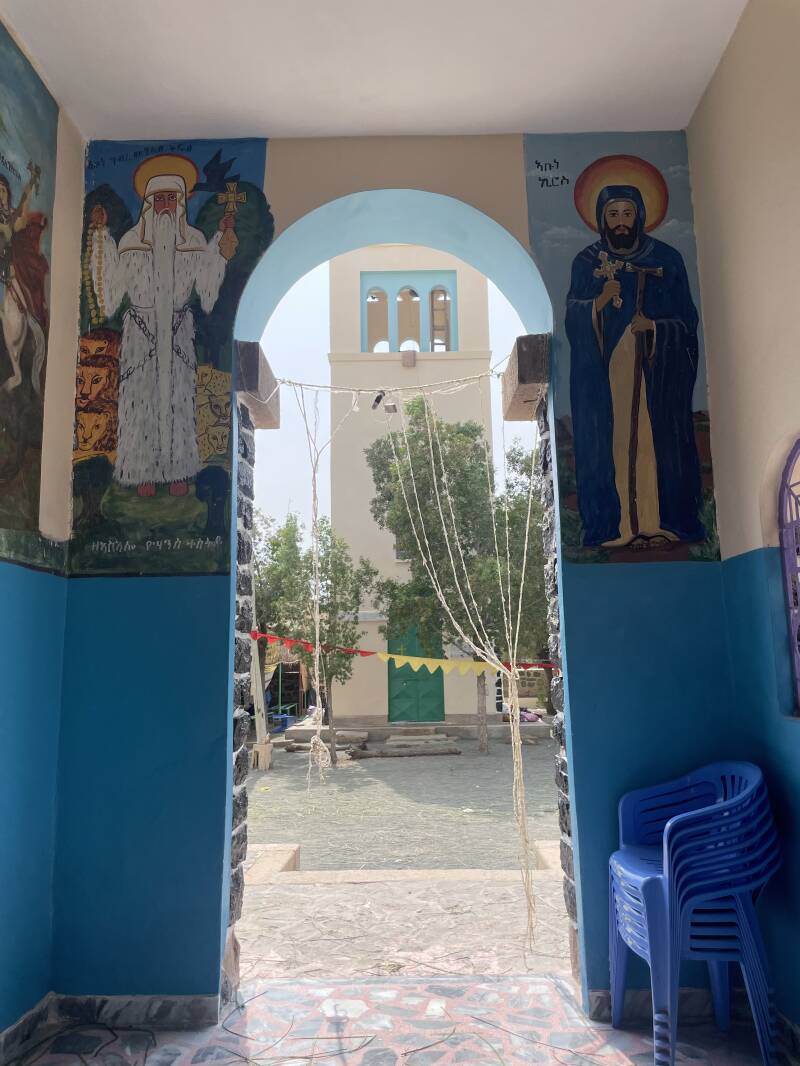
Views of St Mariam Cathedral, Massawa after the Fenkil commemorations.
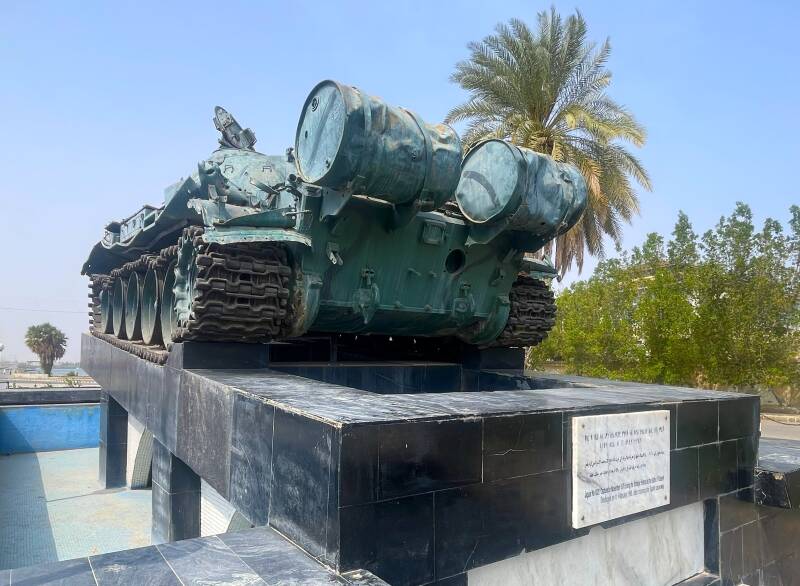
Three Tanks Monument or Fenkil Monument, Massawa.
On the afternoon we arrived in Massawa, we walked across the causeway into Massawa Old Town, despite having read beforehand that there was supposedly “nothing to see” because much of the area consisted of ruins. For us, that was precisely the attraction. The old quarter retained a striking atmosphere, its crumbling facades revealing layers of Ottoman, Egyptian and Italian history accumulated over centuries when Massawa served as one of the Red Sea’s major trading ports. As we wandered through the streets, we passed the remains of former banks, merchant buildings and grand residences, including structures that had once been palaces and administrative buildings from different eras of rule. Near the waterfront stood a remarkable building whose arched frontage reminded us strangely of a miniature Roman colosseum, weathered and partially damaged yet still carrying a sense of faded grandeur.
What stood out most was that the old town was still inhabited and in use. People continued to live and work among the ruins, and small shops operated from buildings that appeared barely intact. Scattered throughout the decaying architecture were also informal bars and restaurants where locals gathered in the evening air beside the sea. The contrast between ruin and everyday activity gave the area a distinctive character, neither preserved nor abandoned.
Massawa’s strategic deep-water harbour once connected Africa, the Middle East and beyond, and successive powers, including the Ottomans, Egyptians and Italians, all left their mark on the city. Fragments of this history remain everywhere: Ottoman fortifications, arcaded streets, faded Italian balconies and mosques dating back centuries. Yet decades of conflict during Eritrea’s long struggle for independence profoundly scarred the city, leaving many buildings partially destroyed and slowly collapsing under the Red Sea heat and salt air. Rather than diminishing the experience, though, the ruins made the old town feel unforgettable in its layered history and ongoing everyday life.
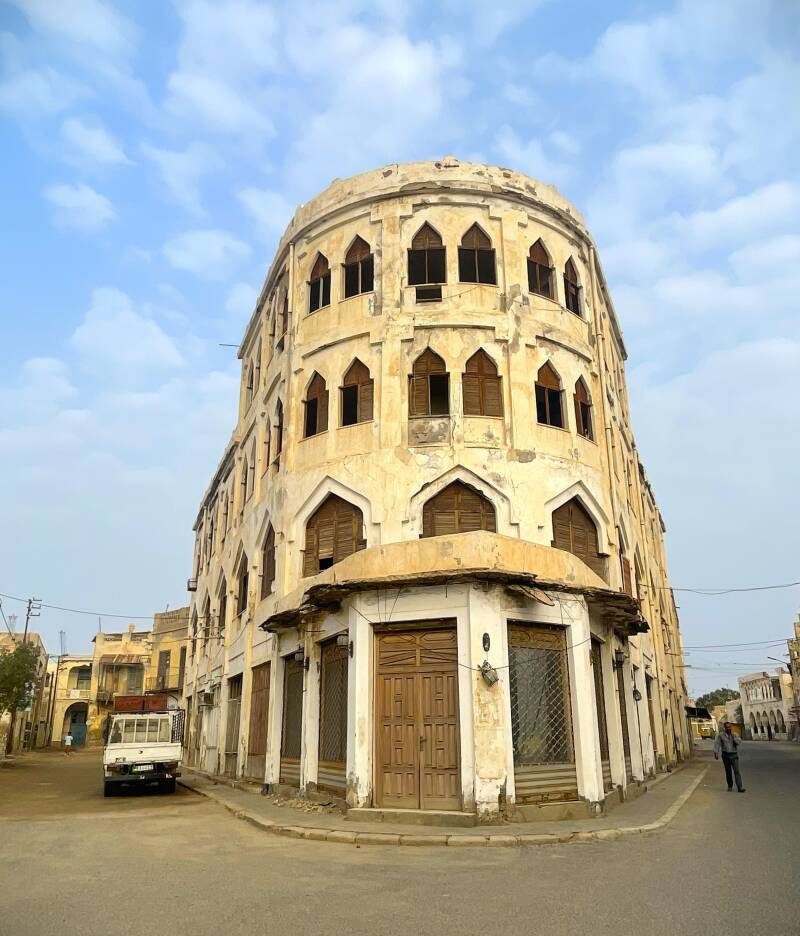
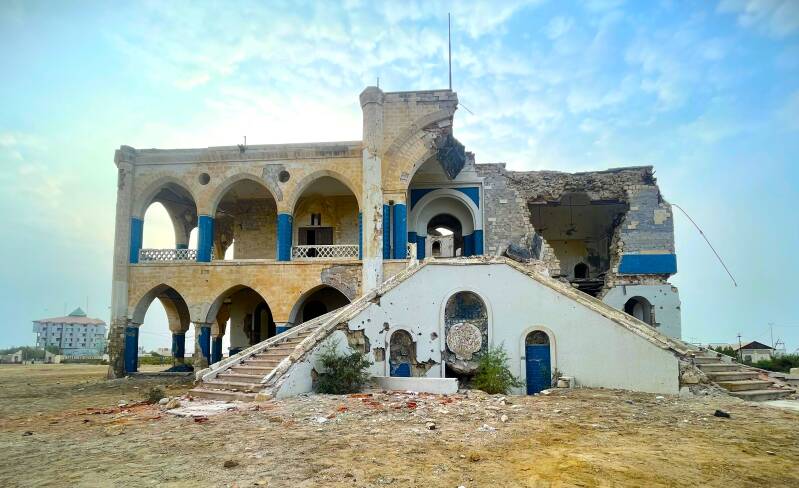
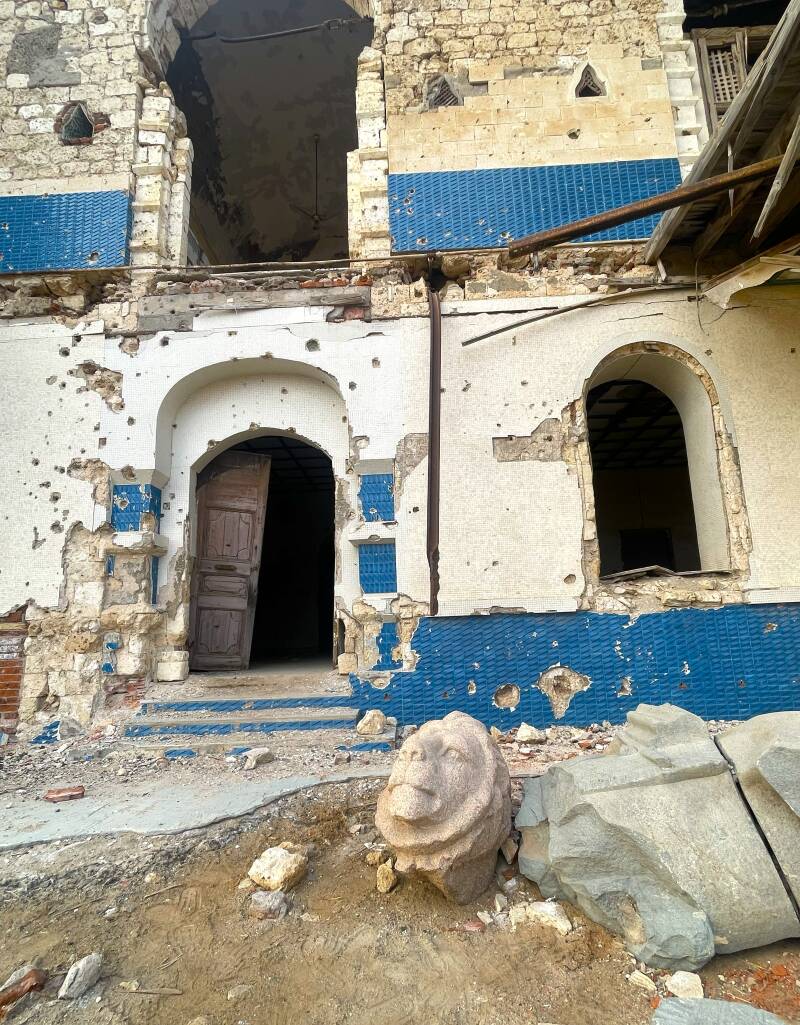
The former Imperial Palace in Massawa, Eritrea, often referred to as Haile Selassie's winter palace, is currently a heavily damaged, unrestored ruin located on the coastline, largely abandoned since the 1990 war of independence. Originally built in 1872, the site once featured prominent stone lions guarding the ruins of its once-impressive, multi-level structure.
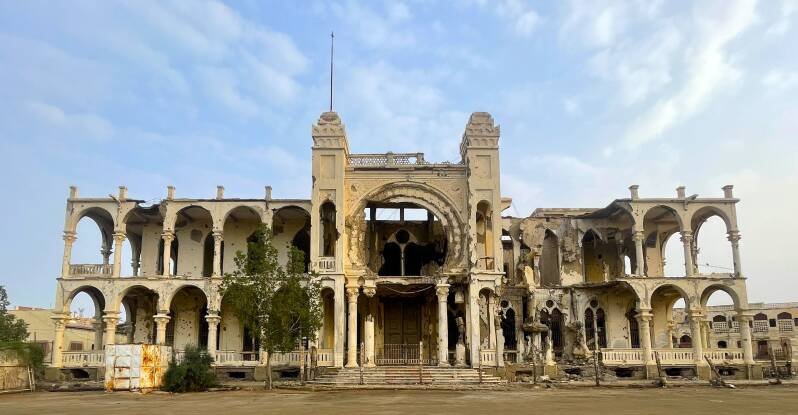
The ruins of the Banca d'Italia (Bank of Italy), built in the 1920s.
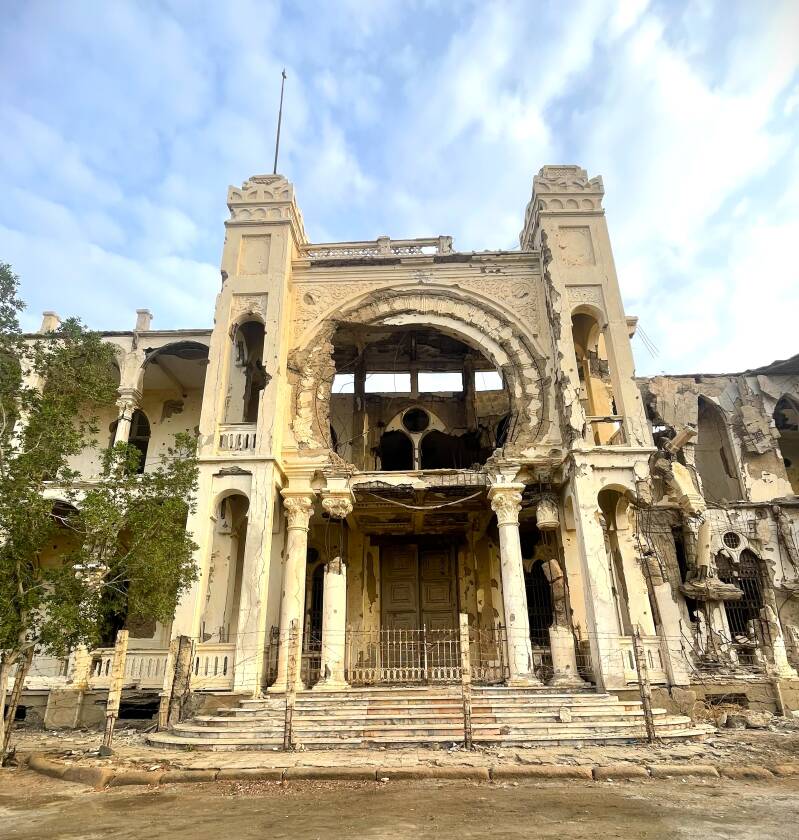

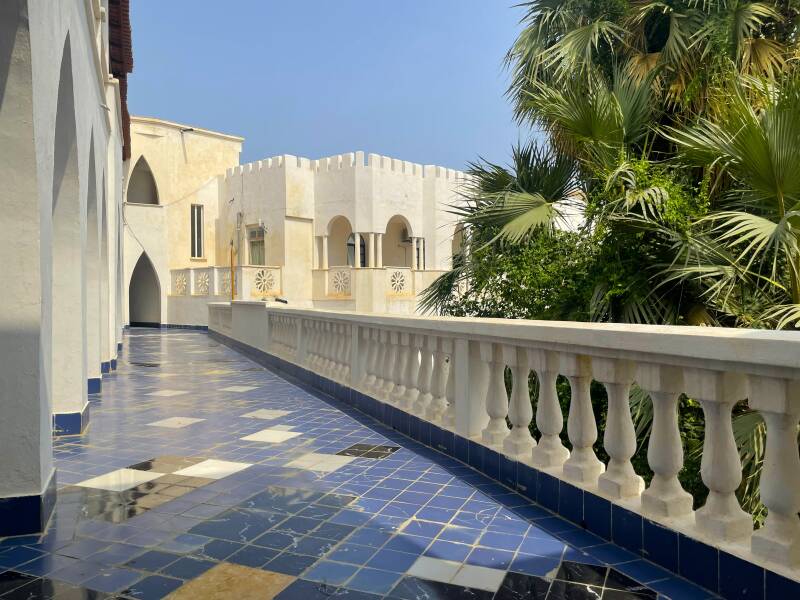
The grand balconies of the Grand Hotel Dahlak.

The carpark and entrance of the Grand Hotel Dahlak.
I stayed at the Dahlak Hotel, an old grand waterfront hotel in Massawa that feels like it belongs to another era. Positioned between the seafront and the area where Haile Selassie’s former palace once stood, it occupies one of the most atmospheric locations in the city, with sweeping balconies looking out over both the Red Sea and the edge of the old town.
Architecturally, the hotel is striking, with Arabic, Turkish and Venetian influences that mirrors the layered history of Massawa itself. From the outside, it still carries a sense of faded grandeur, once clearly intended as a gateway for travellers heading to the Dahlak Archipelago.
Inside, however, time has clearly taken its toll. The building shows signs of long neglect following Eritrea’s extended period of conflict with Ethiopia. Wi-Fi was technically available via a code, but in practice it barely worked, reinforcing the sense of being slightly disconnected from the outside world.
At the entrance were faded but charming tourism posters on the walls, showing Massawa and the hotel in its heyday, a reminder that this coastline was once promoted as a holiday destination, especially in the era when the railway linked the highlands to the sea. Despite its lingering grandeur, the reality of the stay was much more basic, with no hot water in the shower, reinforcing the sense of a place caught between its past ambitions and present limitations. The name “Dahlak” is derived from an Arabic phrase meaning “gates of hell”, a description that feels more like a misnomer than reality, given the hotel’s faded charm and sweeping coastal setting.
The following night, in need of some exercise, I asked Simon if we could walk across the bridge instead. The decorative lights had disappeared, but the atmosphere remained, soft, communal, and quietly joyful. Walking across the bridge, we met up again with Christopher Kugler-Niklas, a German traveller we had first encountered in Asmara. Christopher has published a book about his trek along Spain’s Camino de Santiago and was staying in one of Massawa’s wonderfully atmospheric old hotels, which we later visited. He had needed transport from Asmara, and Simon had instantly provided the name of a reliable taxi driver. Problem solved. This happened repeatedly. Simon seemed to know everyone. We dined together that evening, exchanging travel stories as the city settled into the warm coastal night.
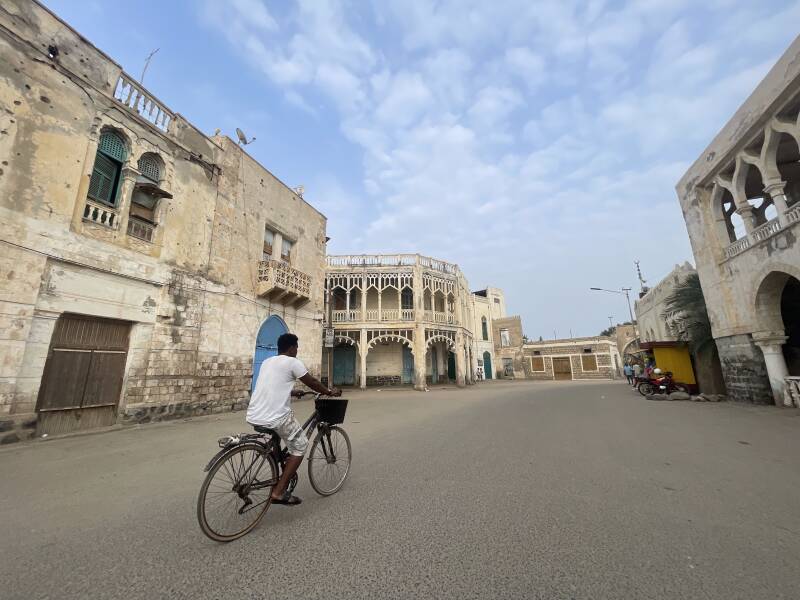
Bikes are the most common form of transportation in Massawa.
On the 30th January, we took a boat to one of the Dahlak Islands, snorkelling in warm, clear water. Lunch was simple, but perfect: freshly cooked fish, white bread rolls, and bananas. On the return journey, the Italian family I travelled with (the mother was working for the United Nations) requested an extra snorkelling stop, thankfully. It turned out to be the highlight of the day, with far richer marine life than earlier sites.
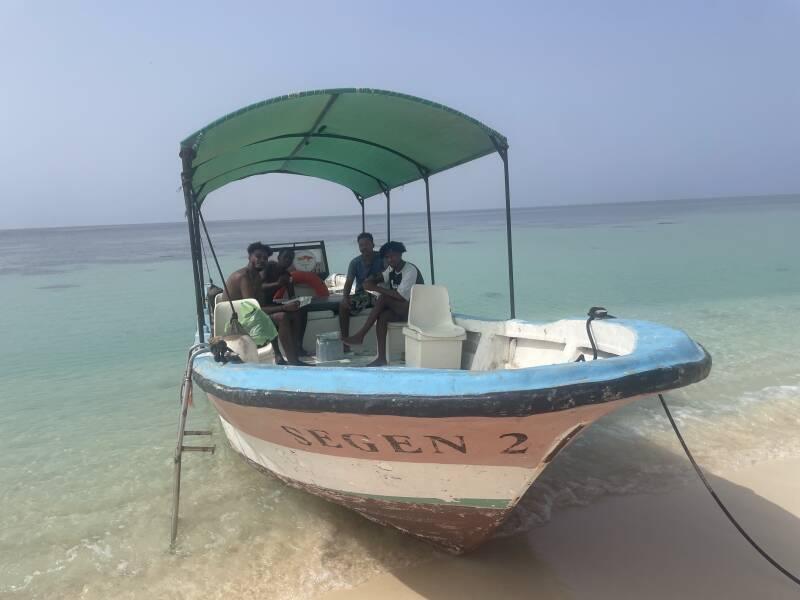
The boat and our drivers.
31 January – Back to Asmara
On our return to Asmara, we ended up at a wedding almost by chance. Simon mentioned there might be a celebration happening that Saturday, and sure enough there was. We weren’t formally invited, and I’m still not entirely sure he knew the bride and groom, but we followed the sound of loud music and found ourselves at the event. Along the way, Simon ran into two friends, both female lawyers, who were actually invited guests and clearly knew people there. They were impeccably dressed, although not in the traditional white Habesha Kemis worn by many of the other women, which made my own casual clothing feel even more out of place by comparison.
Eritrean wedding customs are typically multi-day, community-focused celebrations, with the Melsi (second-day party) often forming a key highlight. Guests traditionally wear white cotton Habesha Kemis for women and tailored suits or embroidered shirts for men, though modern attire is also common, with a preference for modest, semi-formal dress.
Once inside, however, none of this seemed to matter. The music was loud, the atmosphere lively, and there was plenty of injera being shared and passed around among guests. Any initial embarrassment I felt about being underdressed quickly disappeared. No one seemed concerned with what I was wearing, and instead there was an immediate sense of inclusion. Before long I found myself being drawn onto the dance floor repeatedly, as though participation mattered far more than presentation.
I couldn’t help but wonder: could this happen in Australia? A scruffy stranger welcomed so completely, without suspicion or hesitation?
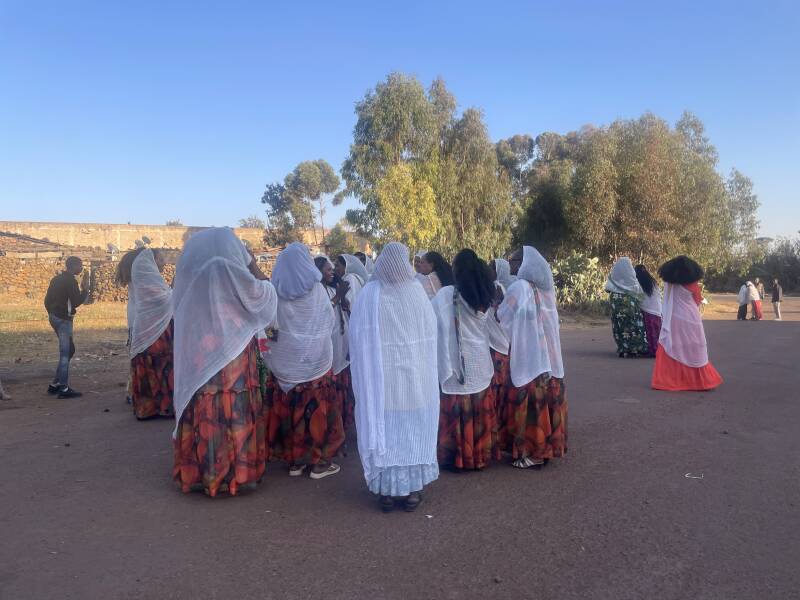
Women singing and dancing outside the wedding 'marquee'.
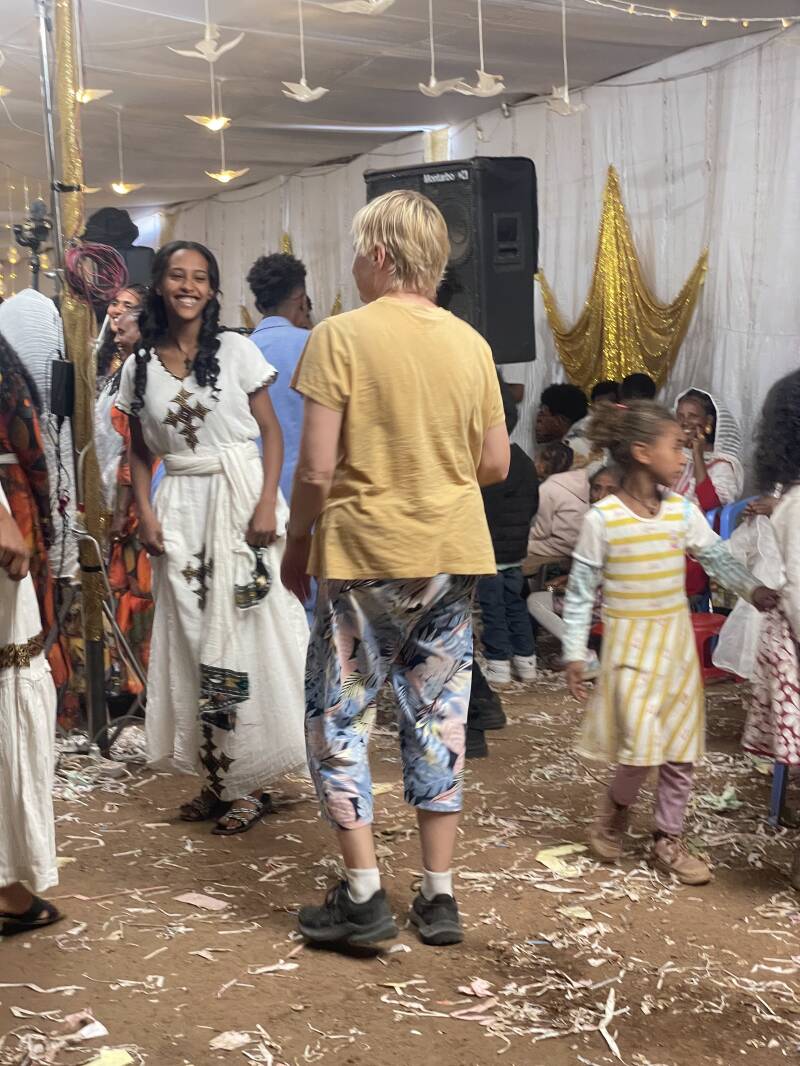
Being welcomed onto the dance floor.
The following morning, being a Sunday was all about Baptisms in Asmara (and a few more weddings), and we once again gate crashed events and found ourselves welcomed in.

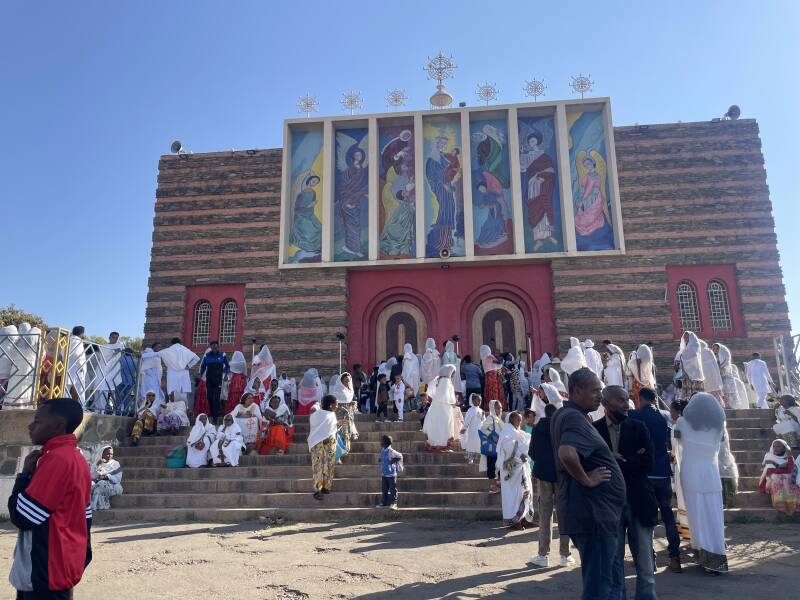
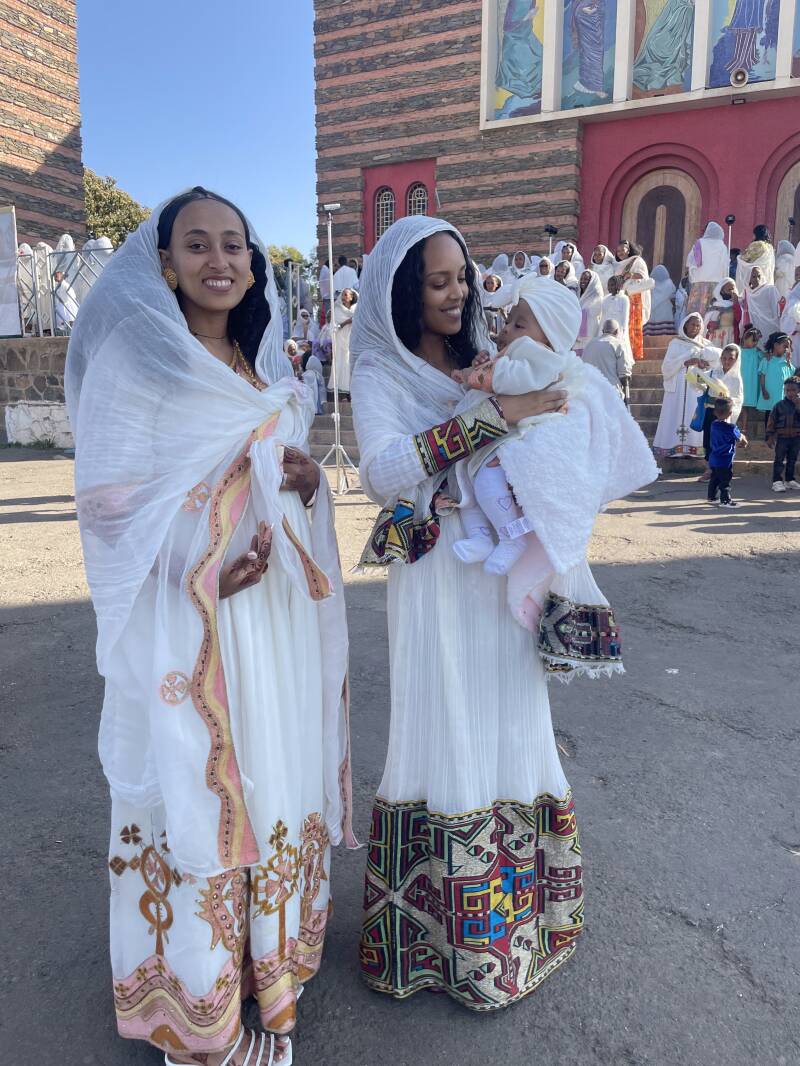
Family gatherings for Baptisms at Enda Mariam Orthodox Cathedral.
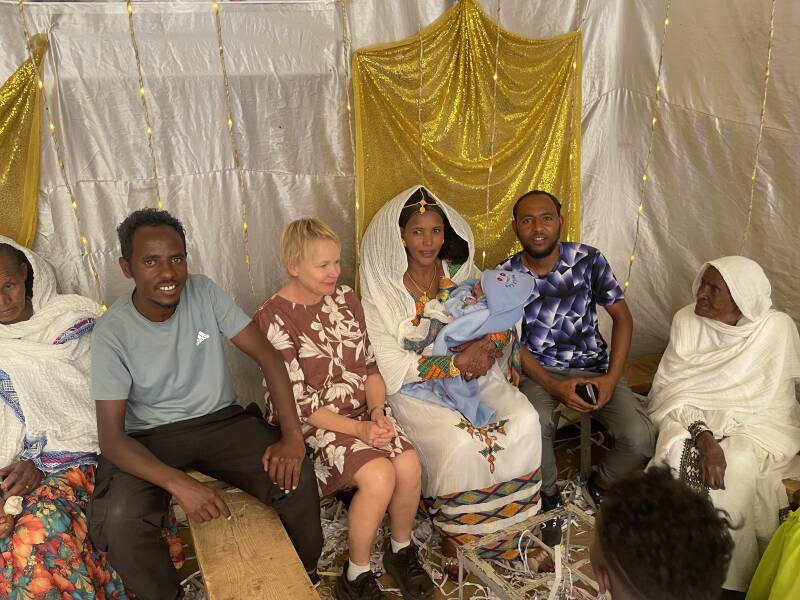
Inside a makeshift tent for a Baptism family gathering.
1–2 February – Keren
The road to Keren introduced me to a new driving rhythm. Goats, camels, and Brahman cattle roam freely, which explained Millionaire’s steady speed of 40 km/h. Sensible, if occasionally frustrating, especially when the “air conditioning” consisted entirely of open windows.

We stopped at a village with traditional thatched roofs and were invited in for coffee which involved heating the coffee and grinding it prior to making it in a pot.

One morning, we visited Keren’s camel market, a fascinating and deeply practical place. A single camel can sell for around USD $1,000, more than many people in Keren would earn in an entire year. The animals stood patiently amid dust and negotiation, their value obvious to everyone present.
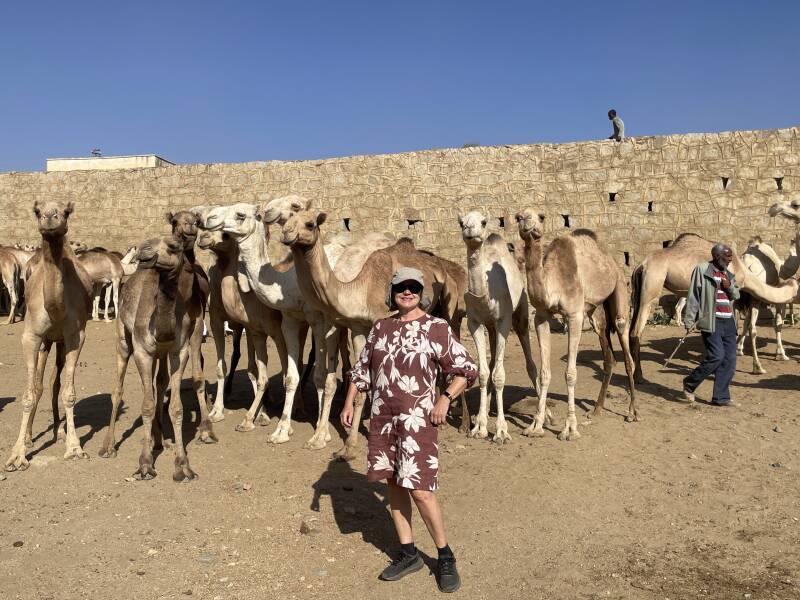
Smiling along with the camels at the camel market.
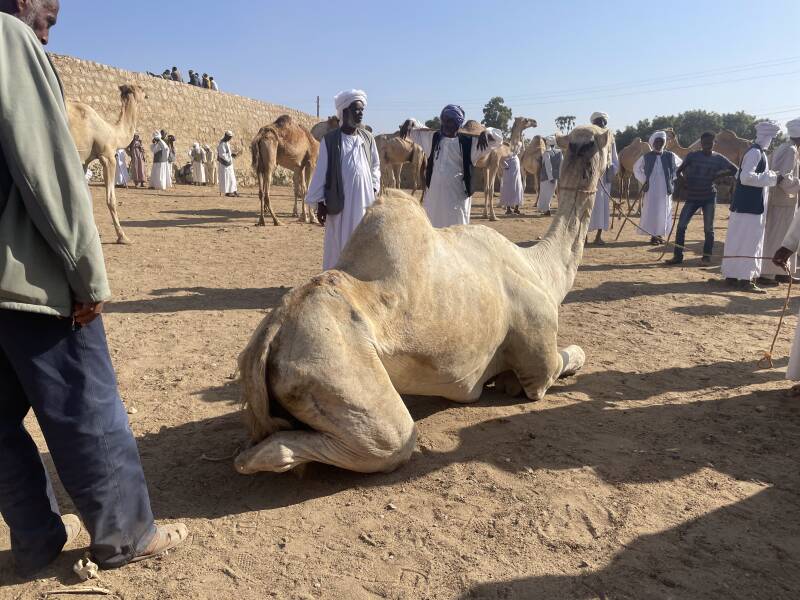
Camels, showing off their abilities.
Keren felt markedly different from the capital. It is home to several ethnic groups, including the Tigre, often seen wearing white robes and carrying sticks. Over our time there, we visited churches and mosques (from the outside), and navigated streets shared equally by donkeys, bicycles, children, and pedestrians. Movement here is slow and communal; driving fast would feel almost disrespectful.
One of the highlights was climbing the spiral staircase at Hotel Keren, which led to the best views over the city, especially at sunset. Once you descend, you end up in the bar, making it the perfect place for a local beer. Out the front, an original and wonderfully faded Drink Fanta Orange sign hangs like a relic from another era.
By evening, the bar had become a gathering point: Italian tourists, diplomats, the American and Russian travellers, and our various guides, all converging as if by unspoken agreement.
On our second night, two teenage boys, possibly brothers, approached me shyly and asked if they could take a selfie with me. I happily obliged, and it gave me the chance to take one with them as well. I usually ask permission before taking photographs, and this felt like a small moment of mutual curiosity. I wondered what they made of my appearance; Westerners, especially with blonde hair, must seem like an oddity here. Whatever they thought, the interaction was warm, respectful, and memorable.
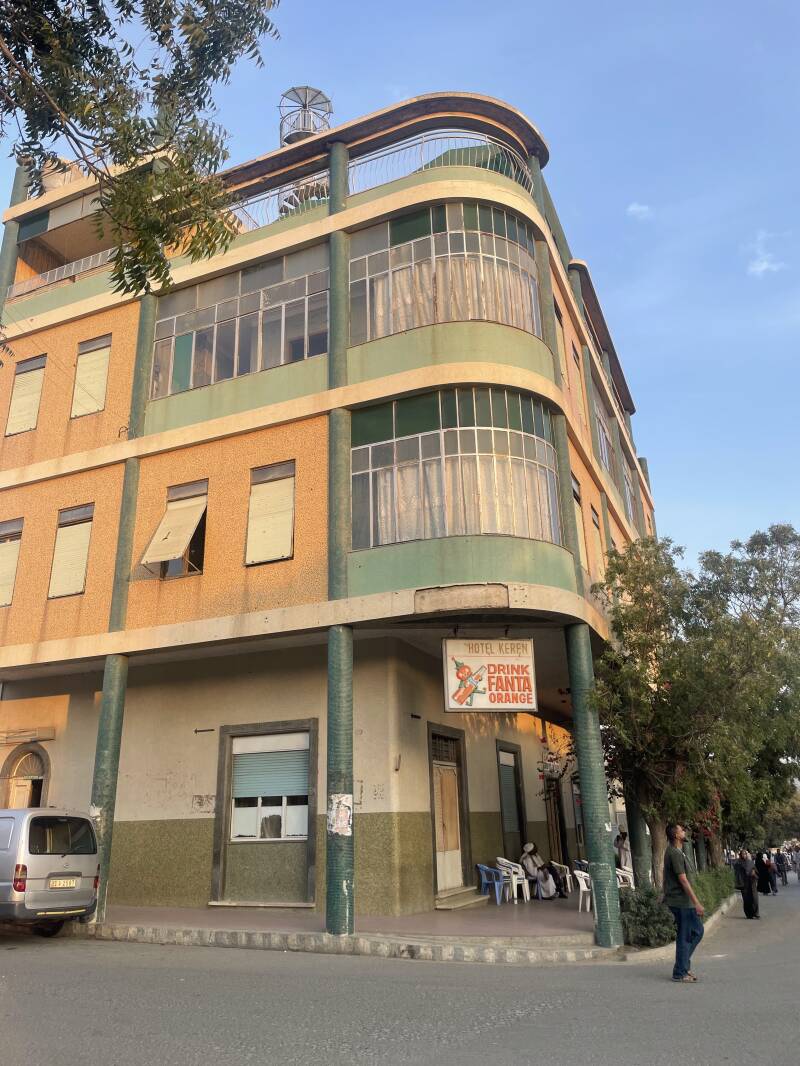
The inauspicious entrance to Hotel Keren with a retro 'Drink Fanta Orange' sign. Note the spiral staircase on the roof.
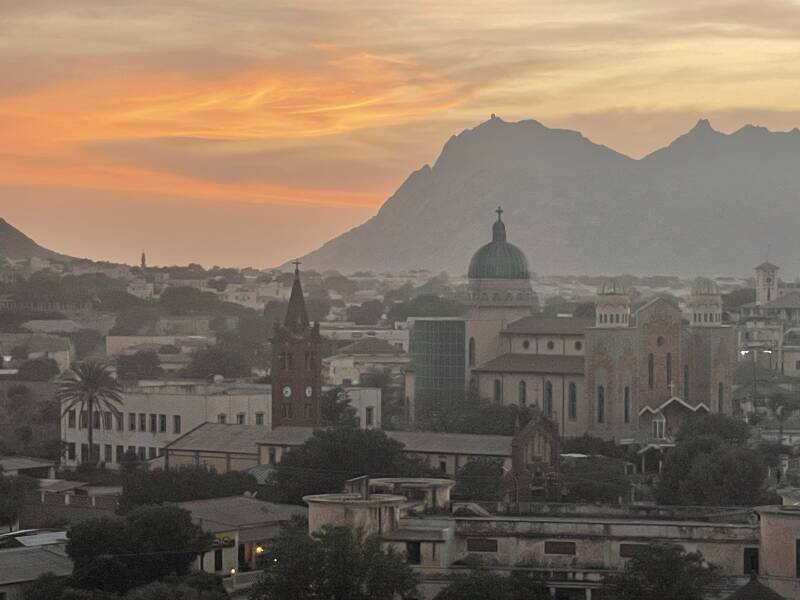
Sunset view from the rooftop of Hotel Keren.
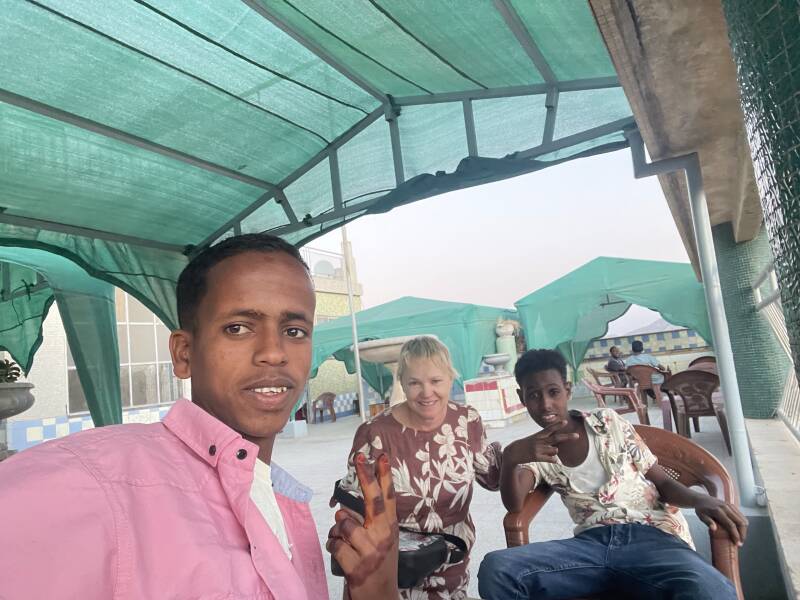
Obliging models who wanted a selfie with me on the rooftop of Hotel Keren.
On our return from Keren, Simon took me to the Tank Graveyard on the outskirts of Asmara, an iconic and slightly surreal site that requires a permit to visit. Rows of rusting military vehicles sit scattered across the desert landscape, remnants of the long war of independence that shaped modern Eritrea. There is little formal interpretation on site, which gives it an oddly quiet, almost suspended feeling, more open-air relic than curated memorial. The silence and scale of the place do most of the storytelling, with the tanks themselves left to slowly decay under the harsh sun.
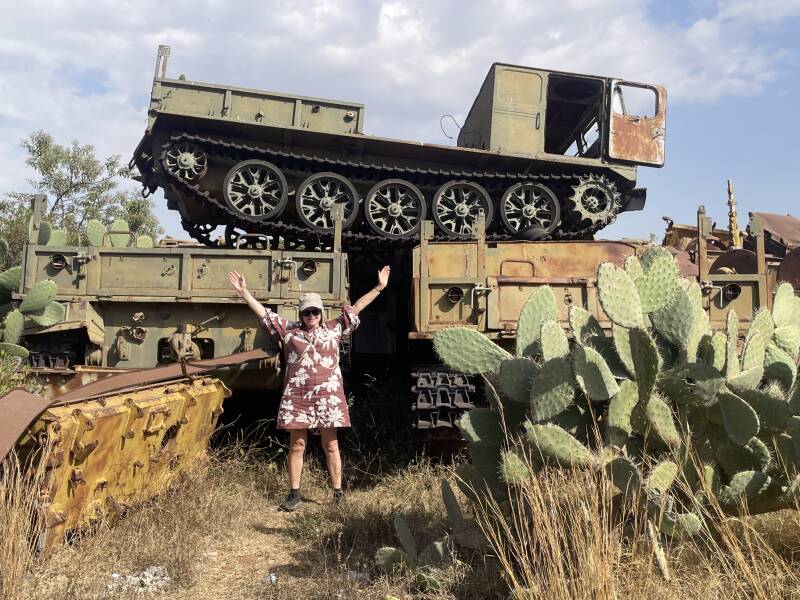
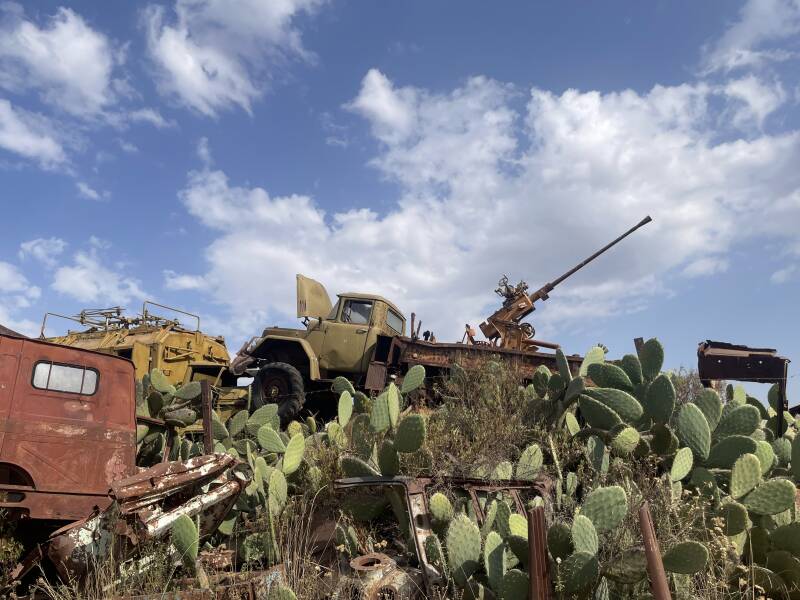
The Tank Graveyard in Asmara.
3–5 February – Adi-Keyh, Kohaito, and the Highlands
For the next stage of the journey, I was joined by a new guide, Mekonen—known to everyone as Moky. From Adi-Keyh, we travelled into one of Eritrea’s most archaeologically rich regions, an area scattered with ancient sites including Kohaito, Tekondae, Hishmele, Keskese, Der’a, Aba-Selama, and Mealewya.
At Kohaito, we were joined by a local guide named Ibrahim, who walked me through the ruins and along the edge of a vast canyon. According to archaeological studies, Kohaito is believed to be the ancient town of Koloe, mentioned by the Egyptian geographer Claudius Ptolemy in the 2nd century AD. Records suggest it was still flourishing in the 6th century before vanishing suddenly, much like the ancient ports of Adulis and Metera.
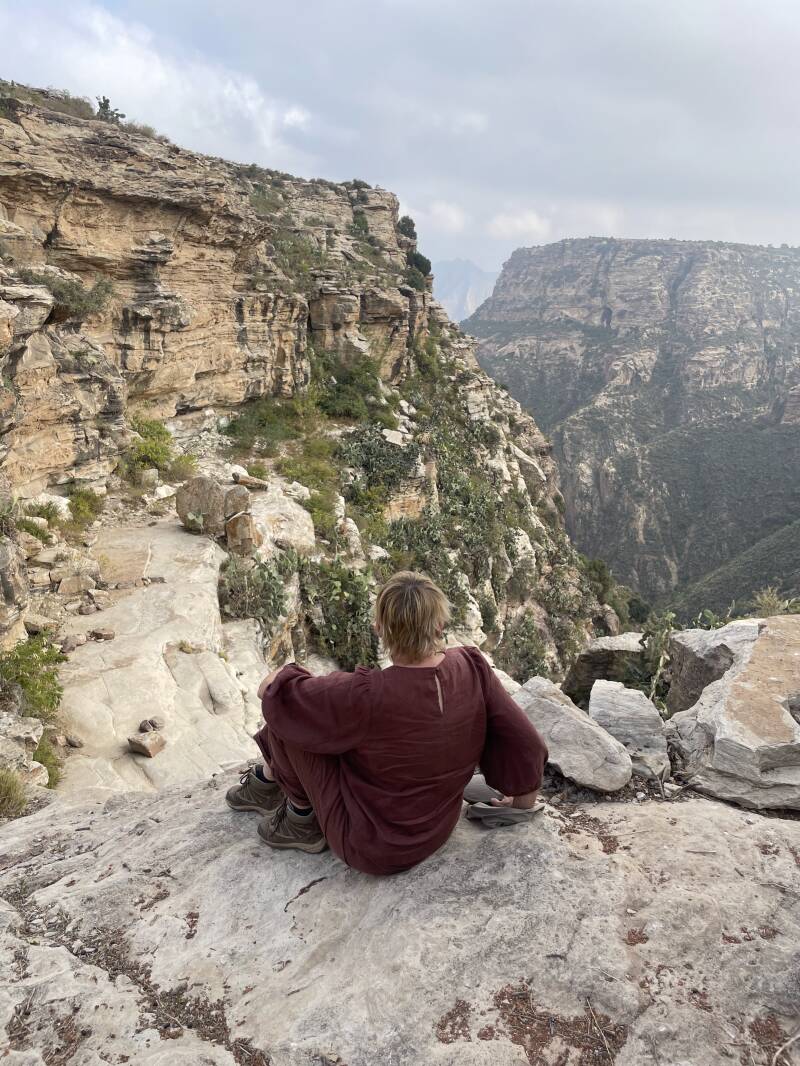
The canyon at Kohaito.
Perched at an altitude of around 2,700 metres, Kohaito may once have served as a summer retreat for wealthy merchants from nearby towns. Traces of cultivated land between the ruins suggest it was once a kind of garden city. The site is enormous, about 15 kilometres long and 2.5 kilometres wide and, as much as 80–90% of it remains unexcavated.
Walking along the canyon’s edge was both terrifying and exhilarating. The drop is sudden and dramatic, the views vast and humbling. Far below, terraced fields and a seemingly inaccessible Saho settlement clung to the landscape. The surrounding mountains stretched endlessly, with Mount Embasoira,Eritrea’s highest peak rising to the south.
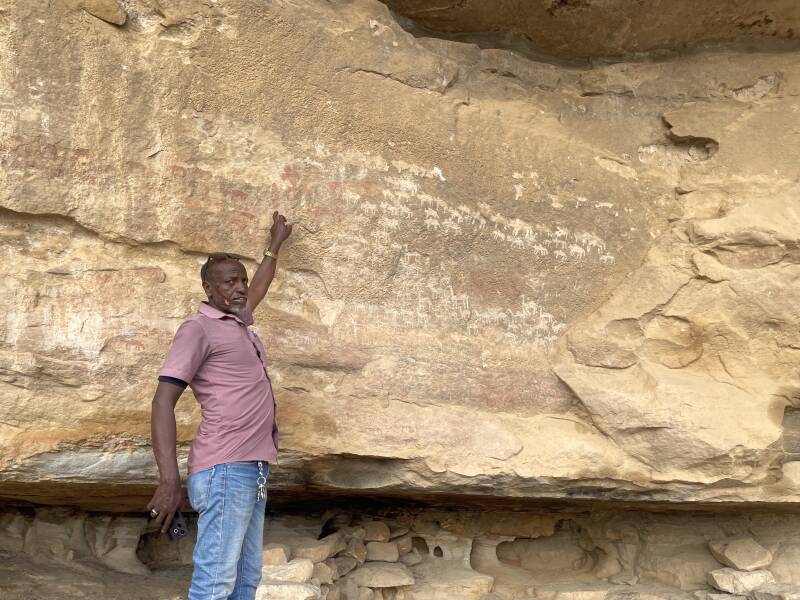
The guide, Ibrahim, pointing out the rock art.
The rock art scattered along the canyon walls immediately reminded me of the First Nations paintings I had seen in Kakadu National Park in Australia the previous September.
Among Kohaito’s most significant ruins is the Temple of Mariam Wakiro, built on a raised rectangular platform and long referred to locally as the “abode of the prestigious one.” It may have been an early Christian church, or possibly a pre-Christian temple. Nearby lies the so-called Egyptian Tomb (Meqabir Ghibtsi), discovered in 1894. Rectangular and imposing, it faces east over the Hedamo River and contains two striking flower-shaped crosses carved into its inner walls.
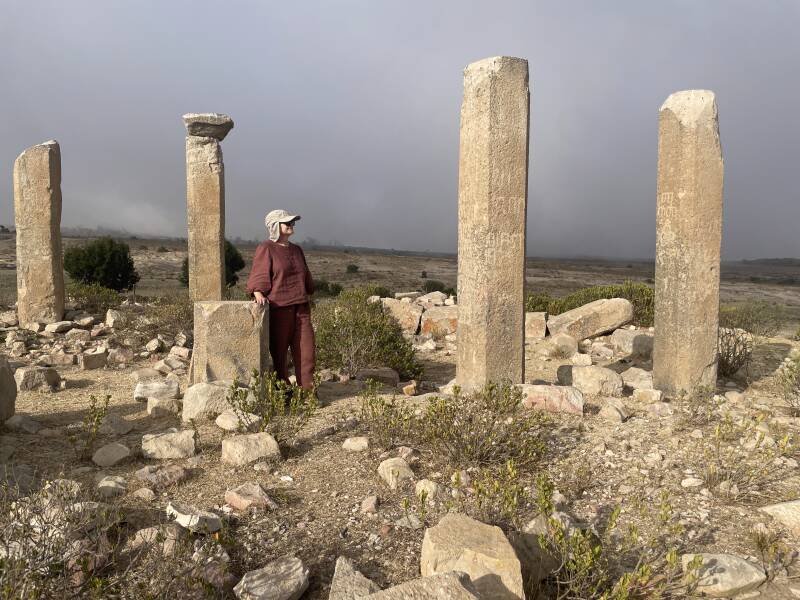
Exploring the the Temple of Mariam Wakiro.
Perhaps Kohaito’s most remarkable structure is Safira Dam, a beautifully constructed stone cistern dating back to around the 1st century AD, or possibly earlier. Built from massive rectangular stone blocks, it has supplied water to local Saho communities for nearly a thousand years. Inside the dam are inscriptions in ancient Ge’ez—79 words in total, the longest such text yet discovered.
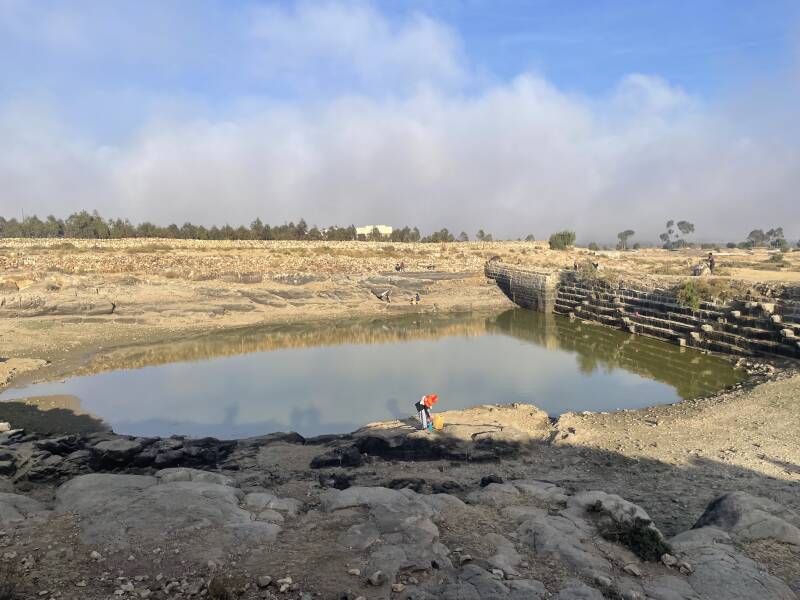
Safira Dam, where locals collect their water for use.
Accommodation in this region was basic and challenging: unreliable plumbing, very limited water, a rock-hard bed, and intermittent electricity. But there was a power point, and that felt like a small luxury.
On the return journey from Adi-Keyh toward Asmara, Moky insisted we stop at one final landmark: a giant sycamore fig tree, its vast canopy spreading out like a living monument. This tree appears on Eritrea’s 5-nakfa note, and standing beneath it, I understood why. For generations, such trees have served as meeting places, where elders gather, disputes are settled, news is shared, and shade is offered to travellers. It is not simply a tree but a symbol of continuity, shelter, and community.
After days of ruins, canyons, and ancient stone, the tree felt quietly grounding, a reminder that history here is not only preserved in temples and dams, but also in living things that continue to serve the people around them.
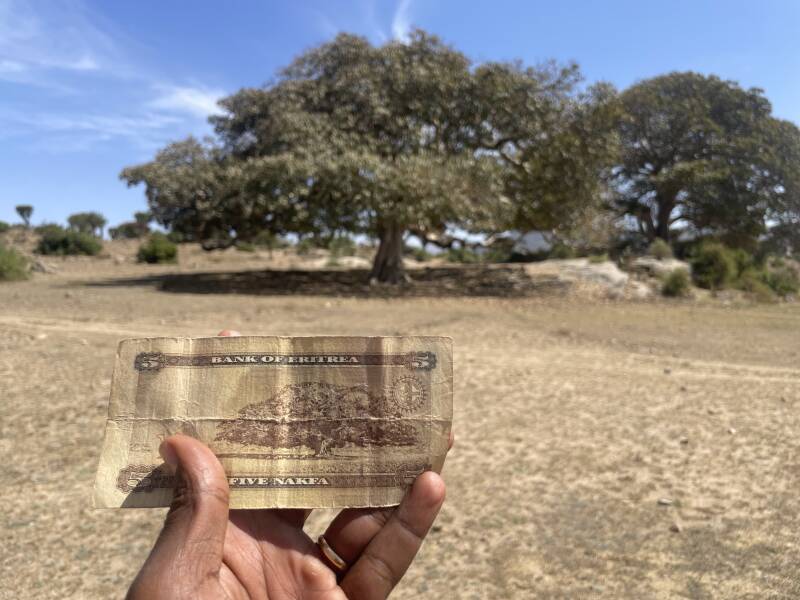

Different views of the giant sycamore fig tree.
The return journey to Asmara was eventful. A well-intentioned attempt on my part to adjust the air settings resulted in (according to Moky) burning rubber under the bonnet. Fortunately this occurred in a small village otherwise we could have been in quite a remote area with rarely any vehicles passing. We had picked up a local female hitchhiker and she assisted in putting out the fire. Locals stopped immediately to help. No one wanted payment. One man eventually accepted money only after it was discreetly dropped from the window as we drove off.
Moky said it was a miracle that it occurred in a village; ‘This happens to me all the time”. Coincidence, I countered. Either way, we were safe, the car made it back to Asmara and I knew I was safe to make my flight out of the country the next day.
Reflections on Eritrea
Eritrea is not just a destination for country-counters. Europeans return here. Italians come back repeatedly. I met writers, diplomats, and seasoned travellers.
There is free healthcare and education. Highly educated people: engineers, lawyers and doctors often find themselves underemployed. Many women of my age were freedom fighters in the 1990s, some still bearing physical scars. National service is universal and accepted, shaped by a history of conflict and constant vigilance.
Life here proves that society can function without constant connectivity. Sewing machines are pedal-powered. Cars from the 1980s remain in service. Markets thrive. People help each other instinctively.
And perhaps most tellingly, despite material hardship, I never felt harassed. No begging. No aggression. That contrast became striking only after arriving in Djibouti.
Final Thoughts:
Eritrea is complex, contradictory, and deeply human. It is a place where time feels suspended, where hospitality is instinctive, and where dignity persists despite constraint. It challenges assumptions about progress, comfort, and freedom and leaves you thinking long after you’ve left.
And perhaps that is the mark of meaningful travel.
Further reading: https://hyperallergic.com/reflections-on-asmaras-modernist-and-colonial-dream/
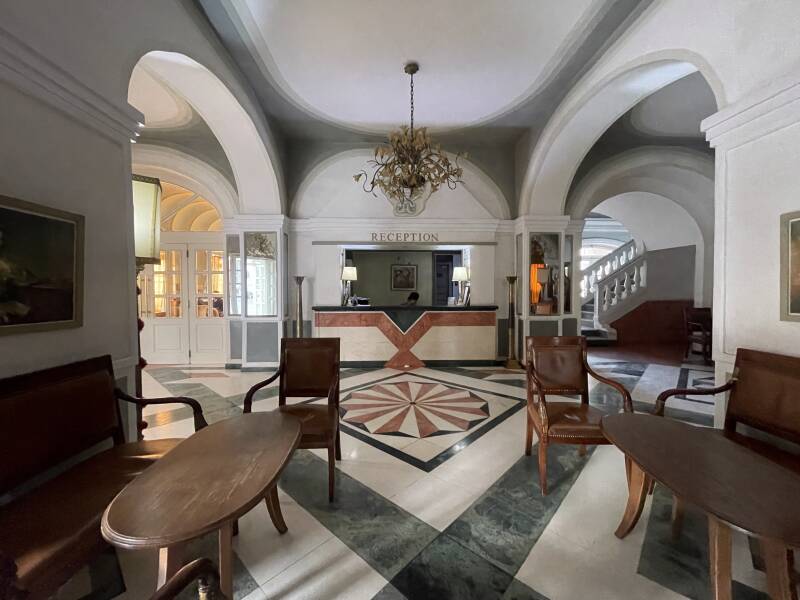

The reception and exterior of Albergo Italia, another stunning Art Deco Hotel in Asmara.
Create Your Own Website With Webador