

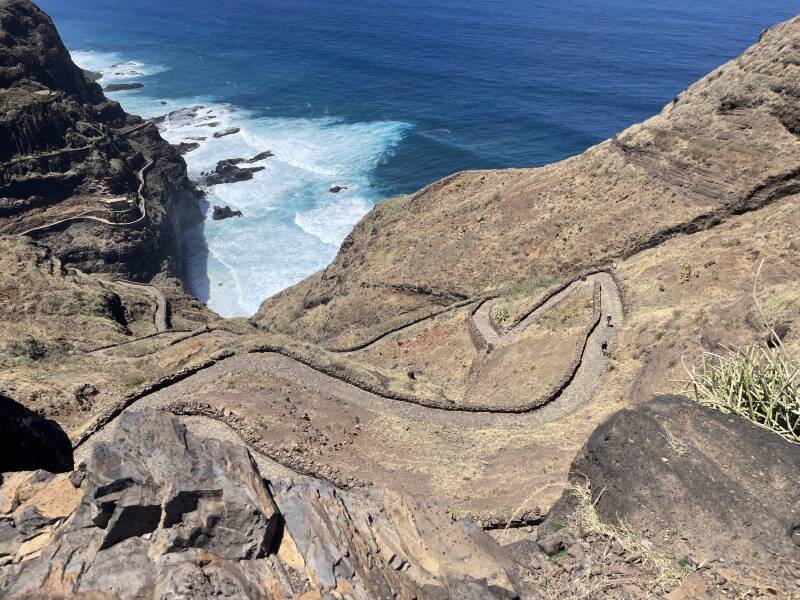
The walking track near Fontainhas, Ponto do Sol, island of Santa Antao
Located off the west coast of Africa near Senegal, Cape Verde sits within the Macaronesia archipelago alongside the Azores, Madeira and the Canary Islands. The islands are divided into two groups, the Windward Islands in the north and the Leeward Islands in the south. Portugal colonised the archipelago and brought enslaved people from across West Africa, including Senegal, The Gambia and Guinea-Bissau, shaping the Creole culture and language that is still present today. The population is around 600,000.
The biggest early challenge in reaching Cape Verde was logistics. Moving between islands is not casual here, it structures everything. Flights and ferries dictate your route, and you end up building the itinerary around connections rather than geography or preference.
I already knew Santo Antão was non negotiable after seeing images of its green valleys, steep ridges and colourful villages, and reading that solo hiking was entirely possible. But getting there required planning: Santo Antão is accessed via São Vicente, which is reached from either Praia in Santiago or Sal. As Praia had onward connections to Guinea-Bissau and Casablanca, it became my final stop.
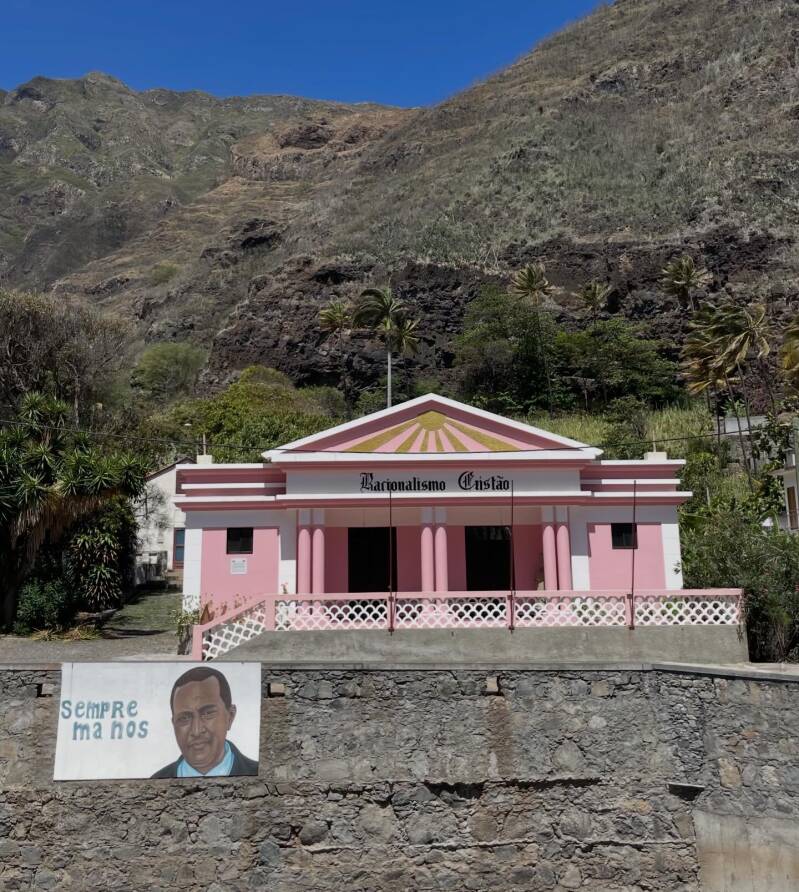
A delightful local church in the township of Paul, Santo Antão, which has been repainted in pink.
As of 2026, although, Cape Verde is visa free for most nationalities, you need to complete an EASE form online. This cost me 53.50 € (5900 CVE). For some reason, the computer rounded it UP to 53.51 €. The Cape Verde EASE form is an mandatory online pre-registration for visa-exempt travelers, which stands for Efficient, Automatic, and Secure Entry Process for Travellers. It acts as an Electronic Travel Authorization (ETA), designed to make entry quicker and includes payment of the Airport Security Tax (TSA). I was caught napping and forgot to apply 5 days before travel, but I still applied two days before travel and it was not rejected. The main thing I was asked for when checking in at Dakar was my Yellow Fever Certificate, which thankfully I had.
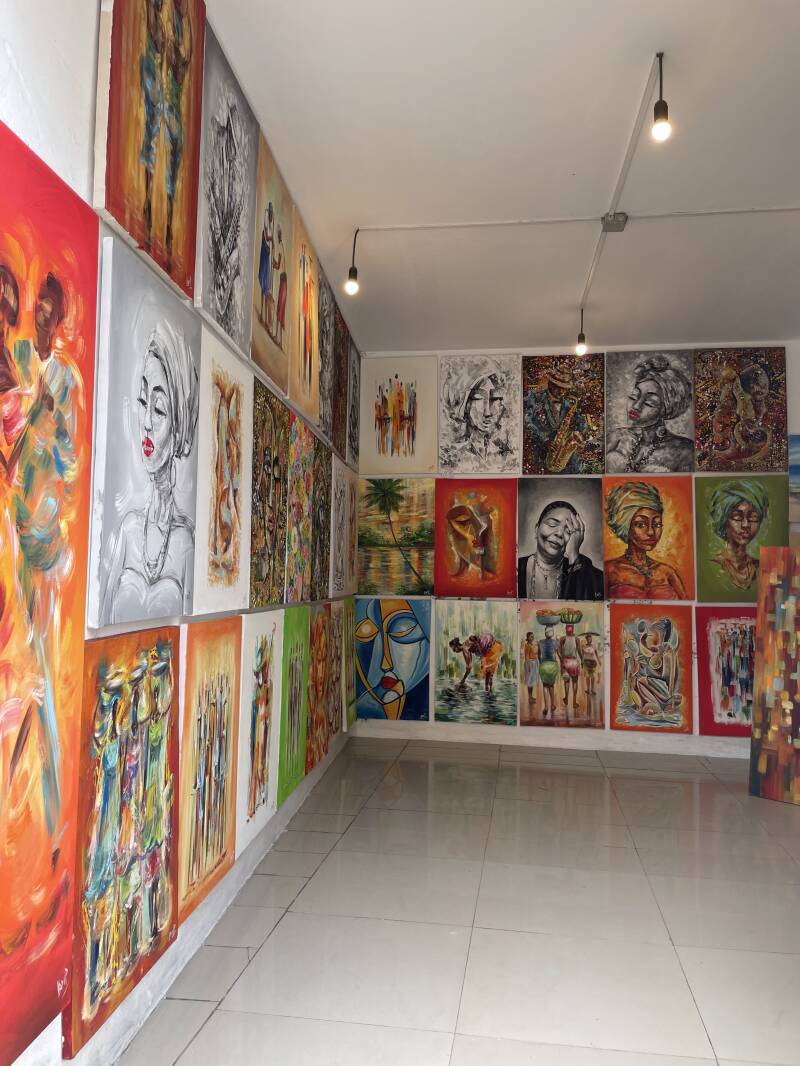
Paintings for sale in Santa Maria, Island of Sal.
I have to acknowledge a sense of passport privilege here. Even though West Africans have the ECOWAS (Economic Community of West African States) Free Movement Protocol through whichcitizens can travel within member states, they need to provide a return flight ticket, not onward flight ticket. As I was travelling from Senegal to Cape Verde to Guinea Bissau, I actually had more freedom than West Africans in this respect.
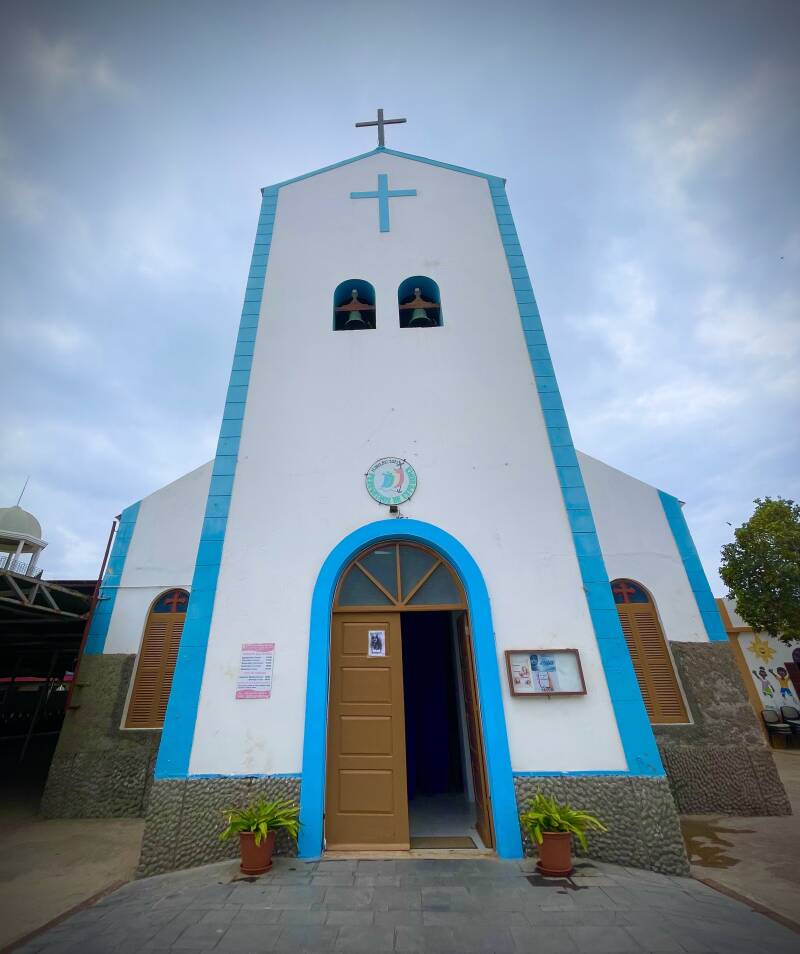
The main Catholic church in Santa Maria, Sal, Cape Verde, is the colonial era Parish of Our Lady of Sorrows (Igreja de Nossa Senhora das Dores)
My first flight from Dakar arrived late in the evening, around 20:45. I landed on Sal Island and transferred to Santa Maria, staying at Cam’s Suites, a practical apartment choice with kitchenette and washing machine after weeks of travel through Senegal and The Gambia.
Santa Maria is a resort town at the southern tip of Sal, with long beaches, pastel buildings, music bars and a strong tourism infrastructure shaped largely around European package holidays. The contrast with West Africa was immediate: cleaner beaches, more leisure infrastructure, and a more visibly international tourist scene. Santa Maria, like Senegambia in The Gambia attract tourists from Europe (Belgium and the Netherlands) and the UK, mostly looking for a restful holiday and sun using Tui airlines who offer resort packages.
On my first morning I woke to loud street life outside and walked down to the beach to take it in.
Having recently travelled through five Gulf countries and several African countries where modest clothing was the norm, I found myself slightly disoriented by the level of exposure on the beach. Covered shoulders, loose clothing, and conservative dress had been standard for weeks, so suddenly seeing so much minimal swimwear, and a lot of exposed everything, was quite a shift.
I caught myself thinking I could personally do without the return of G-string bikinis, even while being fully aware that body positivity and body freedom are part of a wider cultural shift.
There is also something interesting happening culturally. As one sociologist has noted, Western fashion has long focused on enhancing and emphasising the body, particularly the butt, which is often framed as both sensual and non reproductive, and therefore tied more to display and pleasure.
For some people this is clearly liberating. Personally, I had wore sunscreen and hat, more concerned about wrinkles and skin cancer than aesthetic theory.
Realising that Santa Maria was not really my scene and knowing that I was only here for three days, I decided to turn it into an advantage, and sought foods for lunch not usually available in the West African countries I had been visiting. I found a café with a beach view, English speaking staff and a menu which contained poke bowls and wine. And I returned to the beach. It was clean and I could wet my legs up to my knees, and I could go on long walks. There was even a lighthouse!
I did visit the botanical gardens in Santa Maria but was disappointed to see that animals they had ‘rescued’ were put into enclosures without sufficient stimuli. One was a monkey that had been used to help pick pocket tourists. Its cage barely any greenery or foliage. On the other side of the highway from the Botanical Gardens, was a dog and cat shelter where tourists can volunteer to walk the dogs. Perhaps I should have contributed rather than waiting to be entertained. Good to know it’s there.
Two full days was just enough for me explore some of Sal Island and eat good food. There was certainly more to do than I experienced and I did not take any day tours which are possible. You can surf or kite surf as it’s the kite surfing premier destination.
My next destination was Santo Antao Island, but to get there you need to go via São Vicente so it as back to the airport and then a taxi to the terminal with a two hour wait for my booked ferry. The ferry terminal may have looked ordinary from outside but inside was a bustling café serving hearty meals of fish and vegetables so I partook! Having recently travelled on the ferry between Senegal and the Gambia (think trucks full of goats and sheep and ‘grab a seat if you’re lucky’ mentality), the Nôs Ferry was surprising in its luxuriousness. I actually chose to sit inside as it air conditioned, had reclining padded seats and phone chargers. It was nowhere near full so it was easy to find a seat without neighbours. Upon arrival at the terminal, I had organised a transfer bus to Ponto do Sol and quickly realised it as a collectivo as it continued to pick up and drop off people along the way. A curious girl squeezed in next to me and proceeded to examine the skin in my hand before deciding to hold it; I'll never know what piqued her curiosity. Was it the white anglo skin or the wrinkles? We also picked up a disabled man and his wheelchair. The driver and one of the passengers lifted him into the seat. The scenery was magnificent but I was on the wrong side for photos. I didn’t mind that it took more than an hour to reach my apartment. I stayed at Oásis de retour, a delightful apartment with a gobsmacking view of the sea; which the owner proudly showed me when I arrived. She only spoke Portuguese (and maybe other languages I didn’t know of), so our various encounters were possible with Google Translate but when she whipped open the door to the view it was like ‘Ta da…!’ . After several months of travel, my well-worn cotton trousers were starting to wear thin to the point of having a hole pointed out to me by the woman in the shop next door. I asked my host via WhatsApp if she might be able to fix it or get someone else to; she said she’d try but didn’t know how good the result would be. She used a piece of the cuffed fabric to create a small patch and hand sewed it in. that was good enough for me; I could walk around without appearing destitute. On departure day, after I paid in cash (Cape Verde is mainly a cash country), I offered to round it up, gesturing towards the patch on my pants. ‘Oh no, no, no!’ she answered, and wouldn’t allow it!
After procuring some basic groceries and roaming around the town at night, enjoying the sunset along with everyone else (and yes, it was very safe) I found a vibrant and small restaurant with a mix of locals and tourists that had a table spare and, to top it off, live music! I returned the following night only to find it full. For another night I ended up sitting outside to eat and noticed that the owner was also one of the singers for that night. It seemed that every restaurant provided live music from around 7.30pm and these musicians may also double as servers, cooks or family members.
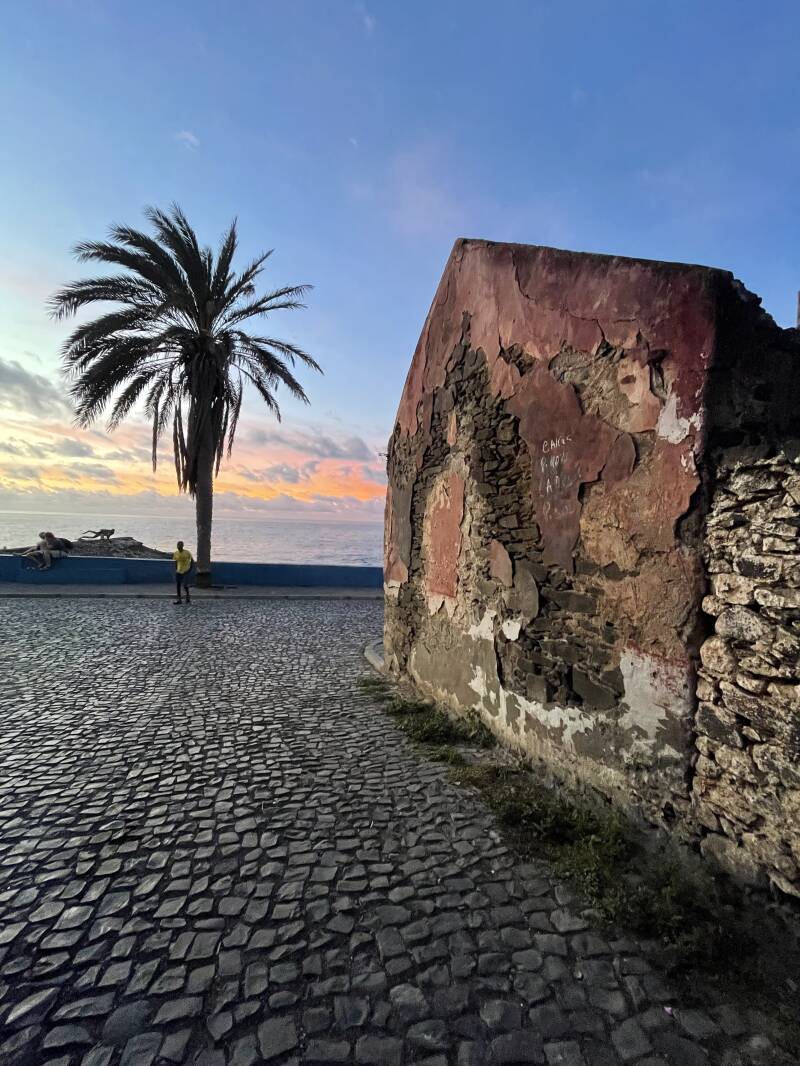
The road just down from my apartment in Ponto do Sol.
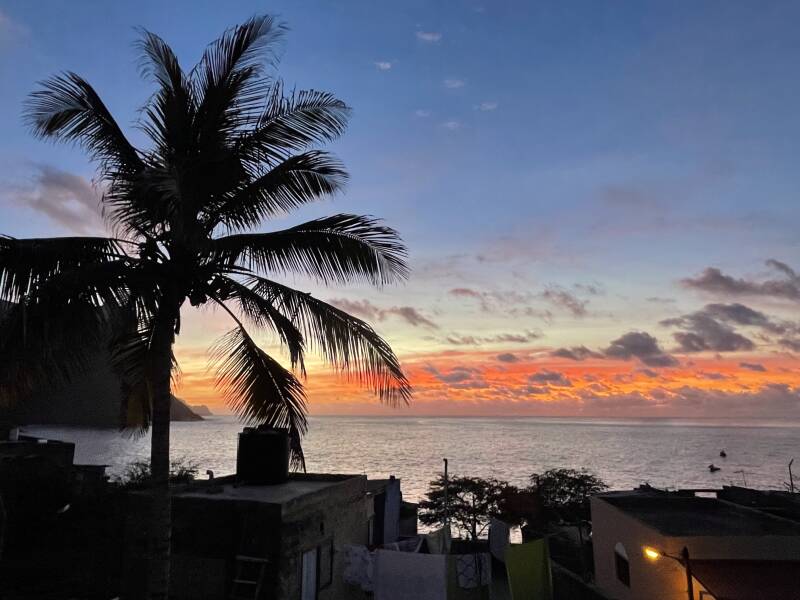
The view from my apartment window in Ponto do Sol.

The road was steep enough but this woman was carrying weight on her head. Gutsy!
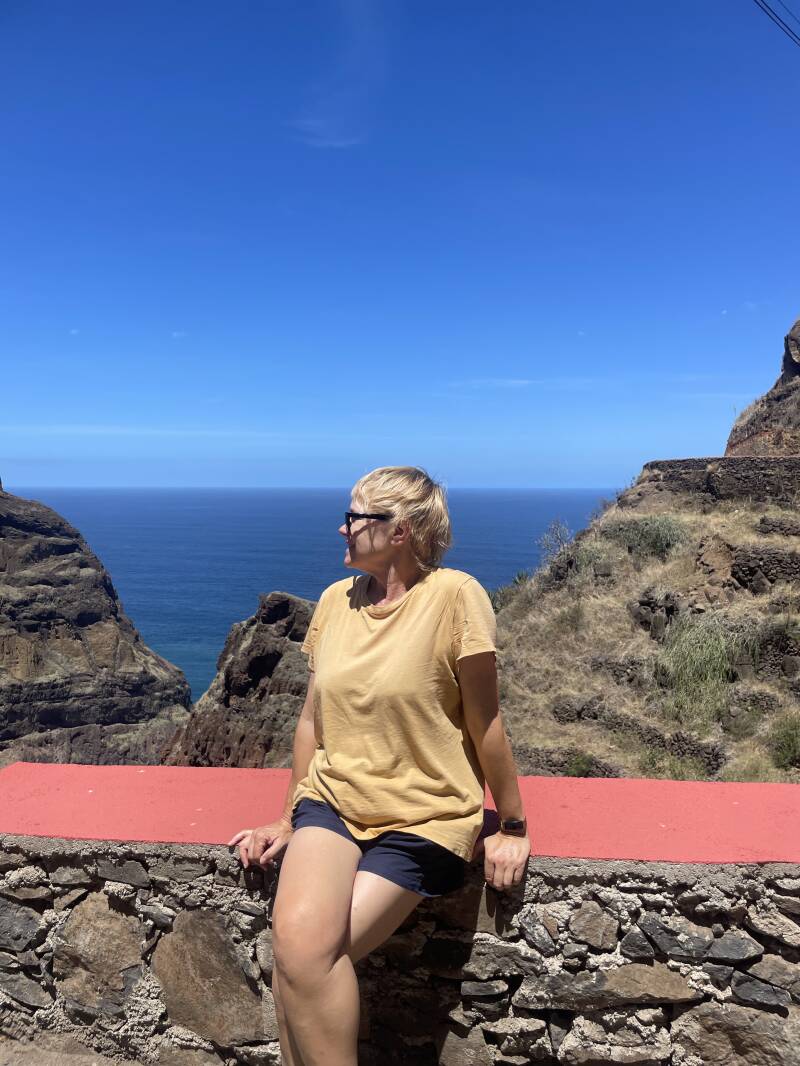
Stopping to admire the scenery on the road to Fontainhas.
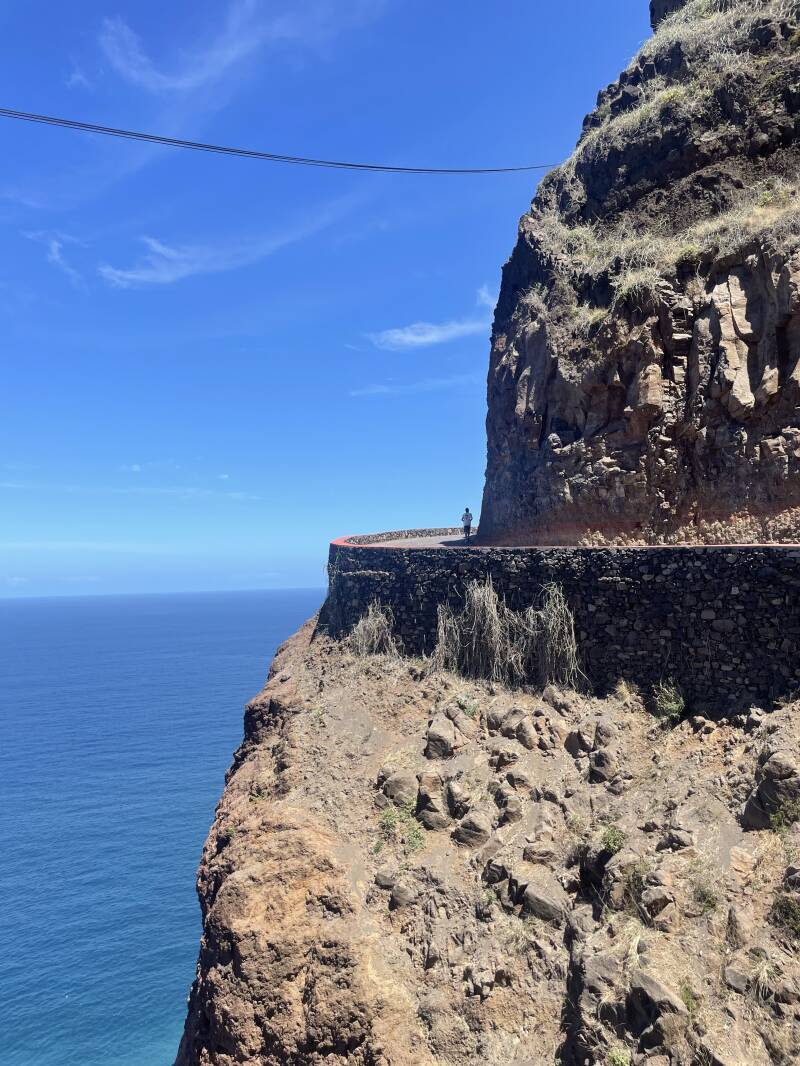
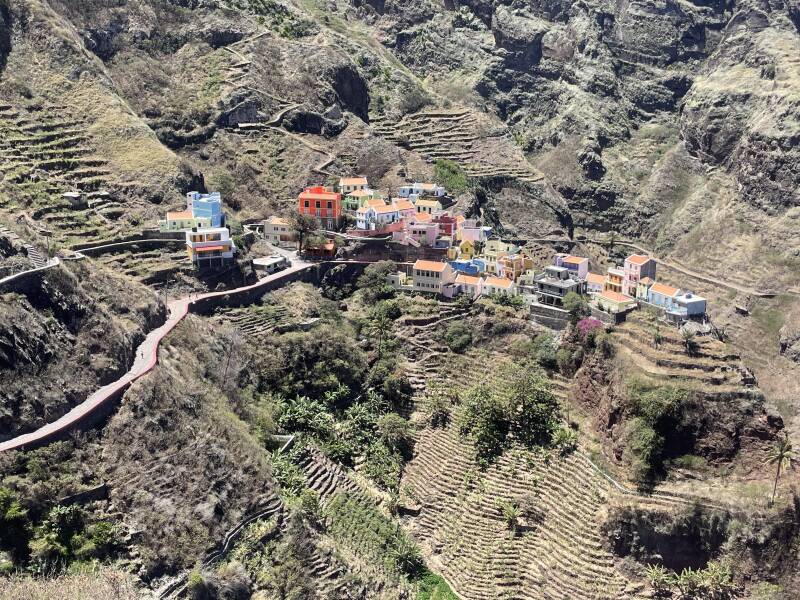
The anticipation was real; I was finally going to do some hiking, with verdant mountains and colourful houses as I had gleaned from a few internet searches. I was headed to Fontainhas, rightly nicknamed Fairytale Fontainhas. According to National Geographic, Fontainhas itself is one of the villages in the world with the most beautiful views and I'm not arguing.
At first I needed to ascend a steep hill within the town, and then I passed by some pig enclosures near the beach – pew! Then the gorgeous mountains and dramatic sea views hit me. Most people undertaking this trail get dropped off at the start or end in a taxi so that they only walk one way but I was happy to walk as far as I was happy with and return as you see things you miss when you are facing the opposite way and to be honest, the views of the delightful Fontainhas and its charming colourful houses and terraced gardens was worth another view. I walked beyond Fontainhas, encountering a stunning steep jagged volcanic wall and continued downhill towards Cruzinha stopping at Corvo before returning. I stopped at Fontainhas for a light meal on the way back. Already I was glad I had come to this part of the world.
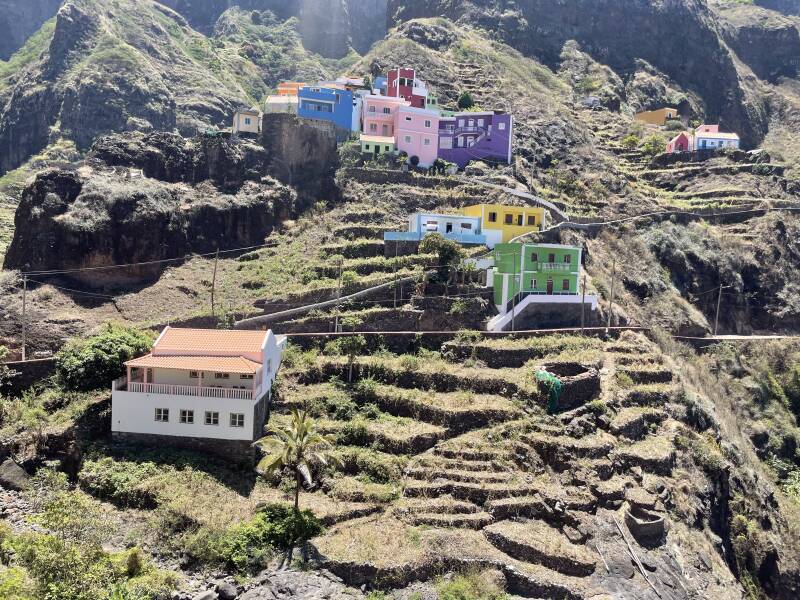
Houses near Fontainhas.
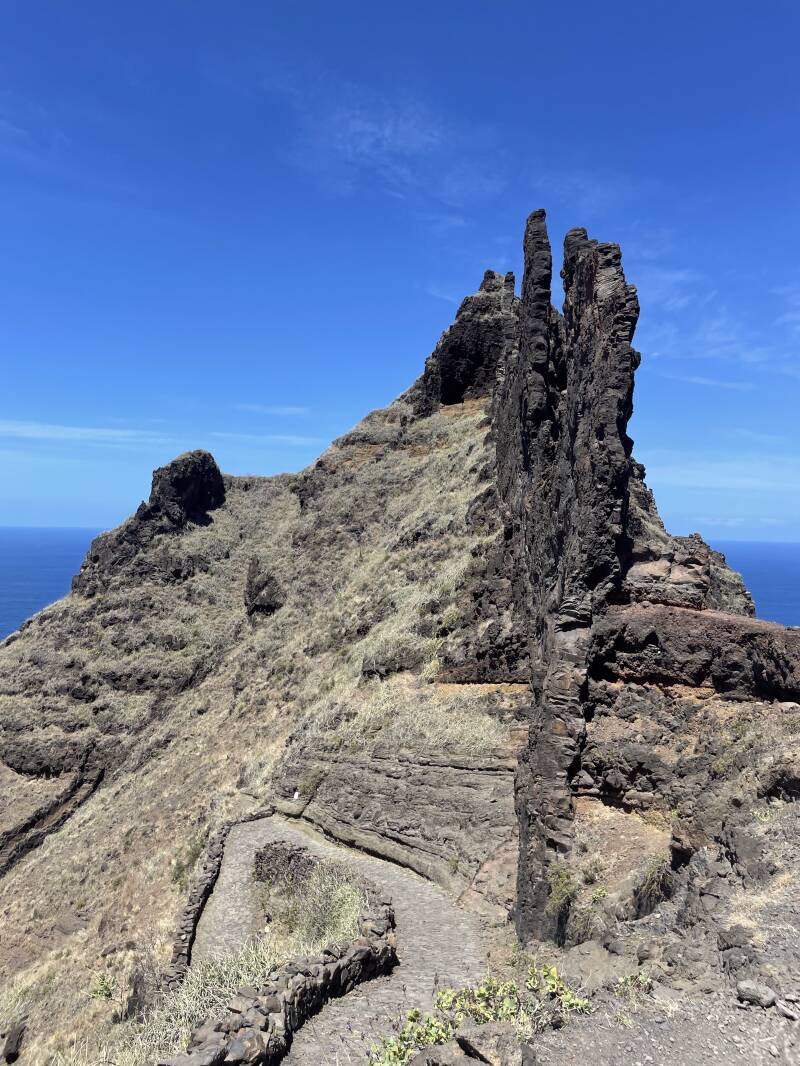
Volcanic rock and the pathway between Fontainhas and Cruzinha.
Sad fact about the roads: Most of the road was built in the 19th century by slaves brought in by the Portuguese, who were the colonial masters of the Cape Verdean islands. They are still in good condition today, maintained by the villagers who live in the towns on the coast. Some of it is also new, built by the villagers in more recent times.
On my second hike from Ponto Do Sol and my third day In Ponto do Sol, I walked in the opposite direction to Ribeira Grande, a township with jaw dropping views of the sea. It was basically on the road shared with the cars but there was a footpath. The township was somewhat developed with plenty of shops and a good place to find lunch.
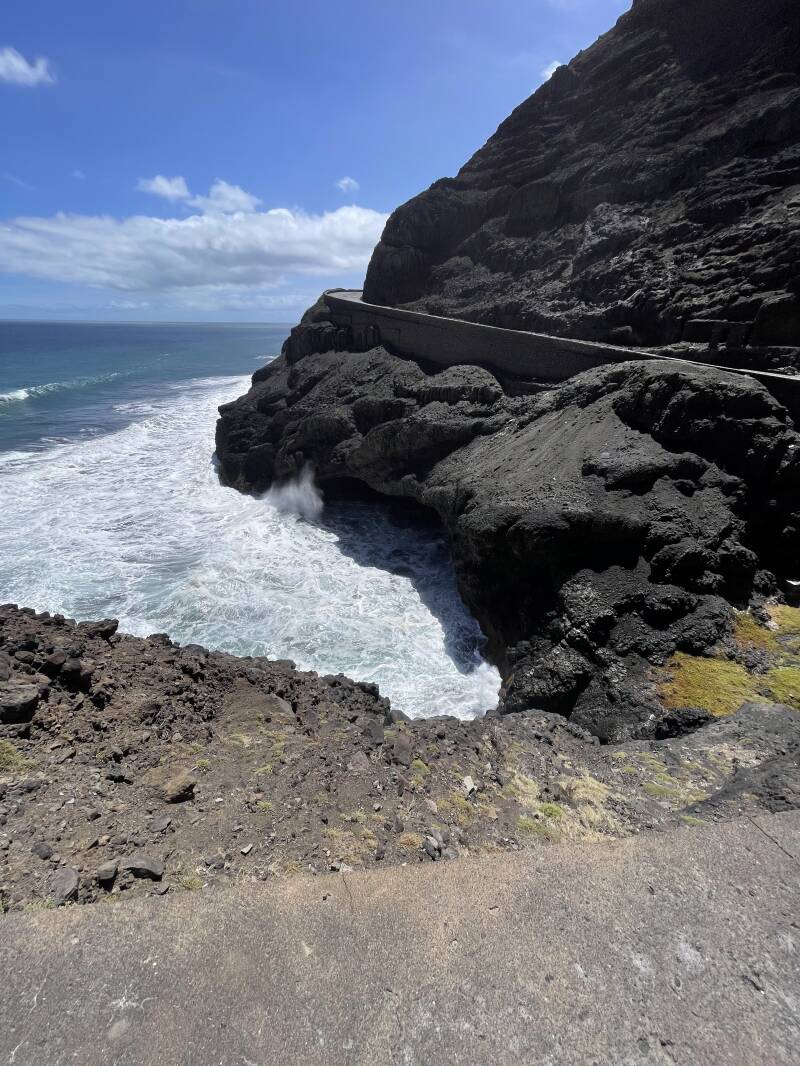
Crashing waves on the road to Ribeira Grande.
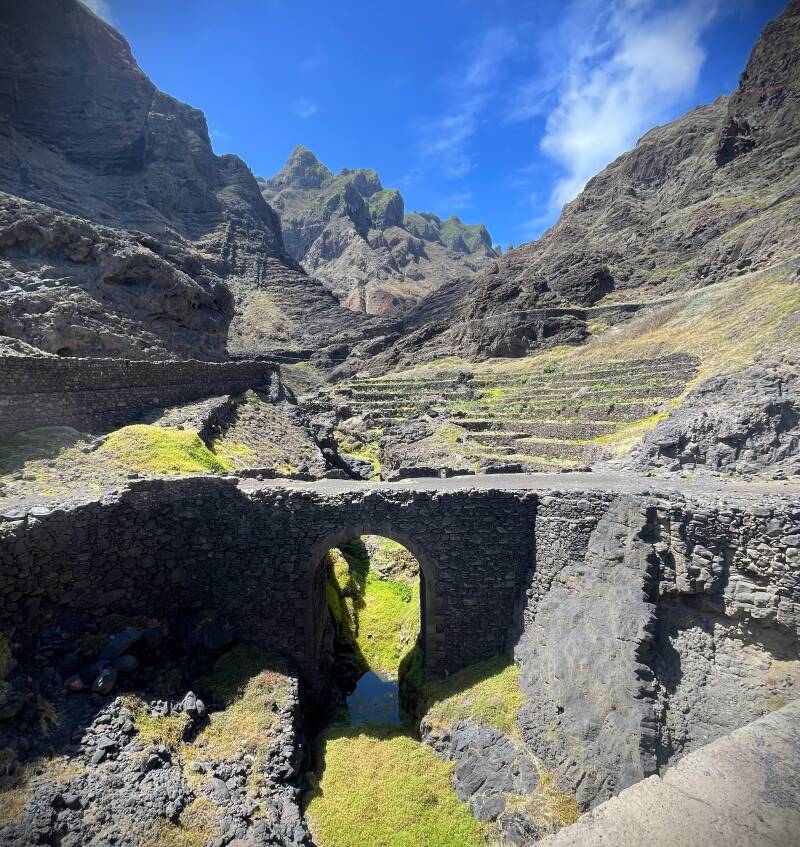
Terraced gardens and a bridge on the way to Ribeira Grande.
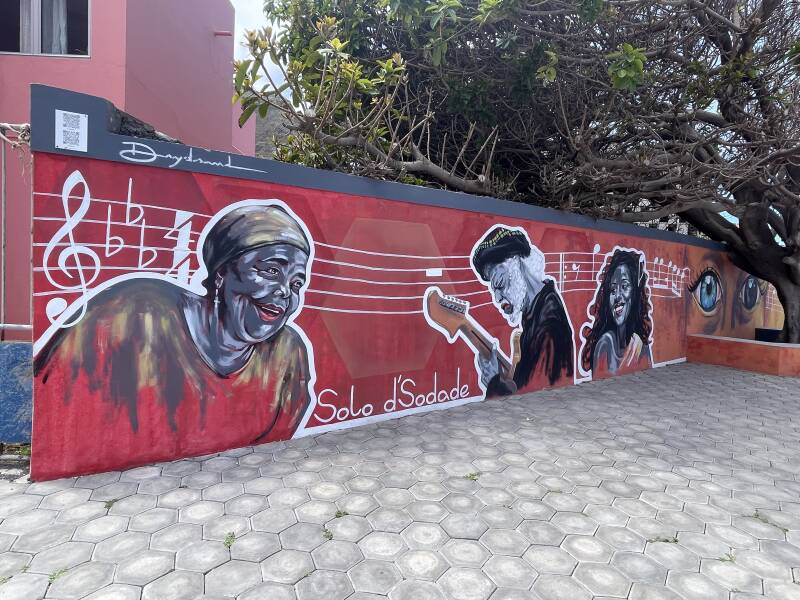
A mural in Ribeira Grande celebrating Cape Verde's music culture.
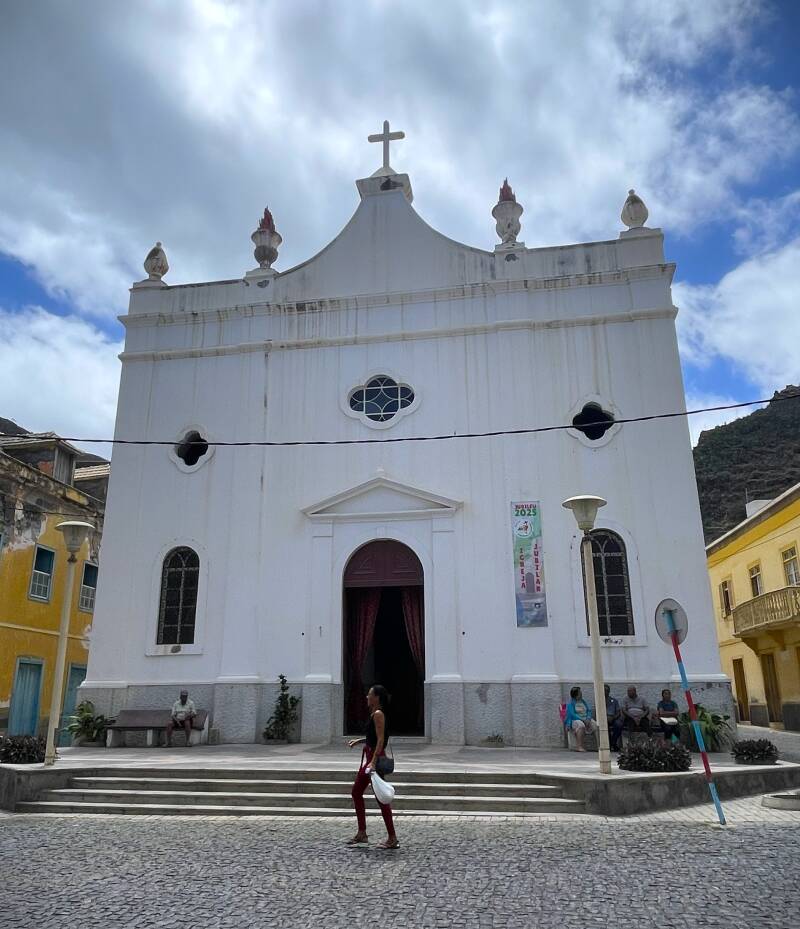
Igreja Nossa Senhora do Rosário (Church of our lady of the rosary).
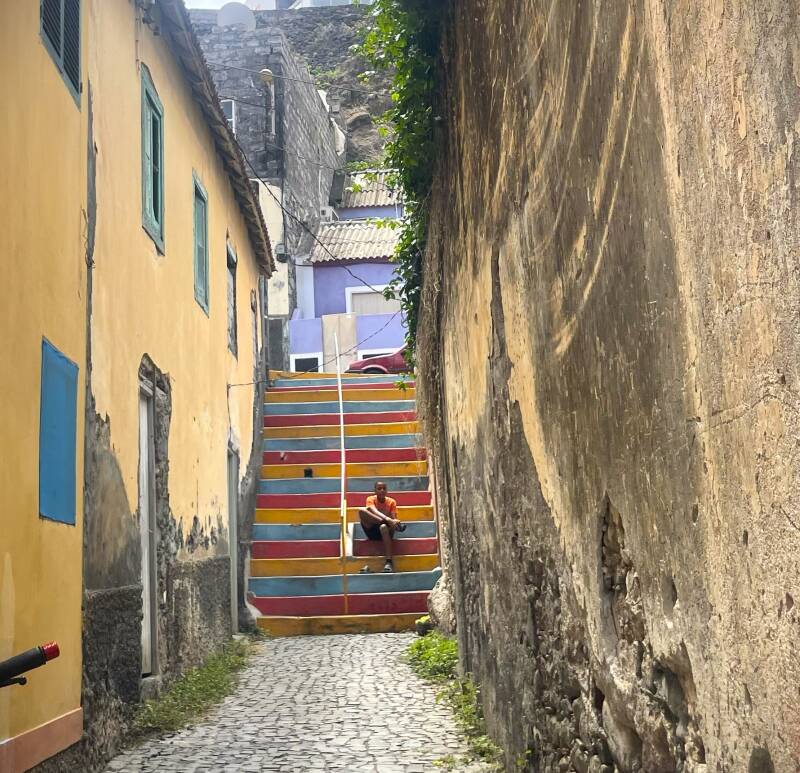
A colourful staircase in the township of Ribeira Grande.
On the next day I organised Philip from the collectivo to again to transport me to Paul, about half an hour away, along the same road. A little bit more expensive as it was a private transfer, but he was totally punctual again, I experienced glorious views; the alternative was to take a collectivo to Ribeira Grande, and then wait for another one to Paul; these collectivos tended to depart when full and I didn't want to waste any time in this highly anticipated part of the world (to me anyway!). I had chosen accommodation up in the hills somewhat to enable me to access the mountain hikes more easily. Kasa d'Vizin (Eito) is a highly rated guest house offering a restaurant with extensive vegan, food, along with a terrace offering panoramic valley views. Even though I’m not a vegan, the guest house seemed the happy medium between being downtown and being stuck so far away from civilisation that I’d need to taxi everywhere. I loved that it was in the midst of a residential area and I enjoyed the evening ambience of everyone heading outside to socialise, play music, play and cook barbequed meat in the streets. The street downhill was very steep and I bore witness to several youths bravely speeding their bikes down the hill.
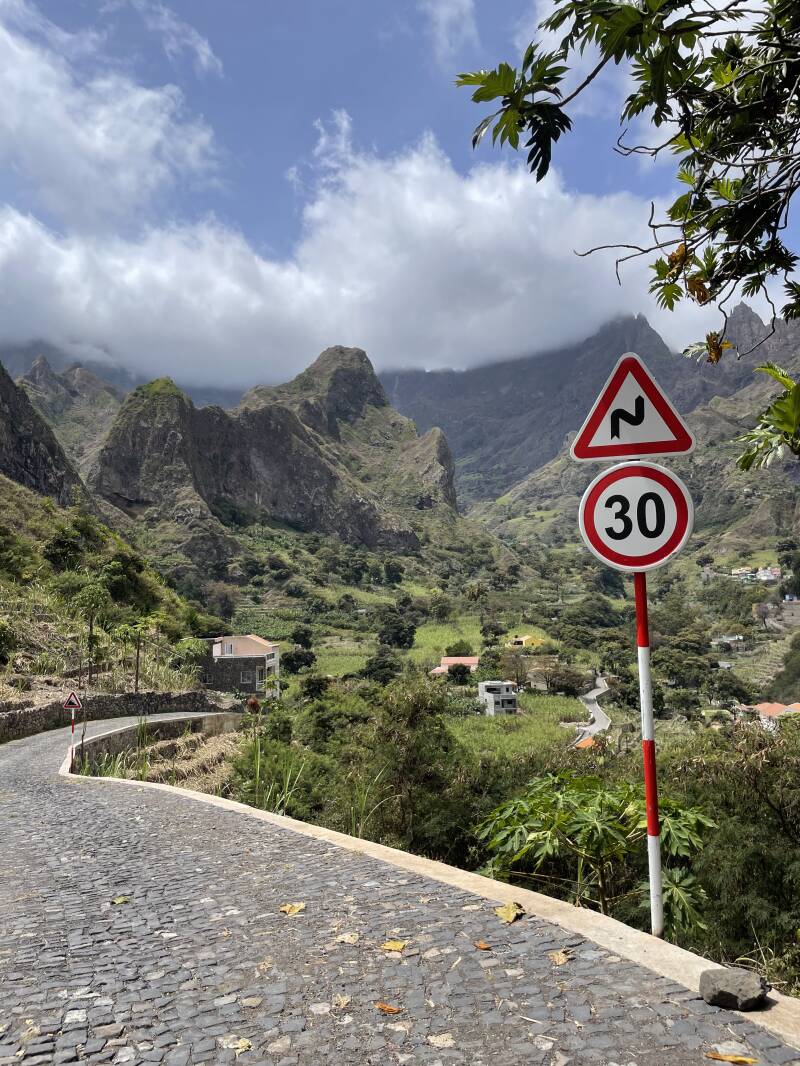
The stunning landscape of Paul.
The land around the building is still used for agriculture. You can see sugar cane, mango, breadfruit and banana trees and cassava.
I met Hannelore, the Belgian woman who, along with her team run the guest house. The provided breakfast was substantial but I found the three course meal a bit on the expensive side for vegan food and mostly carb/ bread based. But I loved my cosy room and the fabulous panoramic restaurant which offered the best views of sunset over the mountains; you could also buy a beer or wine to have on the deck and lounge about on the chaise longes there.
On my second day in Paul I was ready to up the ante and take on a longer hike; I had a hiking tour coming in up in Algeria and had spent far too much time sitting in cars being transported around, rather than exercising. Most people who visit Paul for hiking do the volcano hike which means paying someone to drive you there and then you walk downhill into the volcano. Instead, I used the Komoot app and found that there were many hikes possible so I took off on one hike and somehow ended up on another one! This was inland, so no beach views, but instead I passed through lush, terraced gardens, farmers growing yams and the occasional goat. As I neared the top of a mountain, a woman with her hair in rollers called out to me and introduced herself as Sandra, noting that it was her café at the top of the hill. A fact check on google maps proved she was right; there was indeed a café called Sandra House or Chez Café. ‘A rustic, family-run stop often used by hikers taking the trail from Cova Crater down the valley. It is known as a great spot for a break offering coffee from their own roasting, local food, and a shop. ‘ Then I realised I had effectively done: Valley Trail in Cape Verde – Sandra House loop from Cidade das Pombas, as described in Komoot. I was told that there were juices available at the café, but upon arrival, there was only local fig juice, so fig juice it was! I must have sculled it too quickly though because about ten minutes later I was gripped with stomach pain! I worried that I might need to find a bush to go behind but fortunately, the pain subsided. I had reached the top of the hill and now I had to carefully negotiate my way down the steep hill, using my hands at times. The hardest part was probably the cobbled road at the end as my feet were feeling the pain. But it was a beautiful day and I felt pleased to have hiked 5 hours alone, without the need for tour or taxi. And it was a well-earned beer back on the balcony of Kasa d vizin!
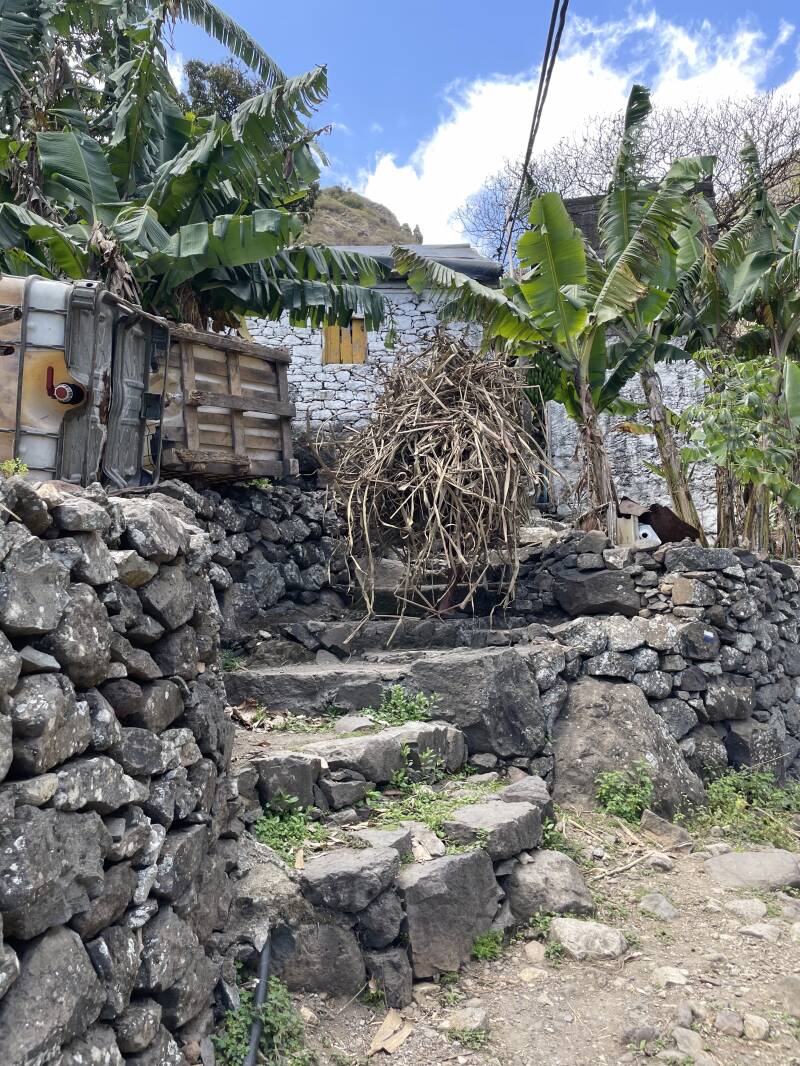
There's a person in there! A farmer carrying a large mound of hay up a hill.
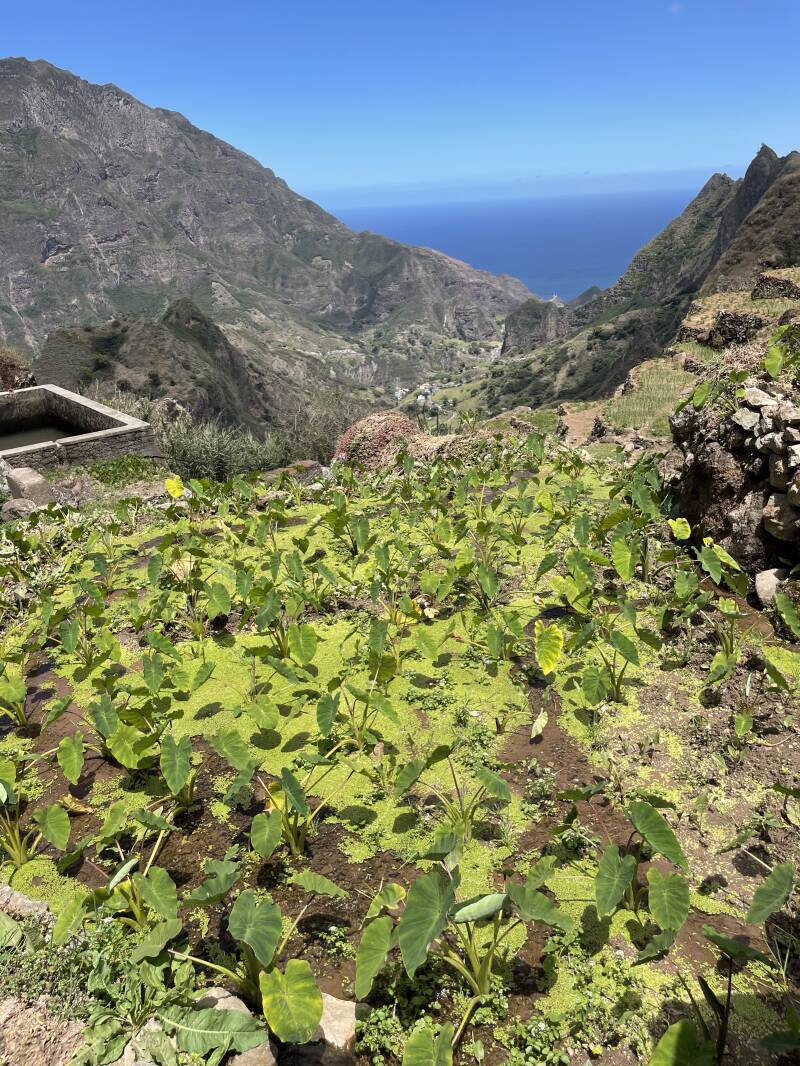
The view down to the sea over plantings.
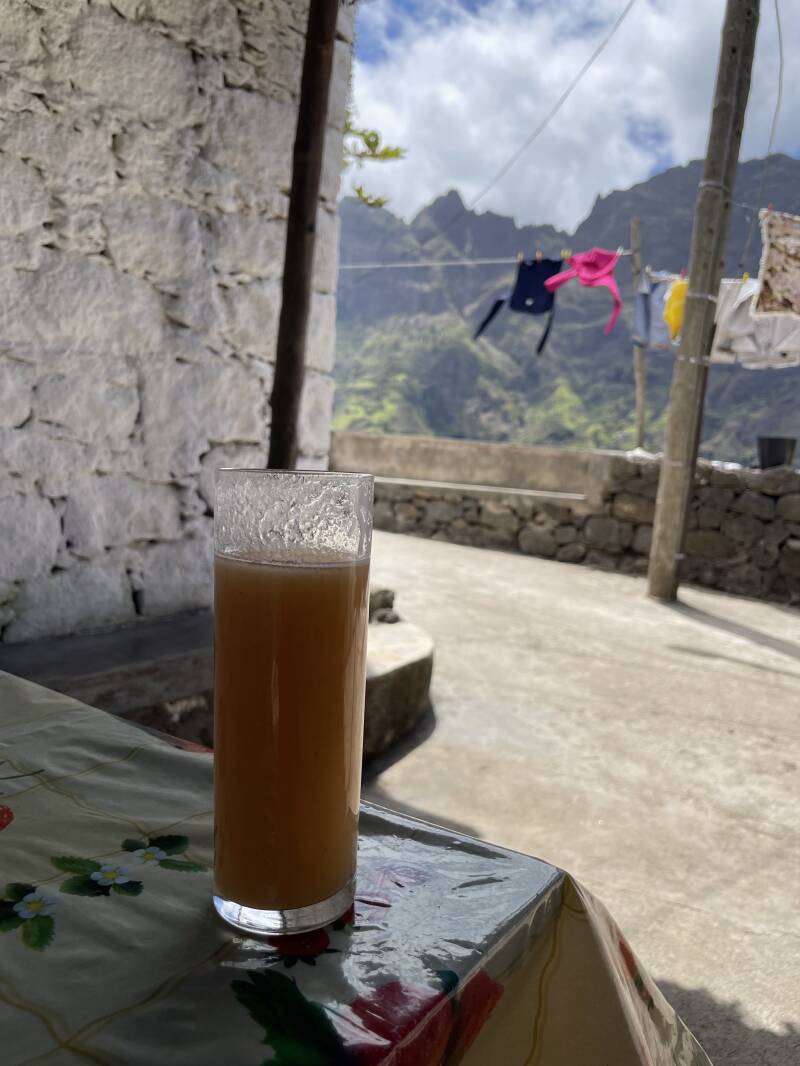
Fig juice at Chez Sandra, near the top of the hill.
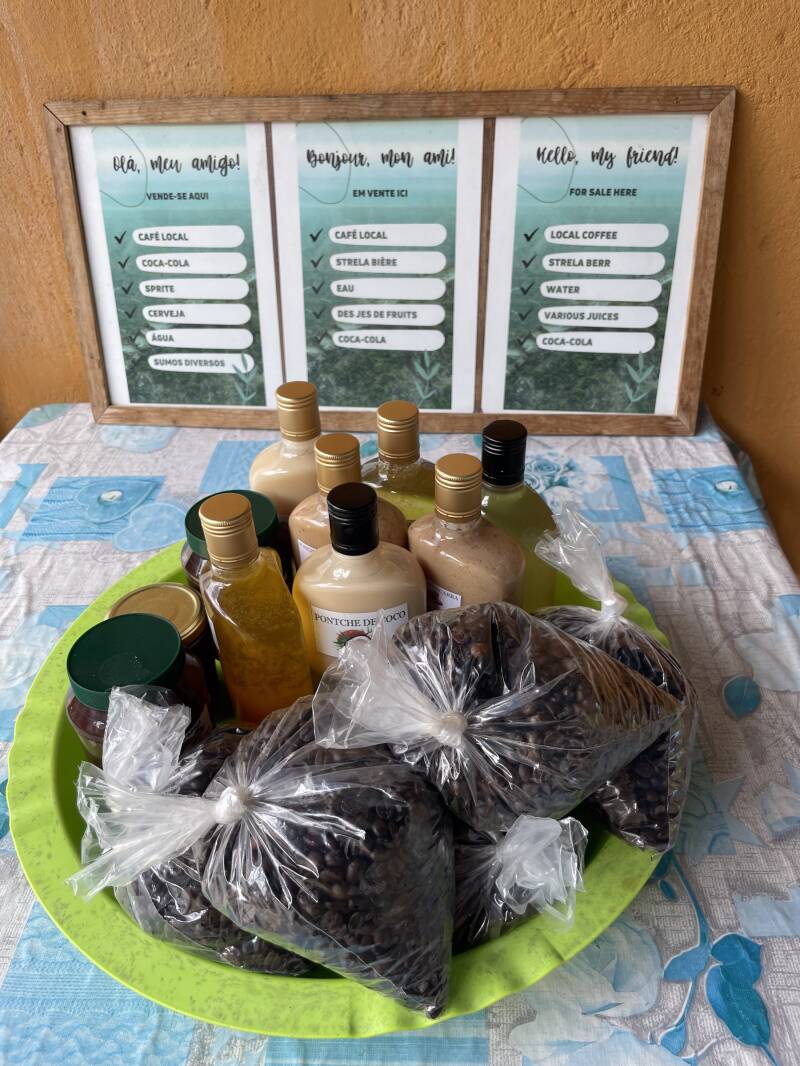
Coffee beans and other things for sale at Chez Sandra.
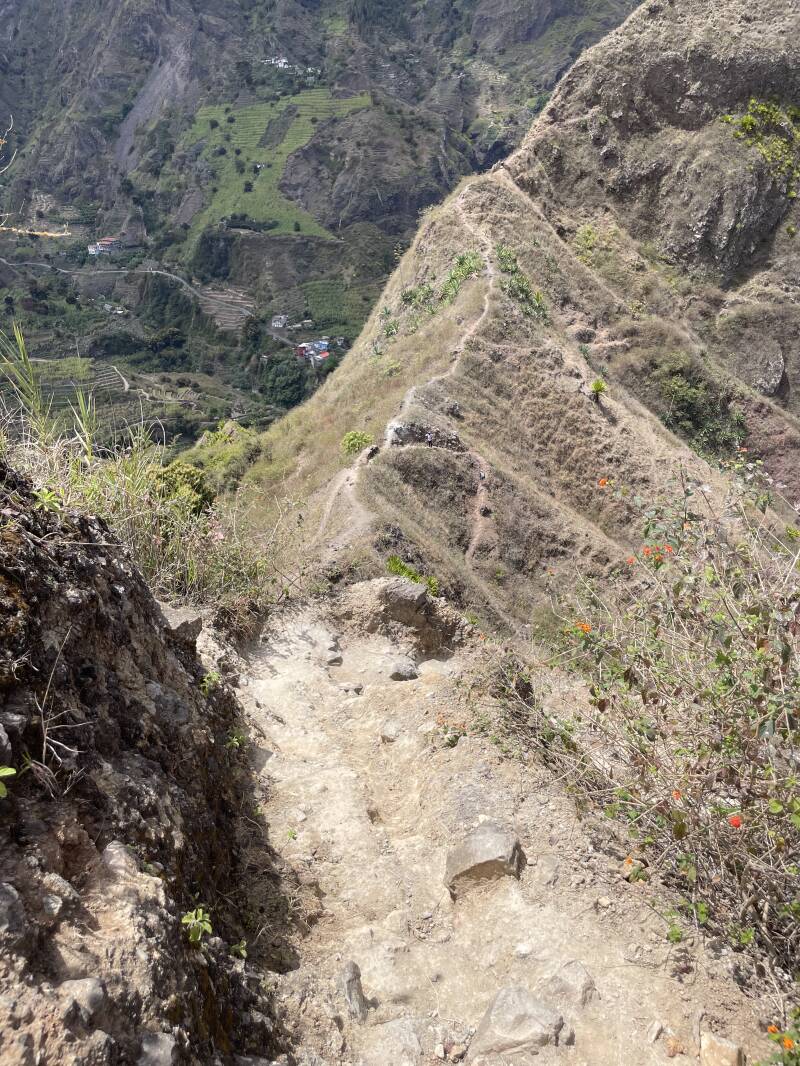
The final track to the top of the mountain.
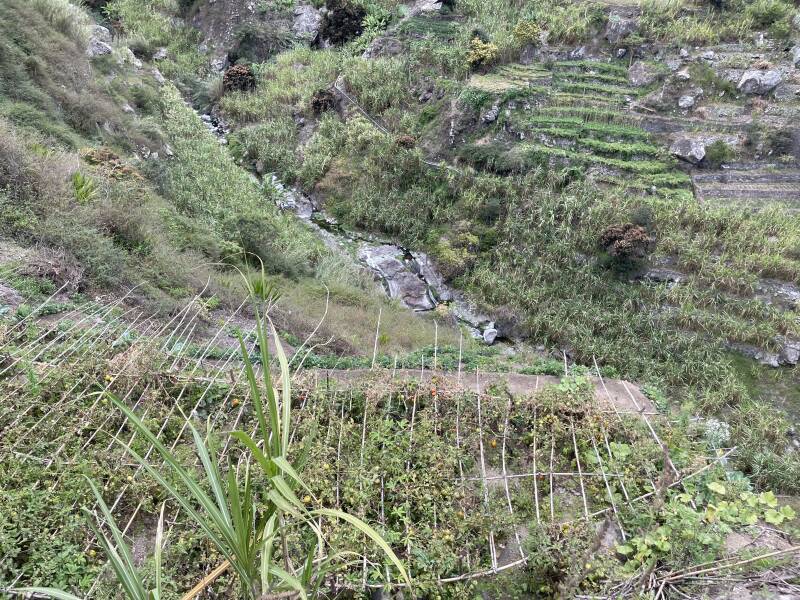
More gardens and streams on the way down.
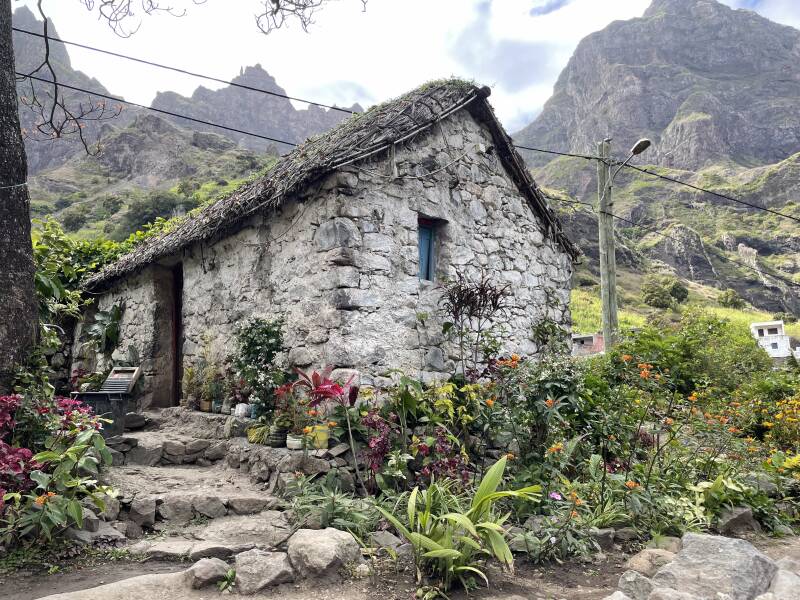
A typical stone home with repurposed plastic containers and flower pots.
After the previous day’s mammoth hike, I opted for a gentler ramble on my third day in Paul, staying closer to the house and descending gradually into the township below.
Looking up towards the hillside, I noticed a statue towering above the town. At first glance I assumed it to be yet another Cristo figure, of the sort that seems to preside over scenic viewpoints across so many countries, until I realised it was in fact Saint Anthony himself, the namesake of Paul.
Reaching the statue proved less straightforward than anticipated. The route initially led me to what was quite literally a gas station, where locals stood patiently beside empty gas cylinders awaiting their refill. Nearby, a building site appeared to block further access altogether, until one of the workers waved me towards a narrow laneway strewn with rubble and construction debris. Following this improvised route eventually brought me to a steep staircase climbing towards the monument and its magnificent panorama over the valley and coastline.
The timber handrails, weathered to the point of near collapse, were best avoided, though the concrete pillars offered sufficient reassurance against an untimely tumble downhill. With construction works continuing around the statue precinct, I found myself wondering whether a properly tourist friendly pathway would ever emerge again. At the same time, observing the queue for gas cylinders below, I felt quietly fortunate that my own inconveniences extended no further than navigating a difficult staircase in search of a view.
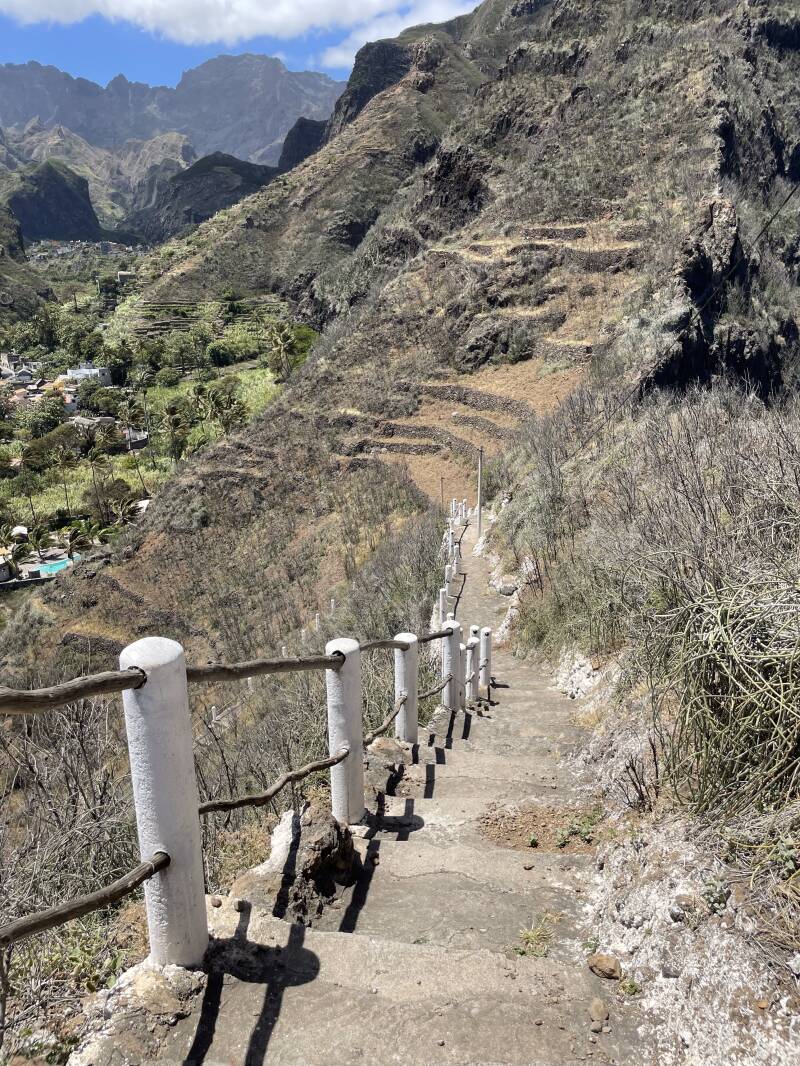
The pathway up to the Saint Anthony statute with the Paul landscape I had explored in previous days in the background.
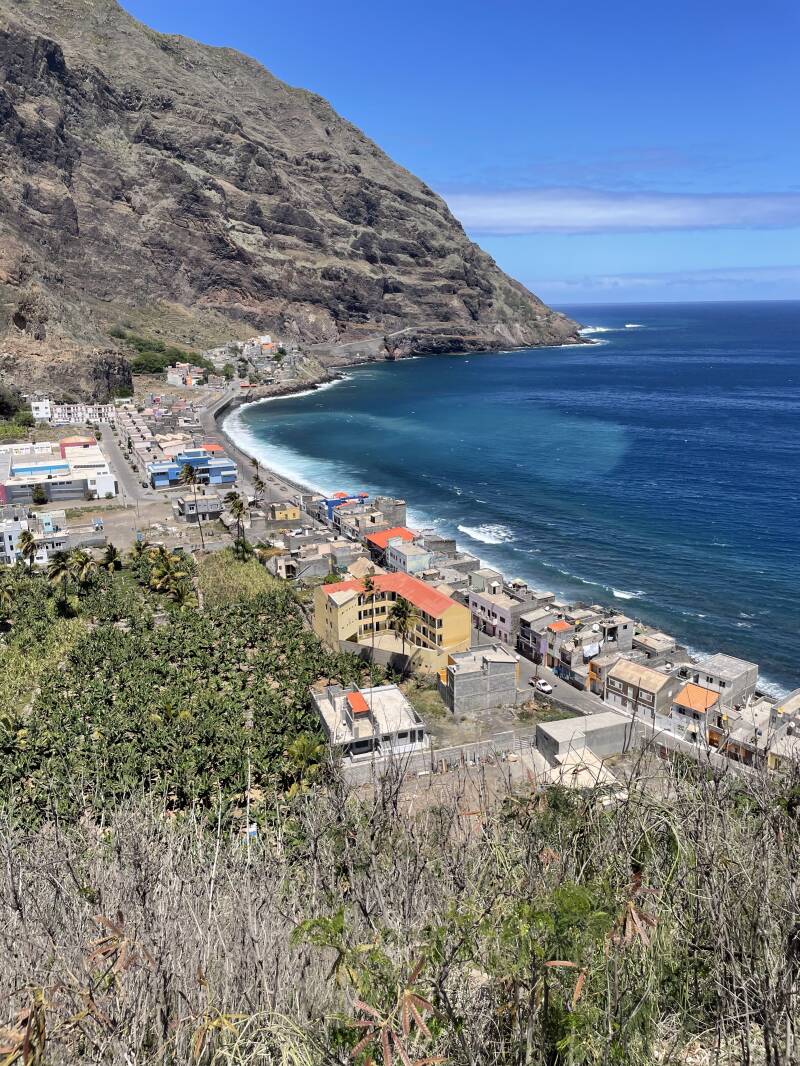
The view from the Saint Anthony statue observatory.
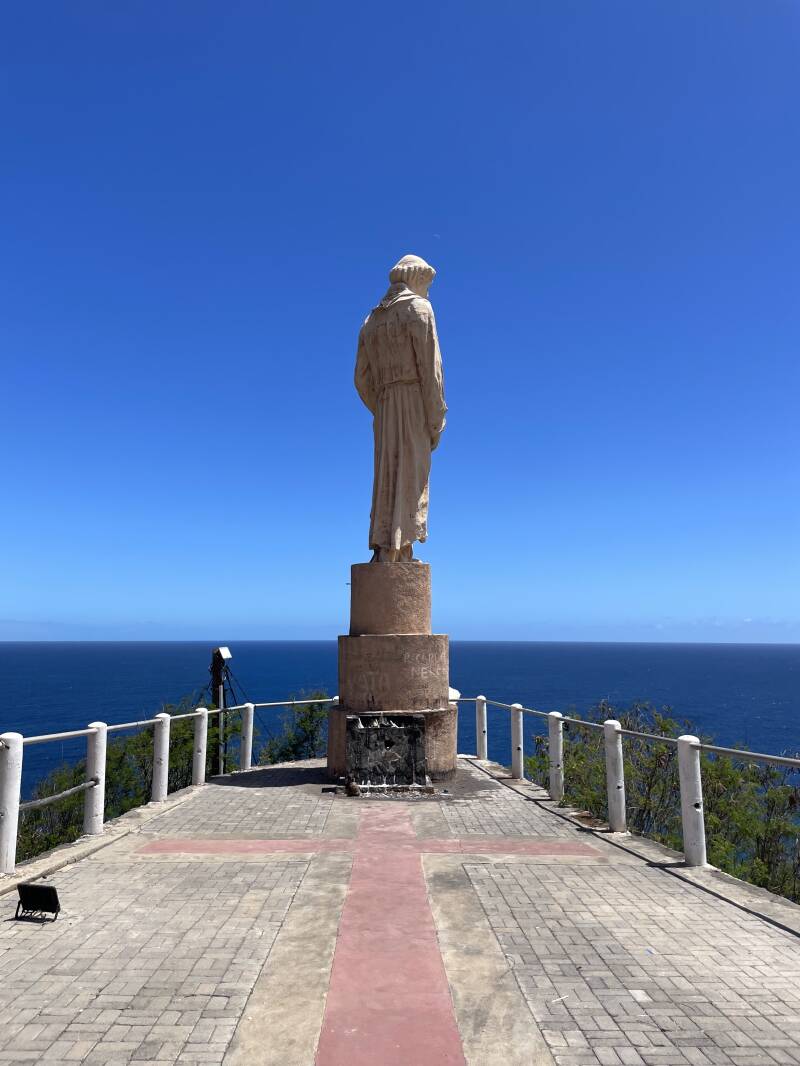
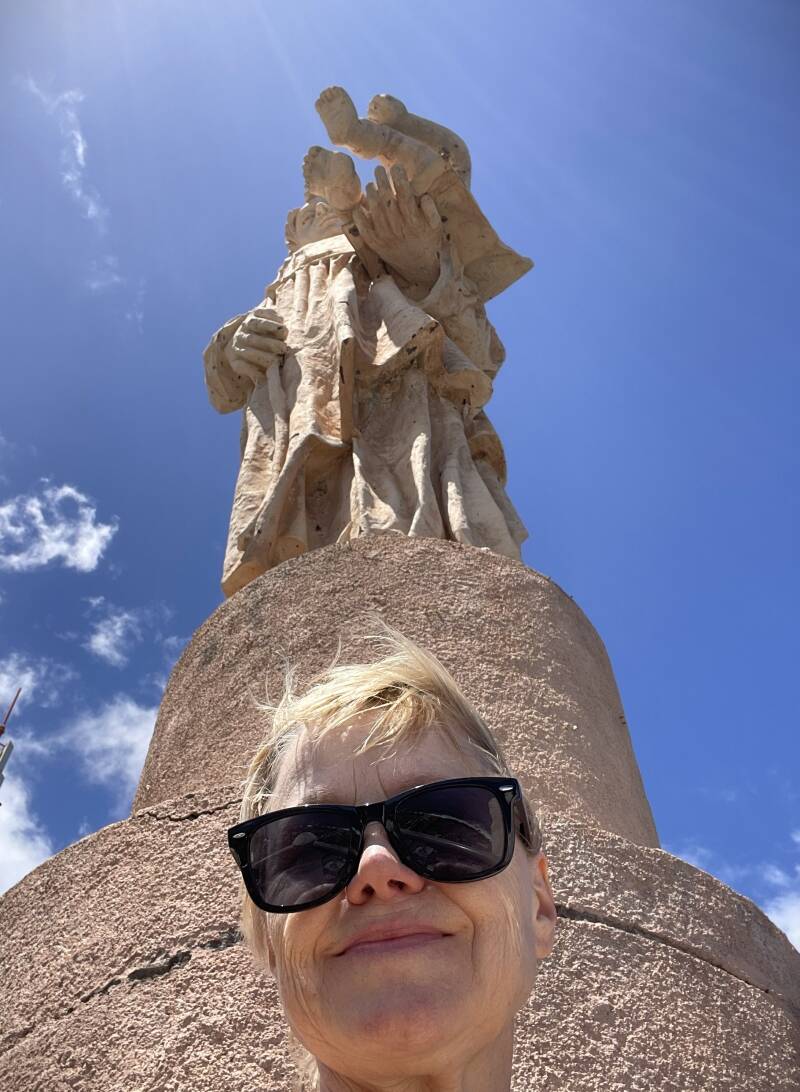
Saint Anthony back and front views.
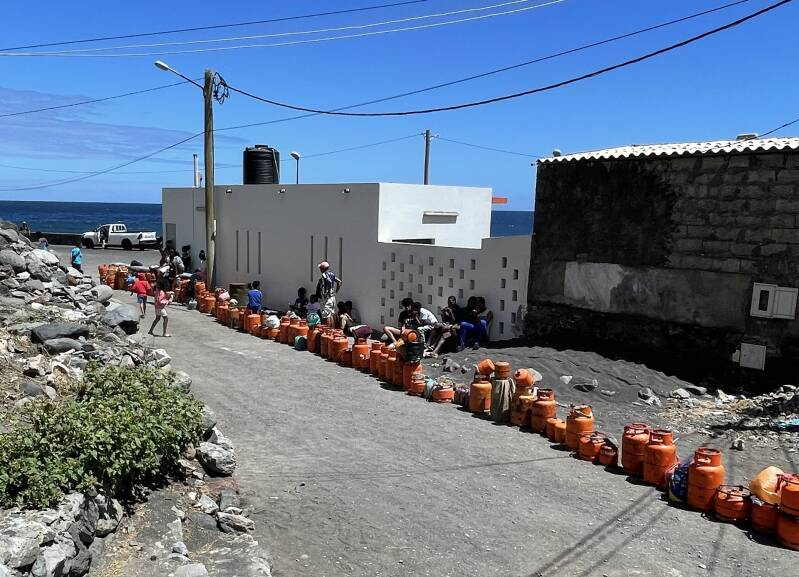
Queuing all day for gas is a reality for the people of Paul.
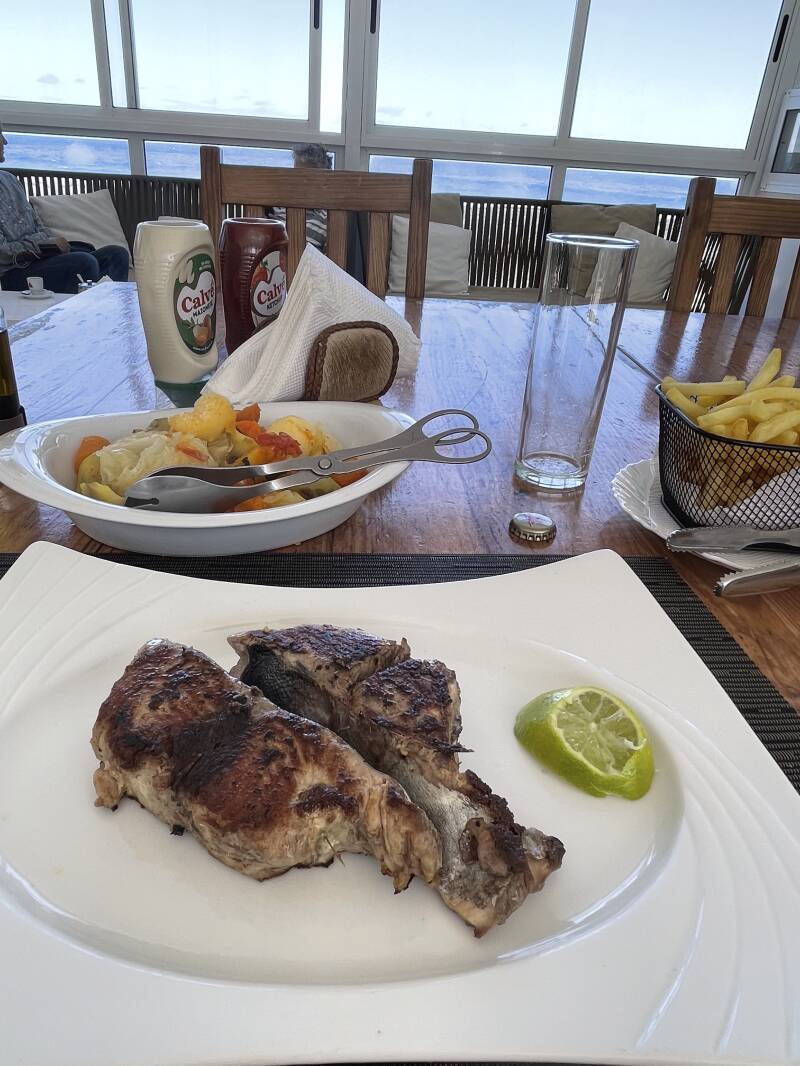
A sumptuous lunch of fish and local veggies with a sea view. It doesn't get much better than this.
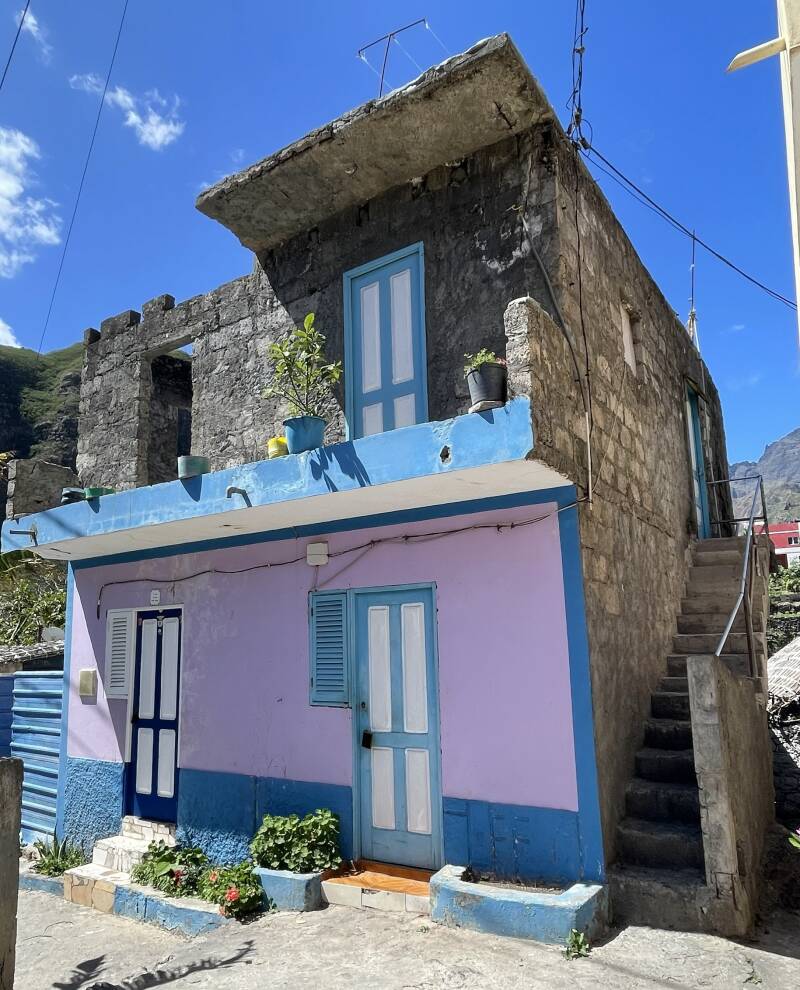
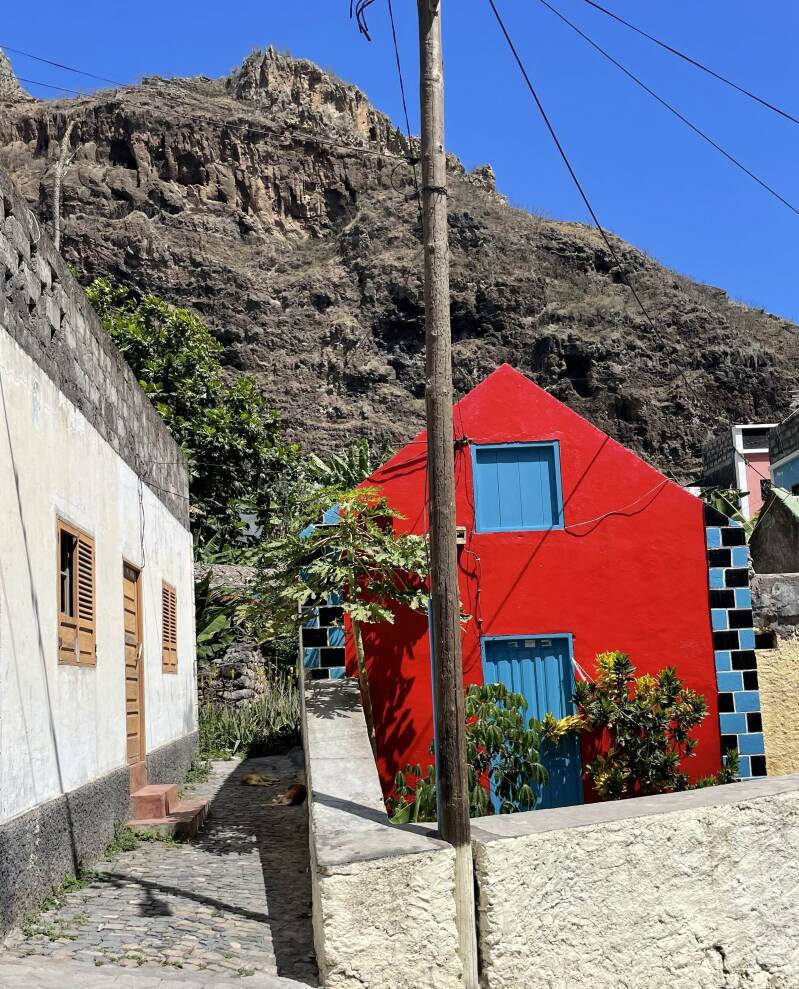
Colourful homes in the main street, near Kasa d' Vizin.
The following morning it was time to leave Paul, a prospect I faced with genuine reluctance. The valley’s terraced slopes, languid pace and magnificent mountain scenery had quietly worked their way under my skin. But yet another island awaited. I was bound for São Vicente, regarded as the cultural heart of Cape Verde and home to the lively port town of Mindelo, long associated with music, art and the legacy of Cesária Évora.
At the guesthouse I had become acquainted with a delightful Dutch couple who shared my enthusiasm for travel and we engaged in long conversations about places half the world overlooks. We took the early morning collectivo together to the ferry terminal, arriving with ample time to spare and several hours still to wait before departure.
My companions immediately made for the upper outdoor deck as soon as boarding commenced, eager to embrace the sea air and panoramic views between the islands. I, however, found myself drawn instead to the unexpected luxury of the air conditioned interior below deck. Reclining seats, functioning chargers and cool air felt positively decadent after months of travel across West Africa, where ferries often involve little more than organised chaos and the vague hope of securing somewhere to perch. In moments like these, Cape Verde felt distinct from much of the region around it, occupying its own curious cultural and logistical space somewhere between Africa, Europe and the Atlantic world.
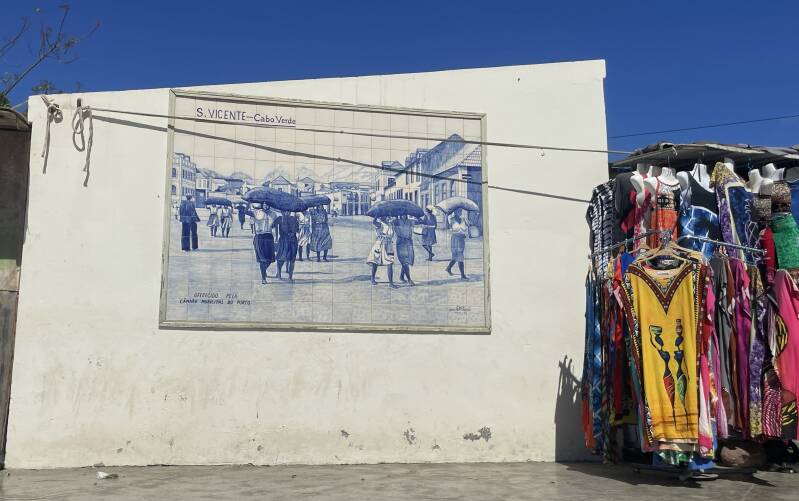
One of a series of cobalt blue tiled murals in the market near my apartment.
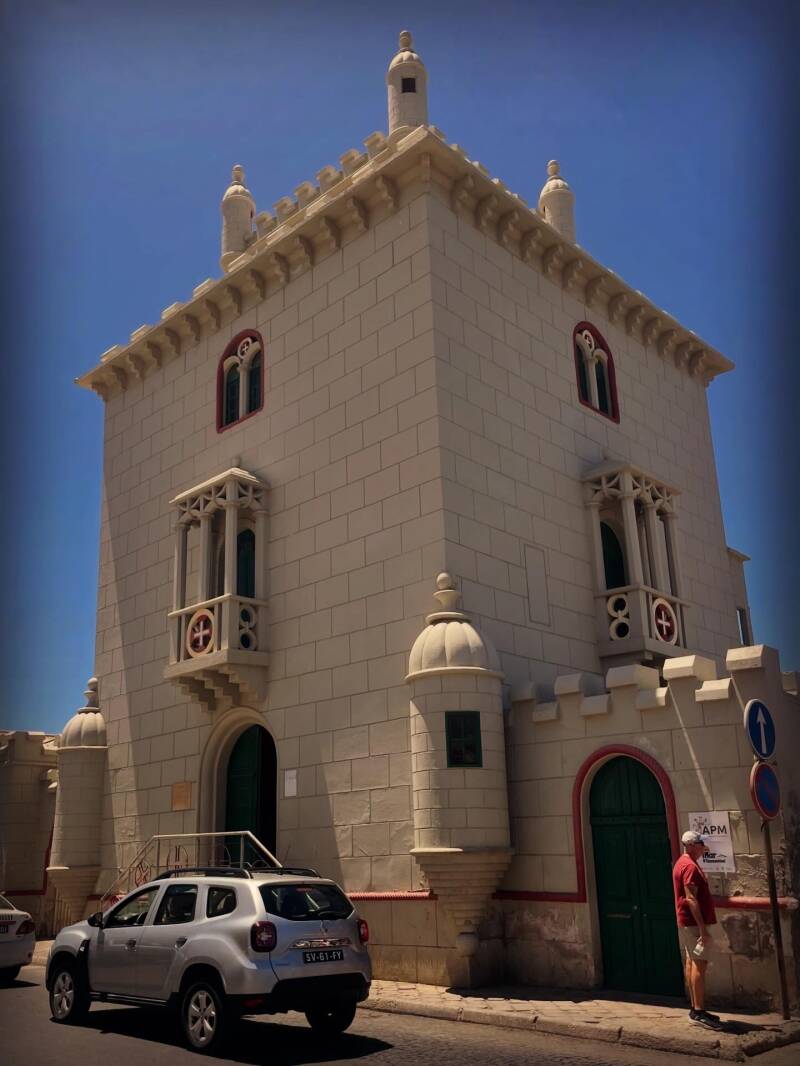
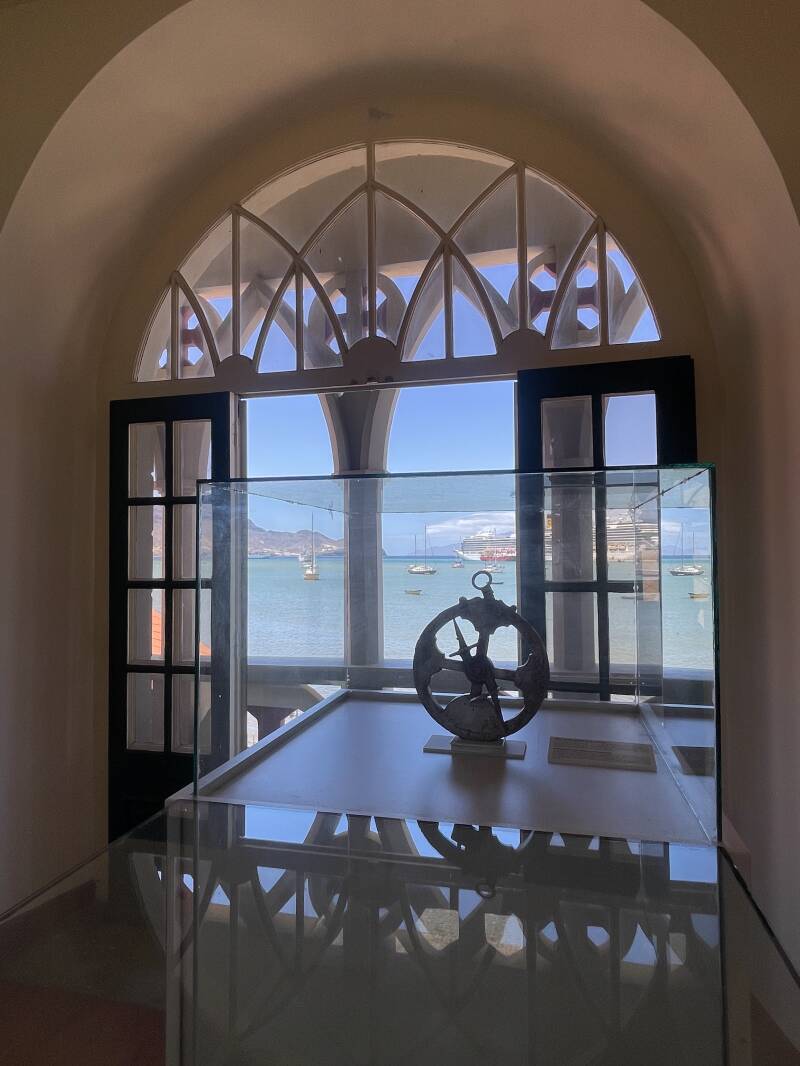
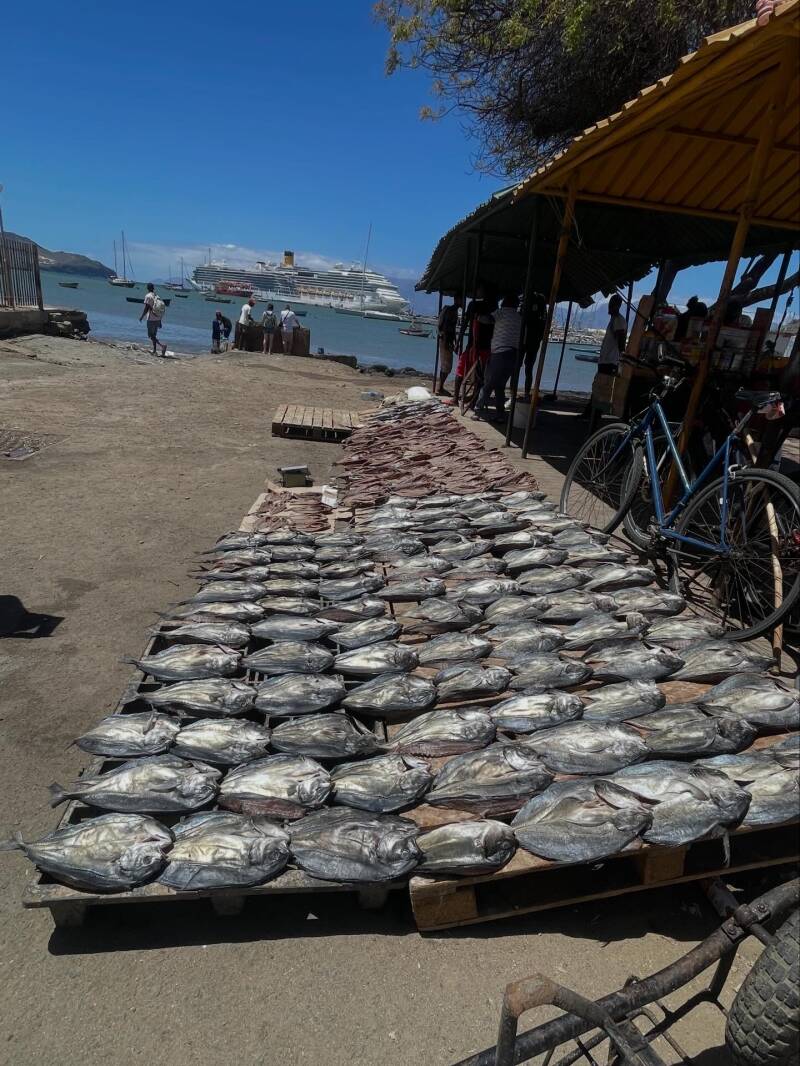
The House of the Sea (Belem Tower) Museum and fish being laid out to dry against the backdrop of cruise ships.
After the exertions of hiking in Santo Antão, Mindelo offered something of a reset. I only had two days in the city and, unlike my previous island routines of steep climbs and ambitious walking routes, this became more of a restorative interlude. Even Chantelle and Bart, the Dutch couple I had travelled over on the ferry with, had embraced the idea of recovery and booked themselves into a hotel with a swimming pool.
Mindelo immediately revealed itself as a very different side of Cape Verde. This was the country’s cultural capital, a harbour city infused with music, sea air and the enduring legacy of Cesária Évora. Colourful colonial façades lined the streets while fishing boats bobbed in the harbour below. There was an easy cosmopolitanism to the place that felt distinct from the agricultural rhythms of Santo Antão.
One of my first stops was a replica of Lisbon’s Belém Tower, now home to the House of the Sea Museum. The city’s intimate relationship with the Atlantic was visible both inside the museum and directly outside along the waterfront, where fishermen sorted nets and prepared their boats beneath the bright afternoon light.
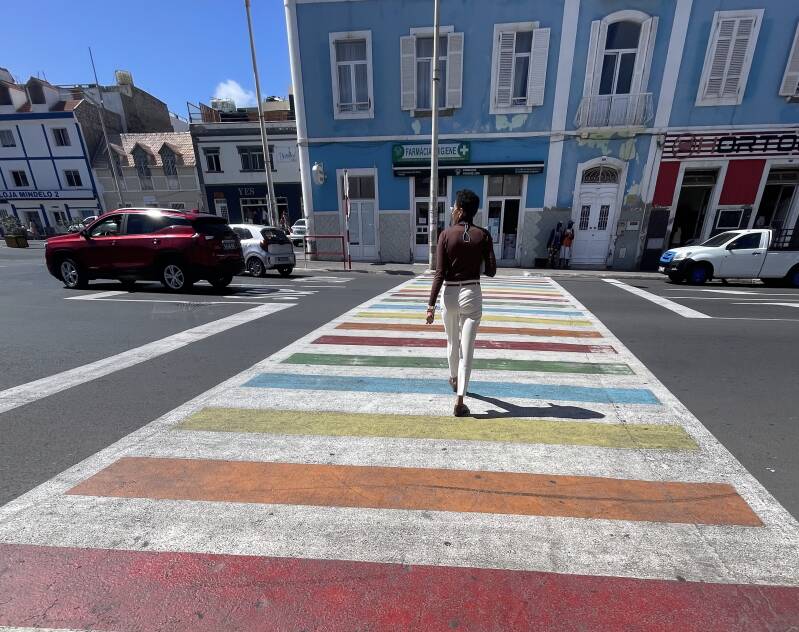
A colourful pedestrian crossing in Mindelo.
By this point, however, cultural enrichment was rapidly losing ground to hunger. Absolutely starvin’ Marvin, I followed a modest sign leading upstairs through a faded and musty smelling hotel to a restaurant called Chave D’Ouro. The establishment appeared almost suspended in time with sections of the building dating back to the late nineteenth century. When I requested un copa de vinho branco (one glass of white wine), I was informed with solemn politeness that the minimum serving available was not a glass but an entire little jug of white wine, (all for roughly AUD $1.50, I worked out). I accepted this inconvenience with admirable resilience.
The fish was beautifully tender and served with locally grown vegetables such as silver-beet, while the restaurant itself possessed one of my favourite details from the entire trip: an old fashioned food chute through which plates descended mysteriously from the unseen kitchen behind. The servers would simply retrieve the meals as they emerged after hearing the knocking sound, preserving the illusion that somewhere inside an invisible grandmother had been cooking uninterrupted since the Portuguese colonial era.
The hotel’s retro charm did not end there. At one point I asked to use the restroom and was pointed in the appropriate direction, only to find myself entering what appeared to be a fully functioning bathroom complete with bathtub and shower. Beyond this sat the toilet itself, elevated by a step onto a platform and crowned, magnificently, with a fake fur toilet seat cover.
Lunch was followed by a practical matter long overdue after weeks on the road: a haircut. Down a steep hill from my apartment I found a tiny salon that appeared to function simultaneously as hairdresser, manicure parlour and neighbourhood social club. It may well have been family run. Throughout my visit the women chatted and laughed constantly in Portuguese, their cackling amusement filling the little space while I sat quietly, smiling along despite understanding almost nothing. For 600 escudos, roughly AUD$9, I emerged with a haircut that seemed perfectly respectable indoors but later developed a far more dramatic personality whenever exposed to Mindelo’s harbour winds.
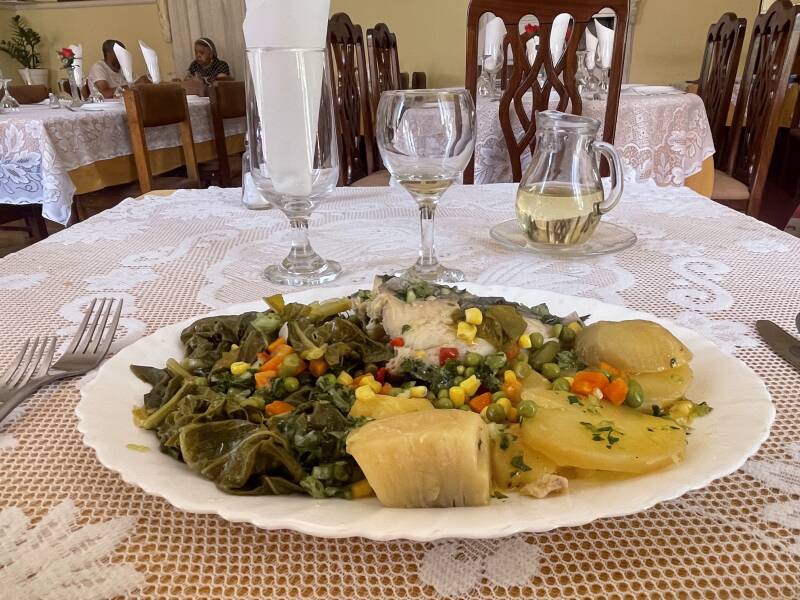
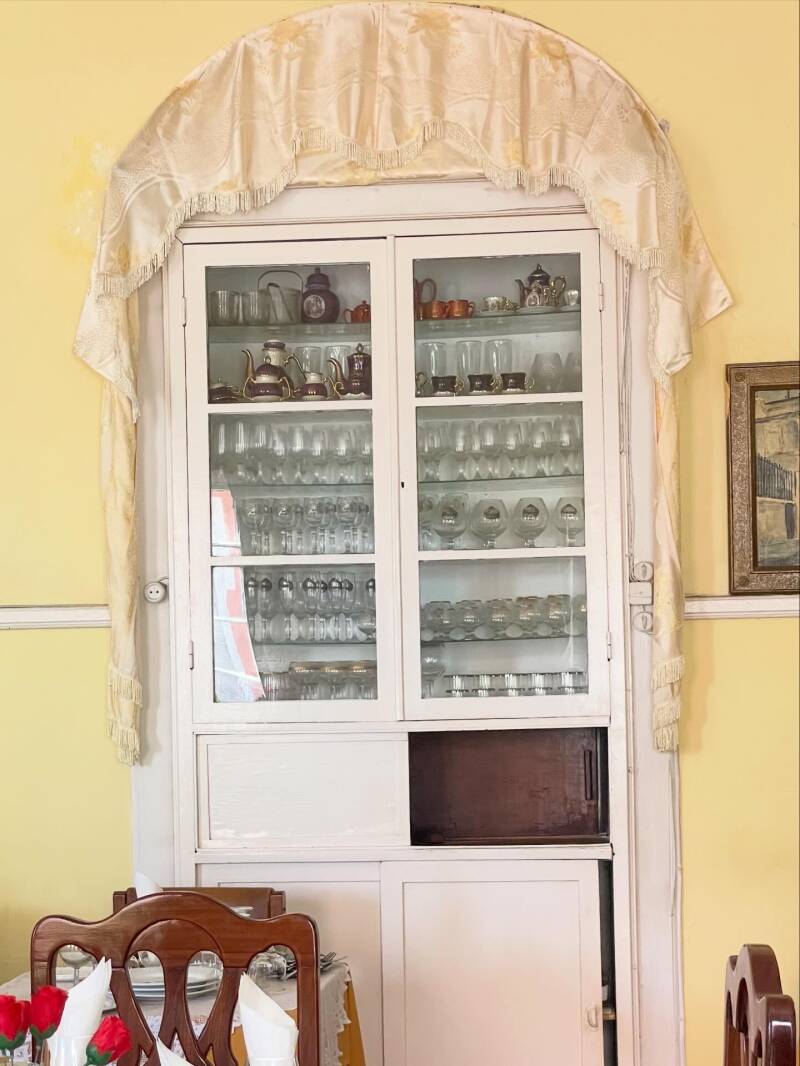
Just like home cooking: fish with vegetables, a piccolo of wine, a curtain cloaked dresser and food delivery chute at Chave D’Ouro, Mindelo.
The following day I visited the Núcleo Museológico Cesária Évora, housed in the very home where Cape Verde’s beloved 'barefoot diva' had lived and died. Inside were personal objects, photographs and stage costumes that gave greater depth to the murals and tributes to her scattered across the islands. She was not simply admired in Cape Verde; she felt woven into its cultural identity. One sign on the balcony casually acknowledged Cesária’s heavy smoking habit and effectively invited visitors to smoke there themselves if they wished as a way to page homage to her.
Later, I revisited the enormous mural near the harbour created by the Portuguese street artist Vhils, who chisels and drills directly into layers of plaster to create his striking portraits.
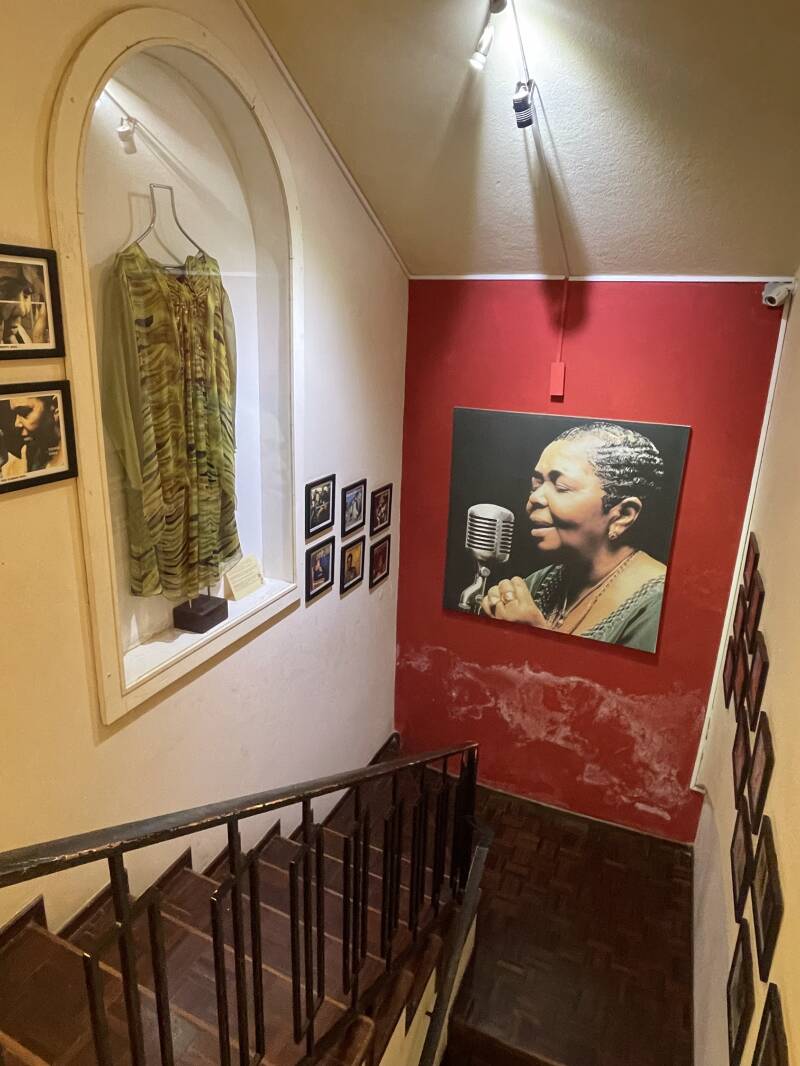
Memorabilia on the stairwell of the Núcleo Museológico Cesária Évora.
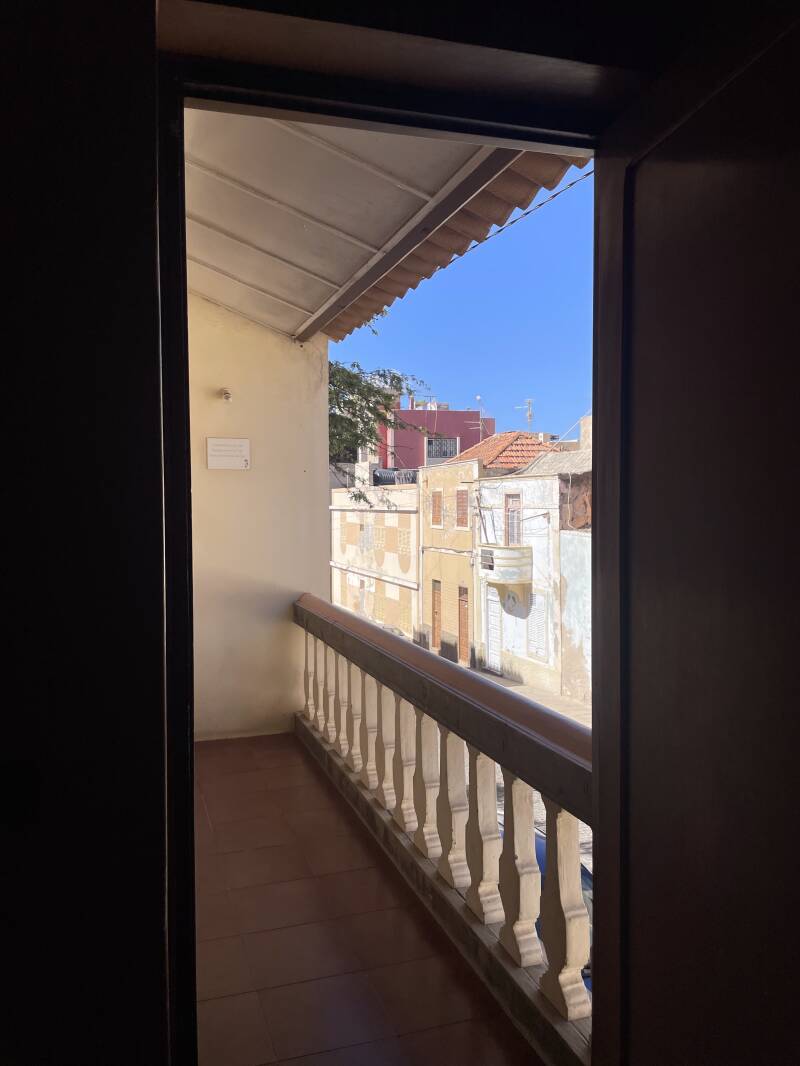
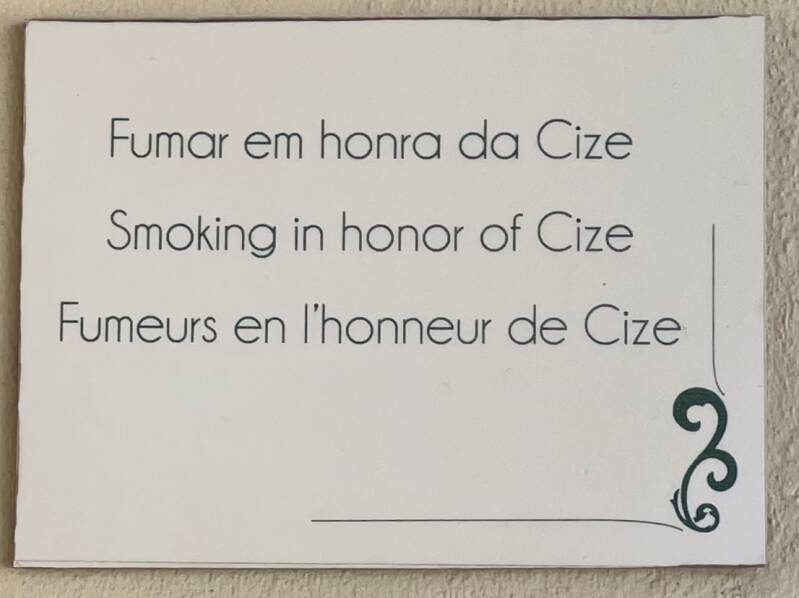
The smoking balcony at Núcleo Museológico Cesária Évora.
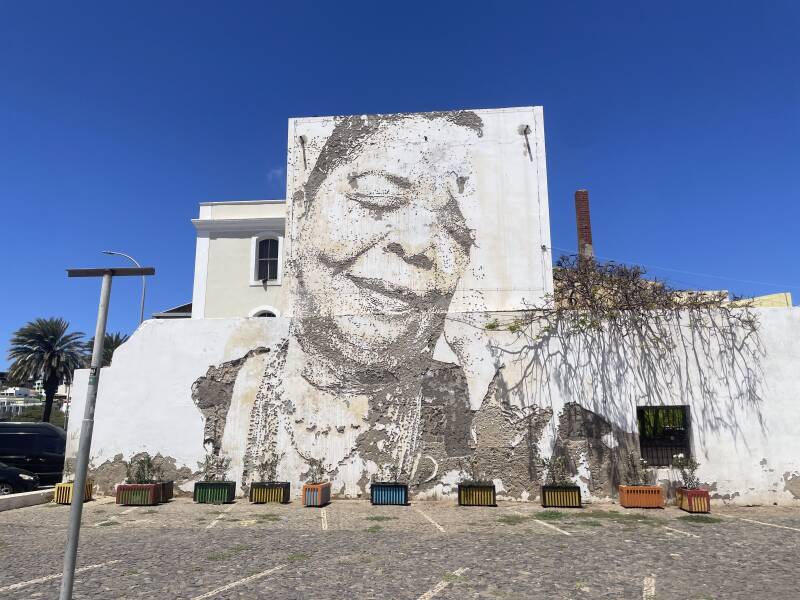
Cesária Évora mural by Vhils downtown.
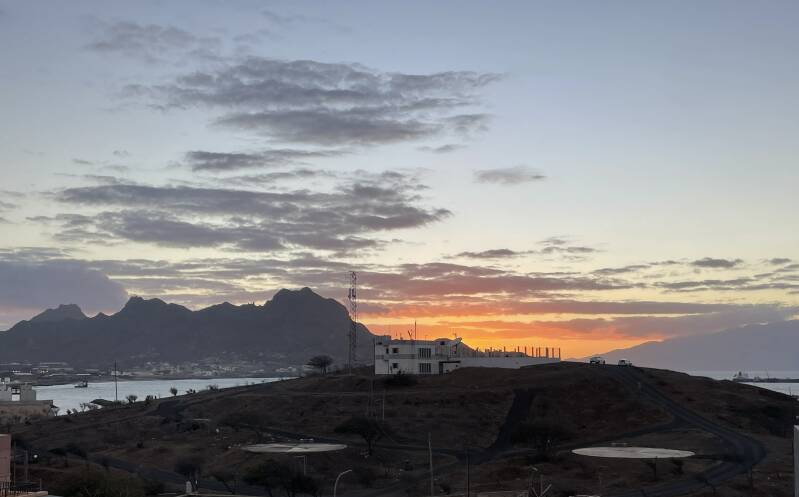
The view from my apartment window in Mindelo. Tourist buses would stop at this observatory for the view over the harbour.
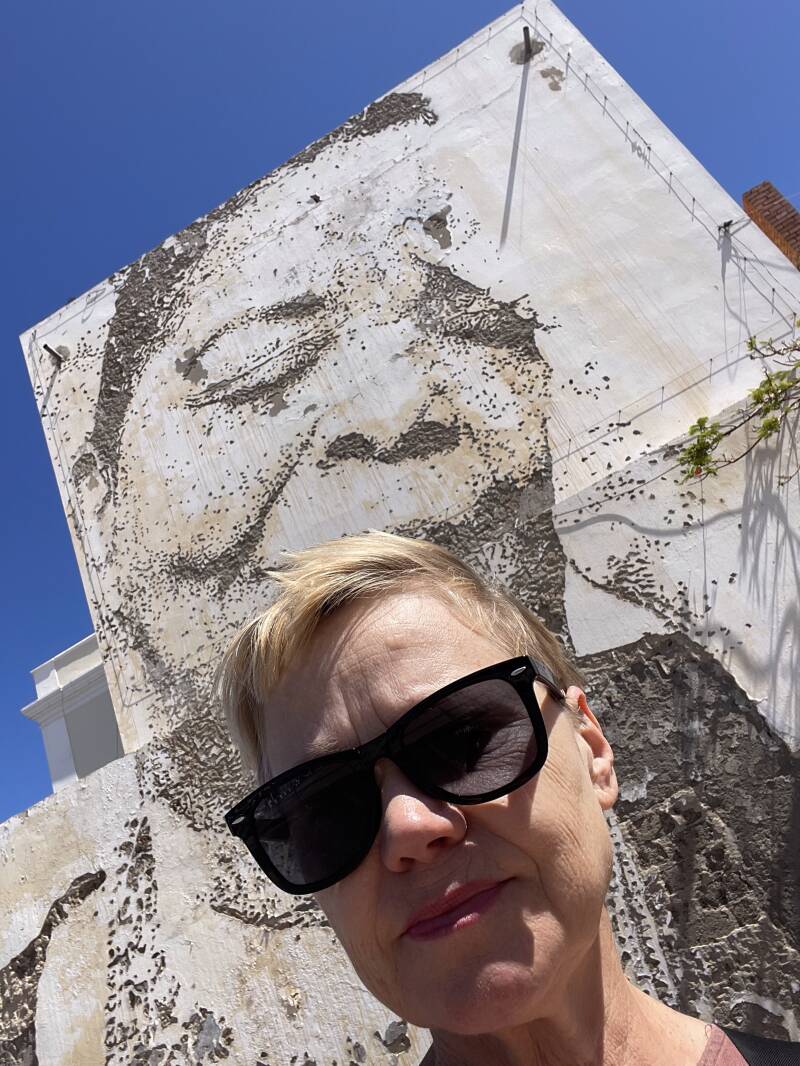
Up close and wind blown with a new do.
My flight to Praia on the island of Santiago marked the final stop of my Cape Verde journey and, a different feeling yet again. Where Santo Antão had offered dramatic mountain serenity and Mindelo had pulsed with music and faded cosmopolitan charm, Praia felt busy, political and unmistakably alive. There was movement everywhere. Markets hummed, traffic flowed along the seafront and conversations spilled energetically from cafés and street corners.
On my first day I walked for about half an hour into the city centre, following the marina under the heat of the afternoon sun. I had imagined a relatively innocent day of museum hopping and historical wandering, and to be fair, that was how things began. I hit Avenida 5 de Julho in Praia, so-called to commemorate July 5, 1975, the day Cape Verde officially gained independence from Portugal and found much to see, hear and experience. I visited several archaeological museums before making my way to the Amílcar Cabral Museum, where I learnt more about the revolutionary leader whose influence extends deeply across both Cape Verde and Guinea Bissau, my next destination.
Cabral emerged not simply as a political figure but as an intellectual force who envisioned liberation through education, culture and anti colonial unity. It felt strangely fitting to be learning about him in Cape Verde while preparing to continue onwards to Guinea Bissau, the two countries forever linked through their shared independence struggle. Even Sal Airport bears his name.
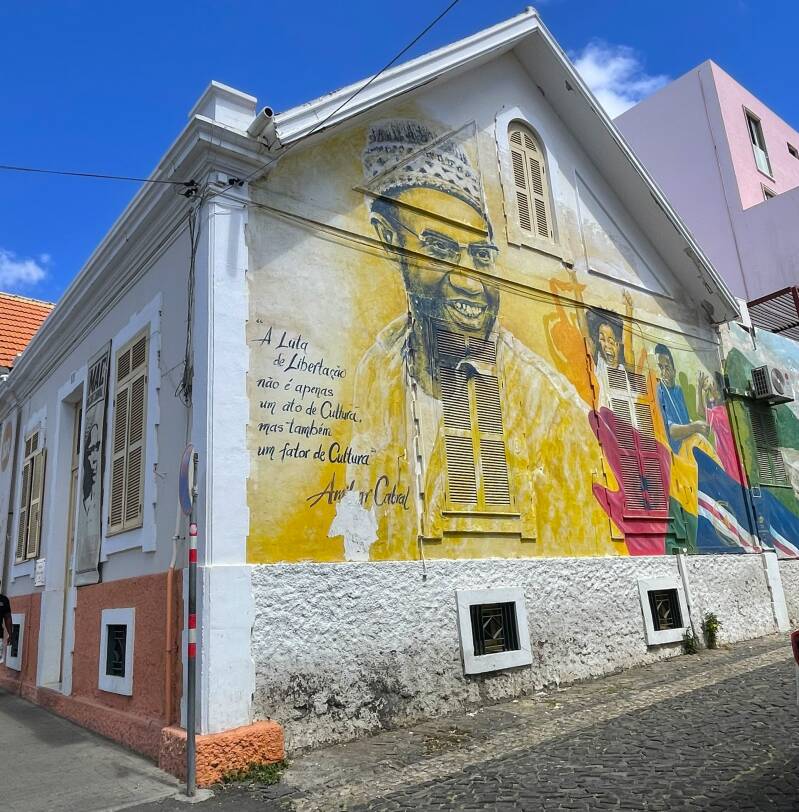
The Amílcar Cabral Museum.
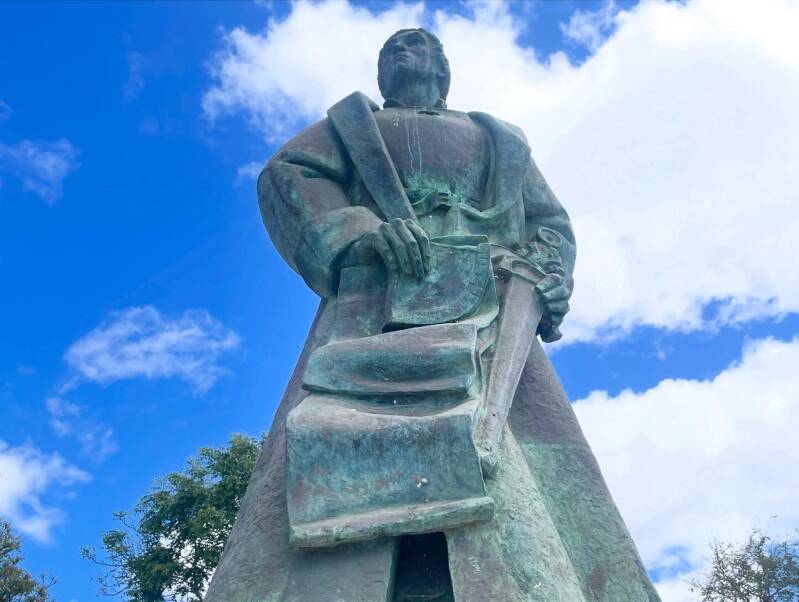
Memorial to Diogo Gomes
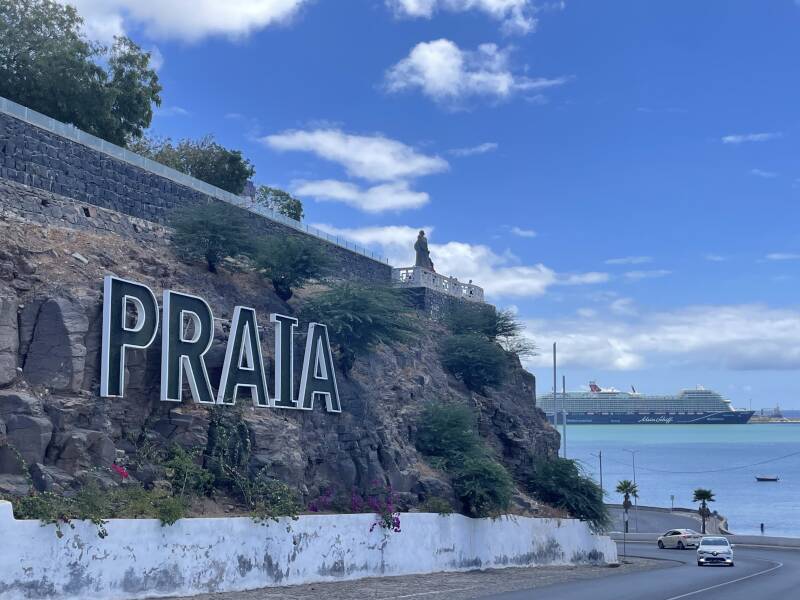
The memorial to Diogo Gomes with a cruise ship in the distance, Praia past and present.
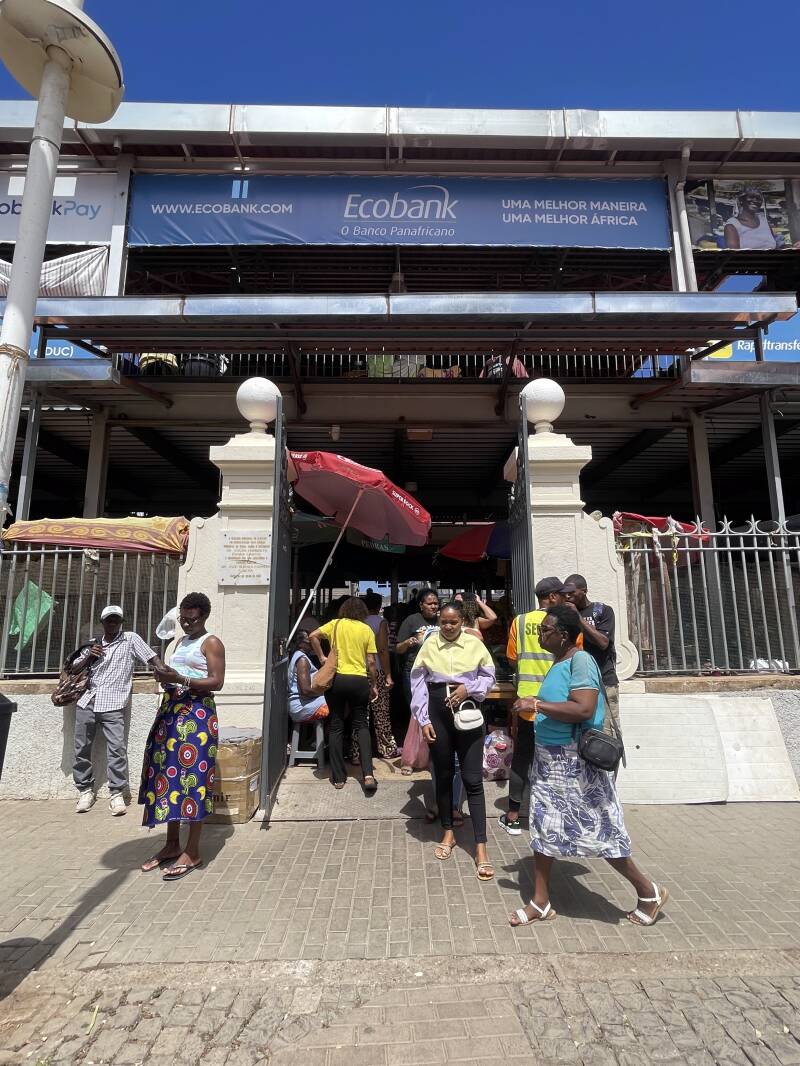
The bustling market on Avenida 5 de Julho (5th of July Avenue).
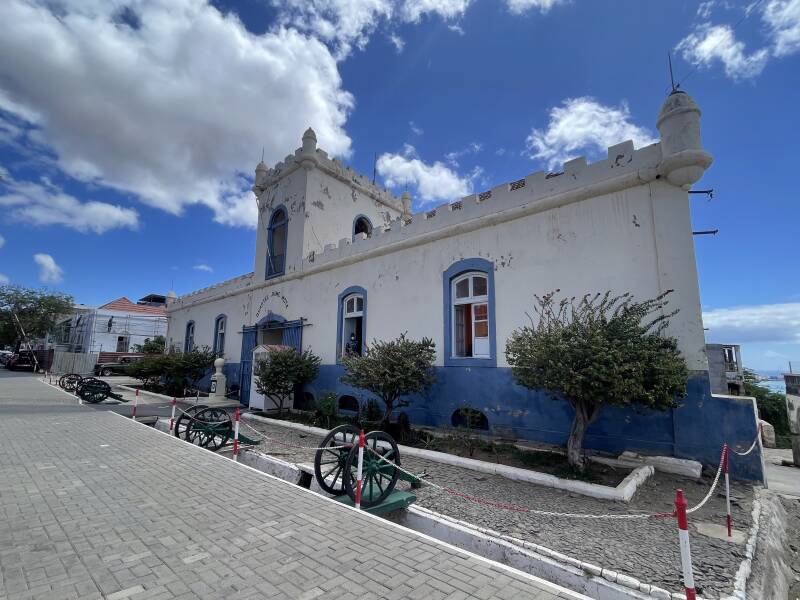
Quartel Jaime Mota is a historical building in the historic city centre of Praia, Cape Verde. It was built between 1823 and 1826 as a military barracks.
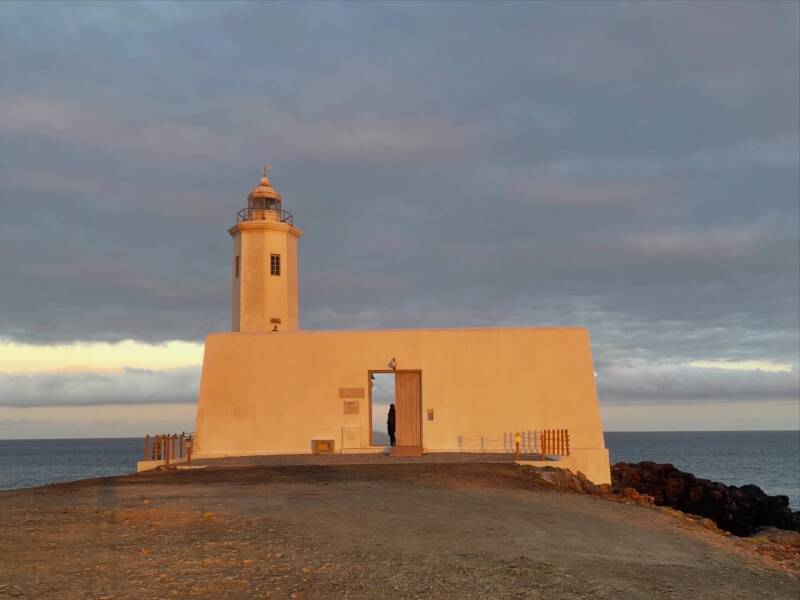
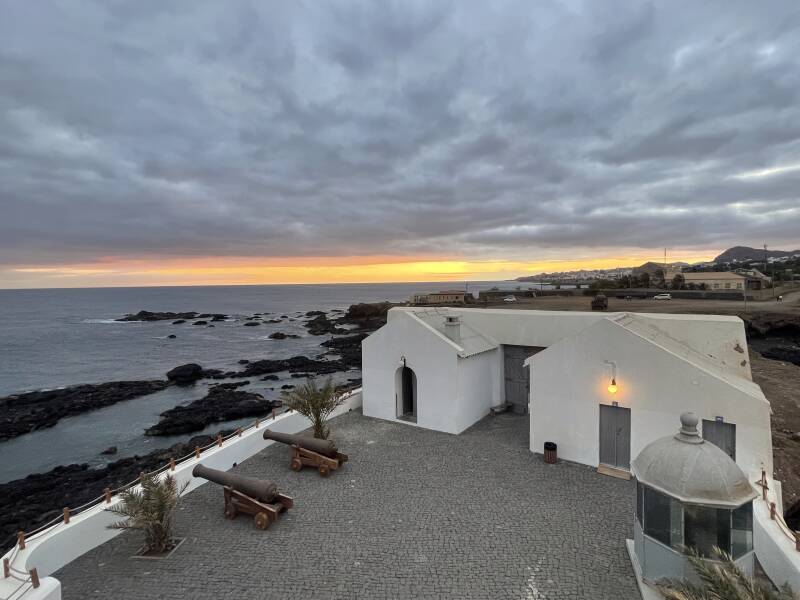
The Farol de Dona Maria Pia (also known as Farol da Ponta Temerosa) is a historic 19th-century lighthouse named after Queen Maria Pia of Portugal.
As I wandered through Praia, murals dedicated to poets and revolutionary figures appeared across walls and public spaces. I also passed a memorial to Diogo Gomes, the Portuguese explorer associated with the early European “discovery” of the islands, a reminder that Cape Verde’s history remains layered with exploration, colonialism and resistance.
One thing I noticed repeatedly throughout the city was the strong visible presence of women, particularly within official roles. On that particular day the police force and army contingents I encountered appeared to include large numbers of women. For a while I wondered whether I had accidentally stumbled into some sort of International Women’s Day event or official celebration.
Then events became unexpectedly lively.
Near what appeared to be a municipal building, I came across a sizeable gathering of people, many of the women dressed in matching yellow t shirts while a small jazz band accompanied them. Curious, I lingered nearby, assuming there might be some local festival or cultural performance underway. Before long a man emerged from the building, smiling broadly and handing out cards while people surged forward enthusiastically to shake his hand.
Naturally, I had absolutely no idea who he was. Was he a singer? A television personality? A beloved jazz musician? Hoping to remain discreet, I attempted a quick sneaky video before quietly backing away. Unfortunately, several people nearby apparently assumed I too was an eager supporter and promptly ushered me forward into the crowd. Before I fully understood what was happening, the man himself was shaking my hand warmly while I smiled graciously with the vague expression of someone trying desperately to appear informed. Only later did I discover that I had just met Francisco Carvalho, Praia’s mayor and a rising political figure in Cape Verdean politics.
The whole scene somehow encapsulated Praia perfectly. Politics, music, dancing and everyday life seemed to intermingle effortlessly. Public spaces felt animated not only by commerce but by civic energy and culture.
As evening approached, I made my way to the Farol de Dona Maria Pia Lighthouse during golden hour. The Atlantic shimmered below the cliffs while the city softened into warm evening light, bringing a calmer end to a day that had unexpectedly included museums, revolutionary history, jazz music and a completely accidental encounter with the mayor of Cape Verde’s capital city.
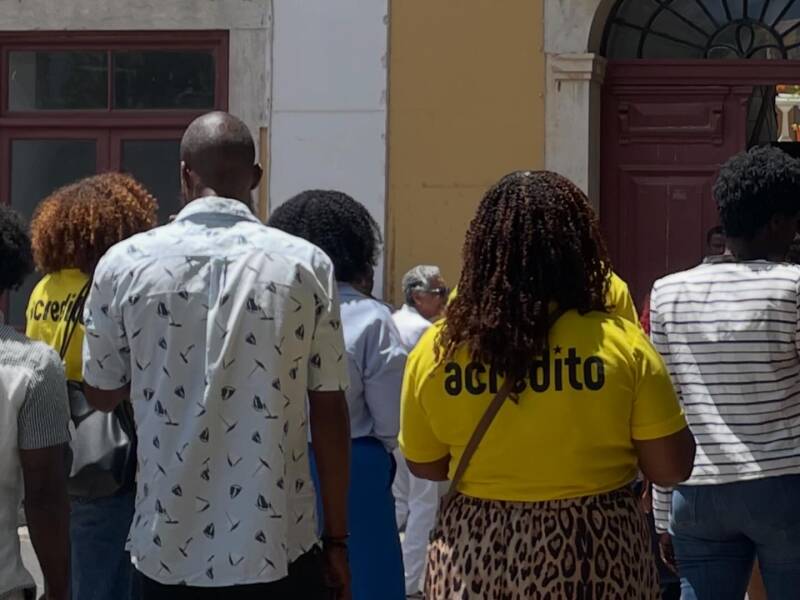
Patient fans of Francisco Carvalho, Praia’s mayor, waiting outside the municipal building.
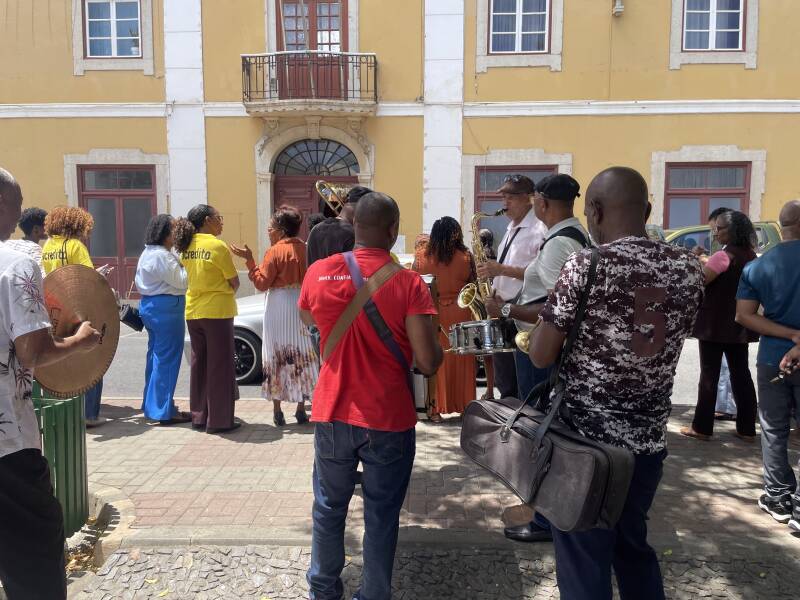
The jazz band plays whilst waiting for the appearance of Francisco Carvalho, Praia’s mayor.
On my final full day in Praia, I set off on foot once again, walking a considerable distance through the city in search of Rua d’Arte, an open air artistic project. Eventually I arrived in a neighbourhood transformed by colour. Walls, staircases, façades and laneways had become canvases layered with murals, portraits and bursts of abstract design that turned ordinary residential streets into something unexpectedly vibrant.
The project began with the local artist Tutu Sousa, who had refined his artistic skills in workshops in Senegal before returning home to Cape Verde. Rather than confining art within the walls of a formal gallery, he transformed his childhood house into both studio and canvas, painting directly onto the building itself. Over time he persuaded neighbours to allow their homes to become part of the project too, until the entire neighbourhood evolved into a sprawling open air gallery.
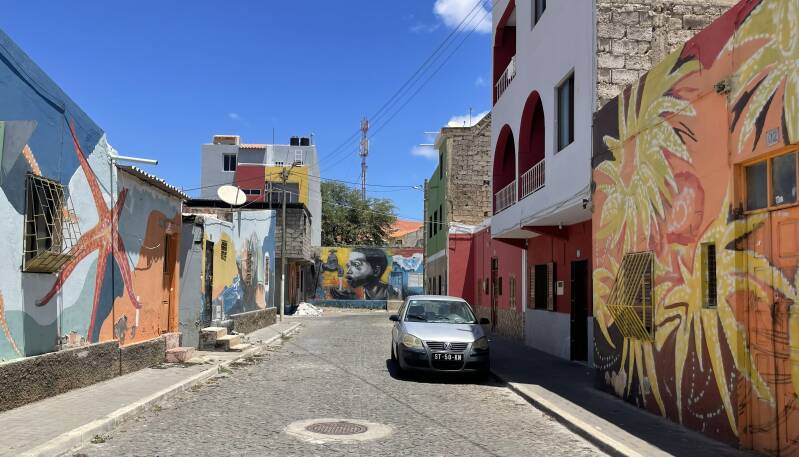
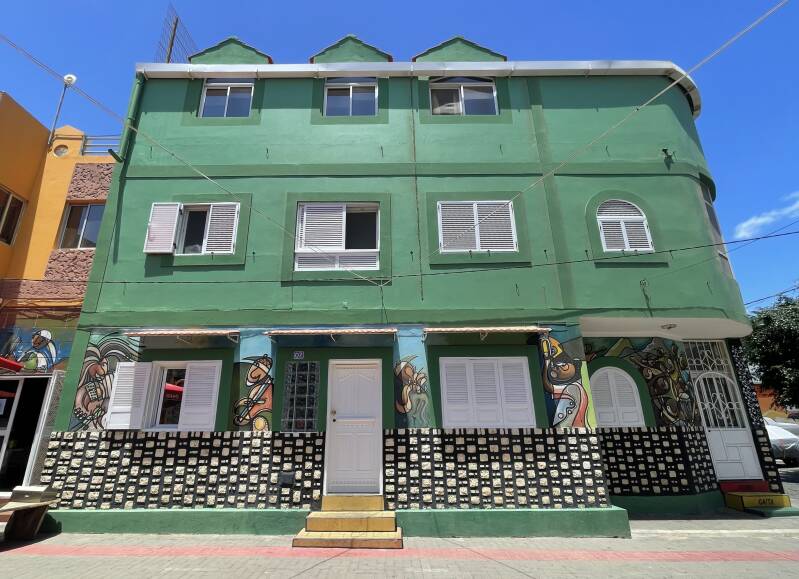
Laneways and buildings adorned with the art of Tutu Sousa.
Later that evening, on my final night in Praia, I wandered down towards the marina in search of dinner. One quickly learns in Cape Verde not to expect restaurants to open particularly early. Around 7.30 pm seems to be the accepted moment at which the nation collectively decides people may once again eat in public.
Eventually I found a restaurant perched up on a hillside overlooking the city, but below at street level an entirely different scene was unfolding. A religious procession with people dressed in white moved slowly through the streets, temporarily bringing traffic to a halt. Cars and minibuses waited patiently while participants advanced solemnly through the road.
What struck me was not the interruption itself but the complete absence of frustration. Nobody leaned aggressively on their horn or attempted to force their way through. Drivers simply waited quietly, seemingly understanding that whatever was taking place carried significance beyond minor inconvenience. Watching the procession snake through the streets below while music and city noise drifted through the warm evening air, I found myself thinking that Praia possessed an almost theatrical unpredictability. There was always something happening.
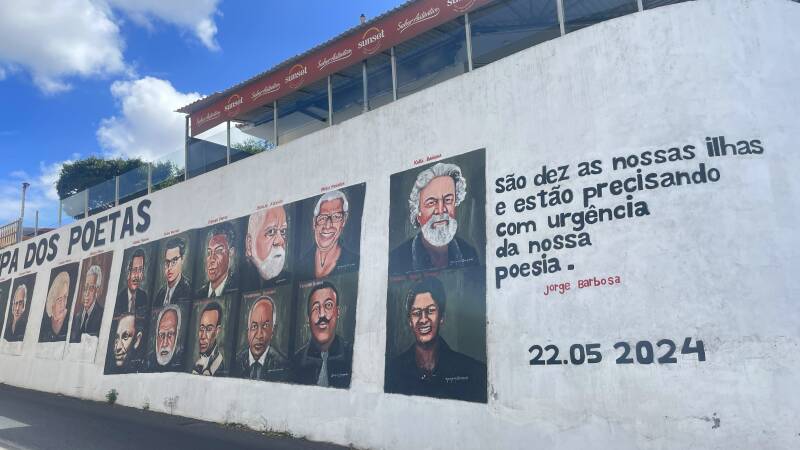
A mural dedicated to poets.
By the time I left Cape Verde, I understood why so many travellers speak of the islands with such affection. Across a twenty country journey in 2026, this small Atlantic nation emerged as my favourite, not because it was the most dramatic or the most exotic, but because it felt so unexpectedly layered.
What stayed with me most was not simply the scenery or the hiking trails, but the sense of social stability and quiet confidence that seemed to underpin daily life. Cape Verde consistently ranks highly within Africa for education, healthcare and democratic governance. There was an ease to public life, a visible civic pride and a sense that people were not merely surviving but building lives with optimism and creativity.
It would be lazy, to conclude that Cape Verde “didn’t feel like Africa,” a phrase travellers too often use when confronted with an African country that challenges their preconceptions. What the journey reinforced instead was that Africa is not a singular experience waiting to be confirmed or contradicted. It is fifty-four countries, each carrying its own histories, cultures, rhythms and identities.
Cape Verde simply reminded me of that truth particularly well, while also serving up volcanic mountains, music filled streets, community murals, excellent fish, unexpected little jugs of wine and the occasional fake fur toilet seat cover along the way.
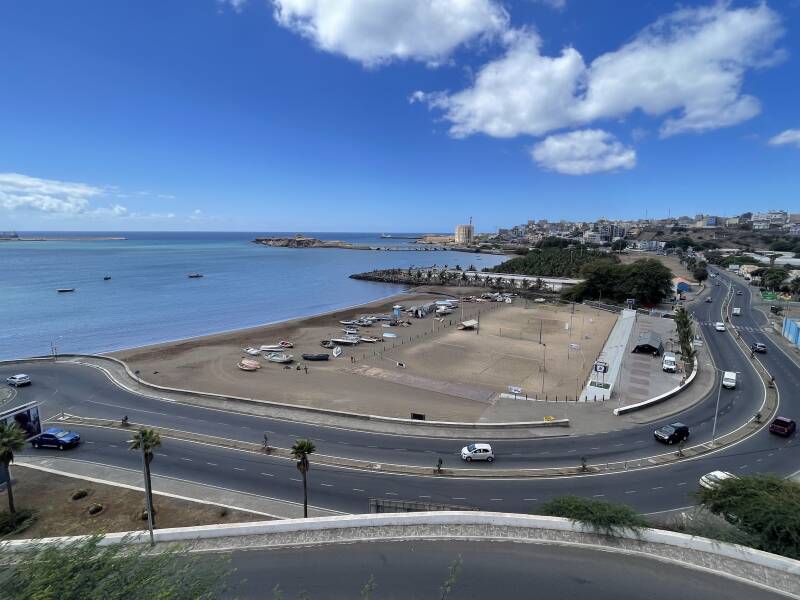
Looking down on the marina and soccer fields.
Create Your Own Website With Webador