

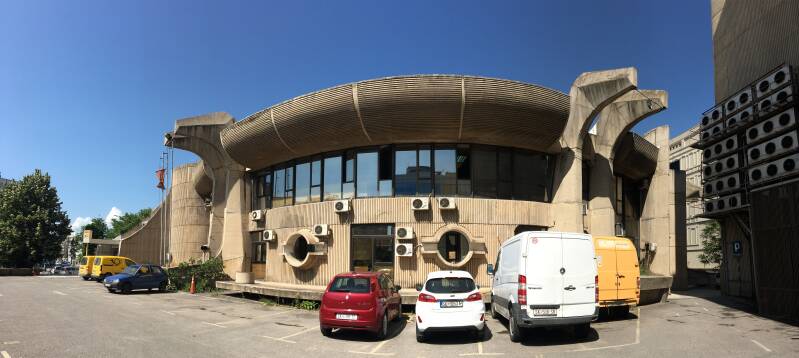
Glavna Posta – the Central Post Office of Skopje (stage 2). Architect Janko Konstantinov.
It is perhaps ironic that the architectural identity of many cities was born out of disaster. Take the proliferation of Art Deco architecture in Napier, New Zealand, born out of the 1931 earthquake or the postwar architecture in European cities such as Berlin, the resulting architectural character is defining. Miami's characteristic Art Deco 1920s architecture was also made possible after a hurricane destroyed the city.
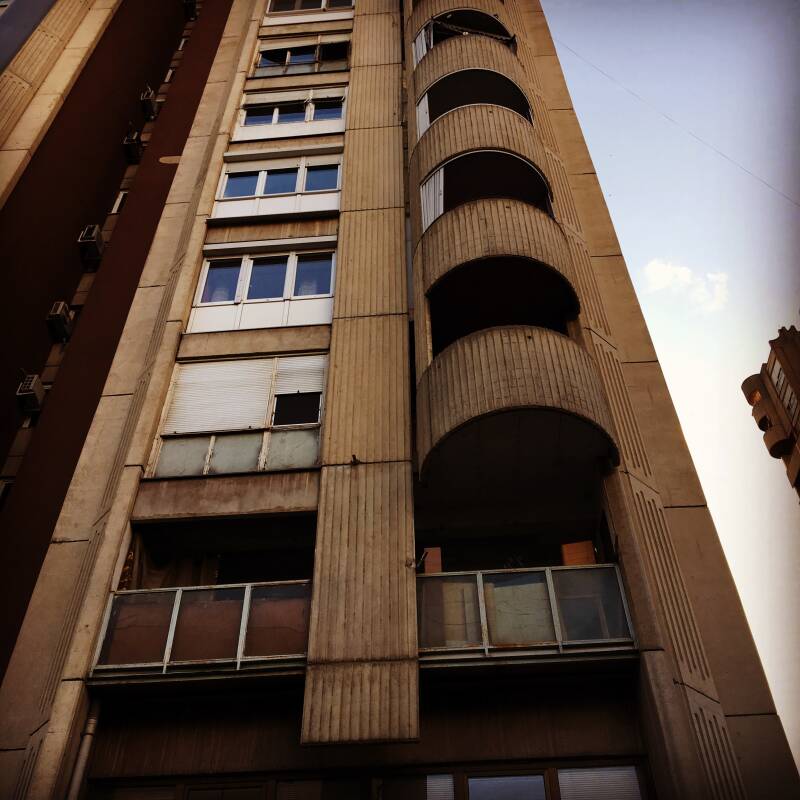
Apartment blocks near my modern apartment.
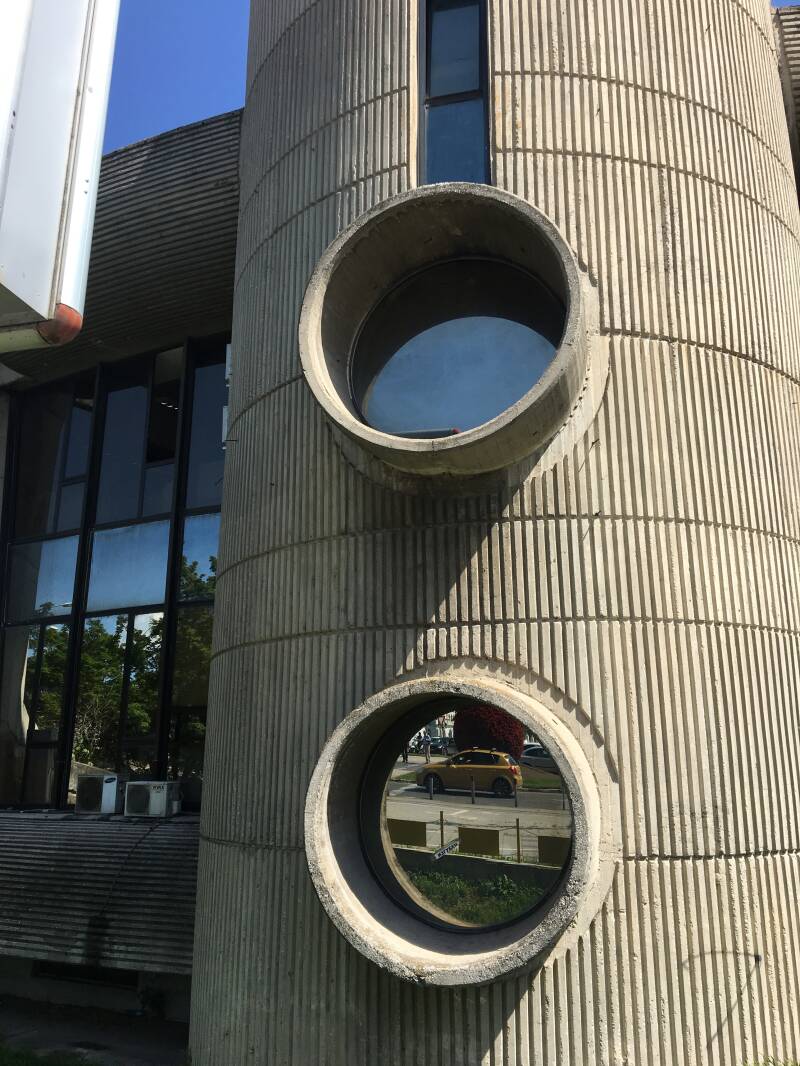
Detail of the Central Post Office of Skopje.
I had no idea until planning my 2019 Balkans trip that Skopje had suffered its own catastrophe back in 1963, when an earthquake killed around 2000 people and wiped out more than half of what had been an ancient, layered city. A few fragments still hold their ground, like the fortress and the clutch of Orthodox churches and mosques, but most of the old fabric vanished in the rubble.
In 1965 an international competition was launched to reimagine the city, and the winning scheme came from Japanese architect Kenzo Tange. No shock there: Tange adored the French-Swiss Modernist Le Corbusier, whose Unité d’Habitation in Marseille I had, by coincidence, wandered through almost exactly a year before.
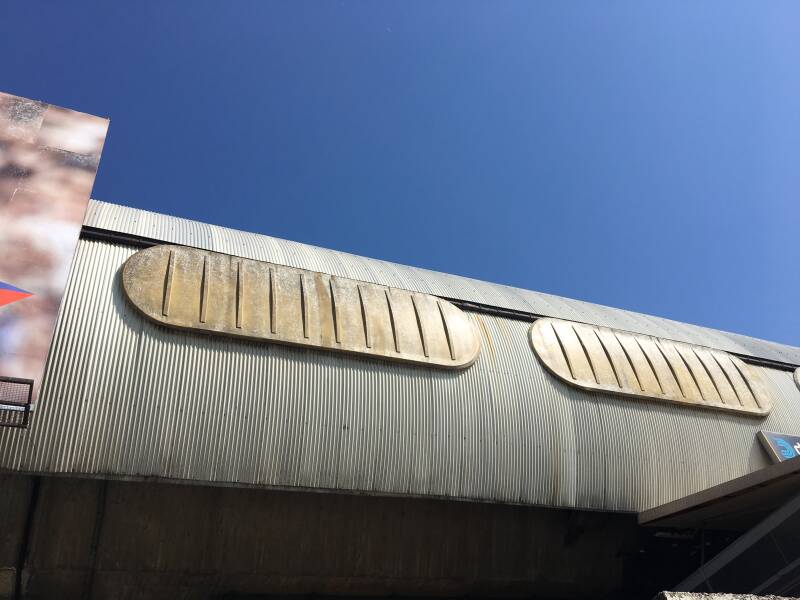
Detail of the local bus station.
I am unsure why I have such a love of Brutalism. We are a small cult of fans, which makes travel tricky at times because few guides bother to list Brutalist buildings among the must-see sights, but that only makes the hunt more fun. Today I searched for the epitome of Brutalism, the central post office, with no reference points and failing internet. I had glimpsed it from the bus when arriving from Ohrid yesterday, so I knew it was somewhere in the centar. Finding it felt like striking gold, and the few passers-by must have wondered what on earth I was doing as I snapped away with my aging iPhone 6 from every angle.
The Central Post Office is one of the city’s most important examples of Socialist Modernism and Brutalist architecture. Designed by the Macedonian architect Janko Konstantinov, it was part of Kenzo Tange’s master plan for the reconstruction of Skopje after the 1963 earthquake.
The structure is large, distinctive and impossible to mistake once you are standing in front of it. It still houses the headquarters of the Post of North Macedonia, although parts of the building were damaged by a fire in 2013 and remain out of use. In 2022 the entire complex was designated protected cultural heritage, a recognition that secures its status within the city’s architectural history.
Visiting it gives a clear sense of Skopje’s post-earthquake ambition and the experimental approach that shaped the modern city. Even with its damaged sections, the Glavna Pošta remains one of the most memorable buildings in Skopje.
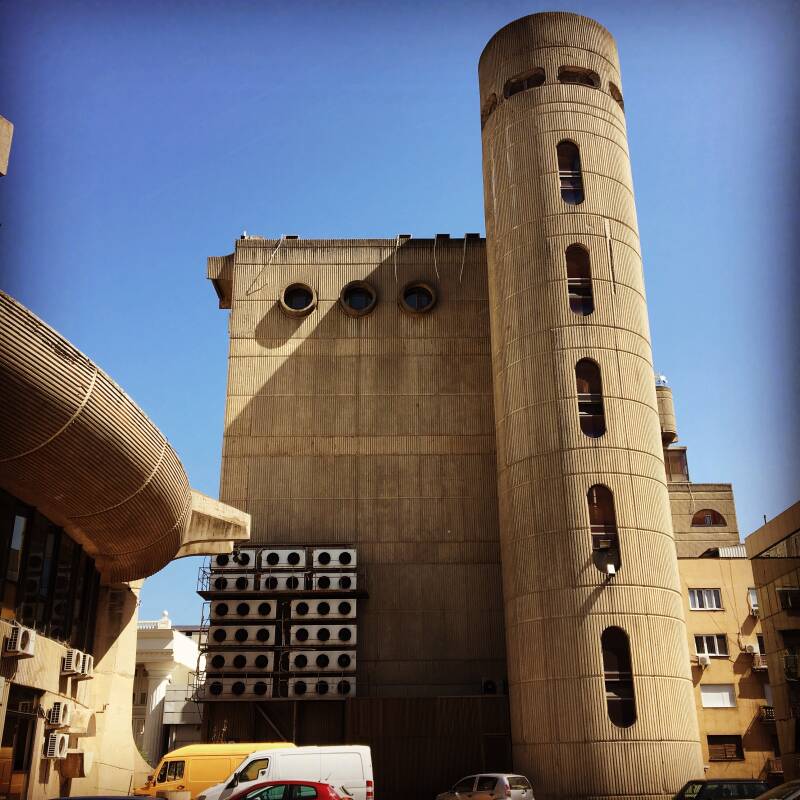
Next to Glavna Posta – the Central Post Office of Skopje (stage 2). Architect Janko Konstantinov.
Of course, a trip to a large city is not complete without visiting some of the other sights, so as an art educator I set off for the Museum of Contemporary Art, a forty five minute walk from my Airbnb. After climbing a steep hill and circling the large concrete building covered in graffiti, my hopes sank when I discovered it was closed for exhibition installations. Not all was lost, though. From that hilltop I could take in panoramic views of the city’s architectural jumble, a blend of past and present, shiny new development set against tired old structures. The sun was scorching and pushing into the thirties, yet in the distance the hilltops still held patches of snow.
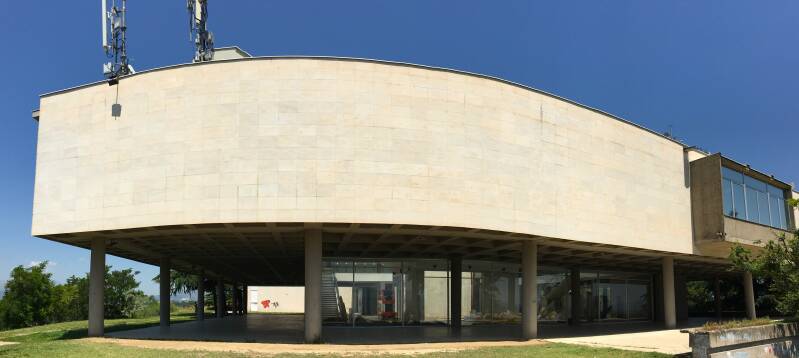
Outside the Museum of Contemporary Art.
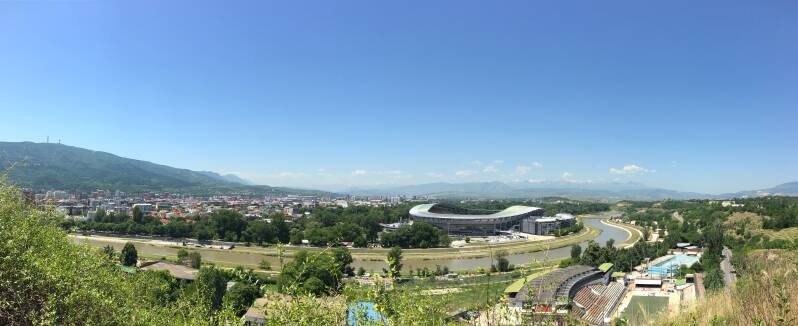
The hilltop view from the (closed) Museum of Contemporary Art.
With a plethora of other museums to attempt, I chose the nearby Museum of the Republic of Macedonia. Always distracted, on the way, I passed a mosque, and witnessed the customary washing of feet before prayer in the forecourt; a while later, and partway through my museum visit I was struck by the strange sound of loud music in the near empty building; this was followed by what I realised was the call to prayer. Despite being an atheist, I found this melodic sound and singing moving, captivating, and worthy of tears. I could sense the silence outside and felt grateful that I was able to take part in the pure enjoyment of the sound as a guest to this city. After the museum visit, I headed back to the bazaar region, just in time to witness all the men to return to work, shutters on businesses vigorously sliding up, hands being shaken, greetings made, a fully social experience.
So, I am sorry, Richard Dawkins, but I disagree with your tweet ‘Listening to the lovely bells of Winchester, one of our great medieval cathedrals. So much nicer than the aggressive-sounding “Allahu Akhbar.”’ There was nothing aggressive about the call to prayer I heard; I think Dawkins is drawing a long bow to associate such beautiful (but non-Western sounding) music and poetry with violence. Maybe, you need to listen to a greater diversity of music such as the non-linear Lisa Gerrard (Dead can Dance) or others with Eastern influences such as Philip Glass. Broaden your experiences, Dawkins; it's possible to to enjoy the spiritual in sound without losing your atheism.
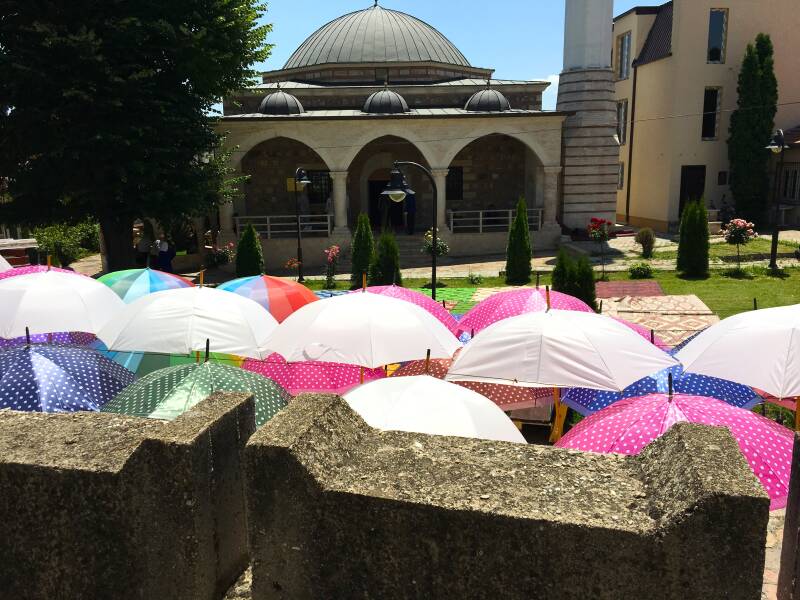
Museum Brutalism, Umbrellas and mosque at midday.
The museum itself was another great example of concrete Brutalism from the outside, but, like I have experienced with numerous Eastern Europe museums, a mystery as to how to enter. Even the main doors had chains on them and only minimal signage. Thankfully, after lingering, I was met by a staff member opening the door for me, seeming grateful for a visitor. Despite spending significant time in the historical part of the museum, I am still somewhat baffled as to the history of Macedonia, but I was somewhat shocked to have learnt that many children of ‘Macedonians’ were taken from them during war time and raised in the orphanages. The didactic labels implied that this benefited the children greatly. I wonder how accurate this is. To my shock, I also learnt, beyond the museum that there are still orphanages in Skopje. I wondered how there could still be homeless children in Europe. Some of these children, taken from their parents in 1948, were forced to trek across mountains for days during the height of Greece's brutal civil war. Many of these children, now adults, stripped of their Greek citizenship and property have only been allowed to re-enter Greece, their birthplace temporarily.
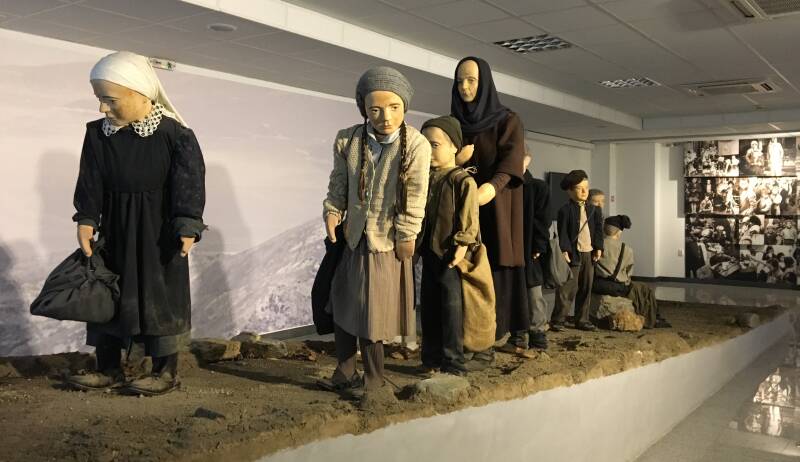
Models of the orphans in the Museum of the Republic of Macedonia.
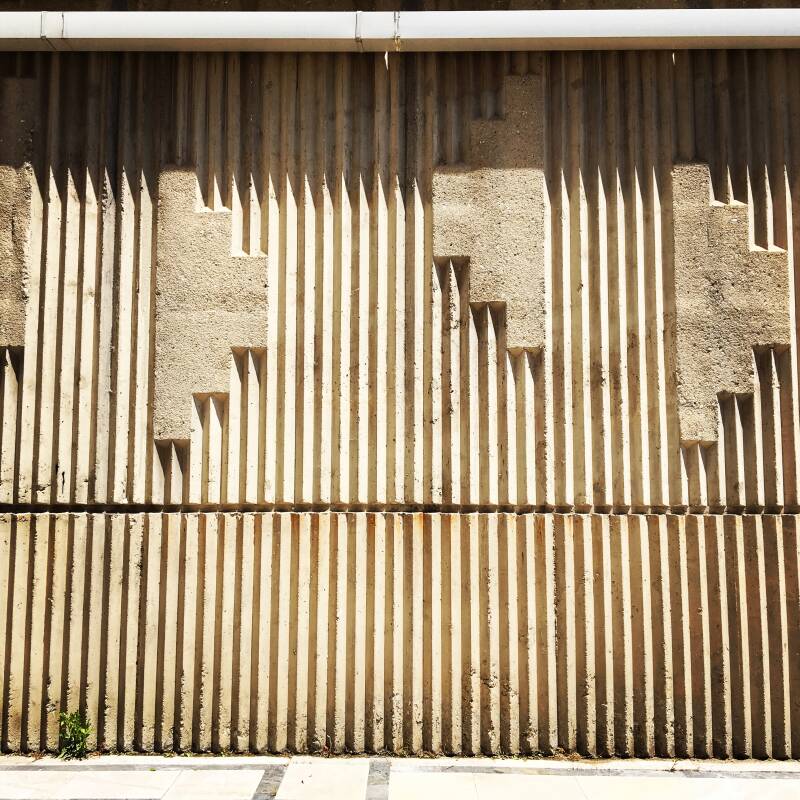
Detail from the exterior of Museum of the Republic of Macedonia.
Skopje, though, is not only a city of concrete dreams. As I wandered deeper into town I kept running into the army of faux classical statues that now fill the centre. They began appearing after 2008 in a burst of nation-building enthusiasm, and the number is astonishing. The Bridge of Civilizations alone carries more than thirty figures, all posed in heroic stances as if lifted from an imagined past. After hours spent chasing Brutalist curves and raw concrete, these contemporary sculptures pretending to be old felt surreal, like the city was trying on an ancient identity while still walking around in modern shoes.
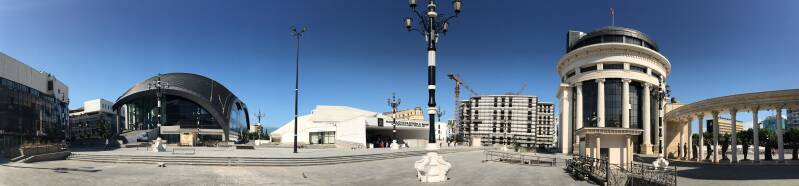
The City and Archaeological Museum of North Macedonia entrance.
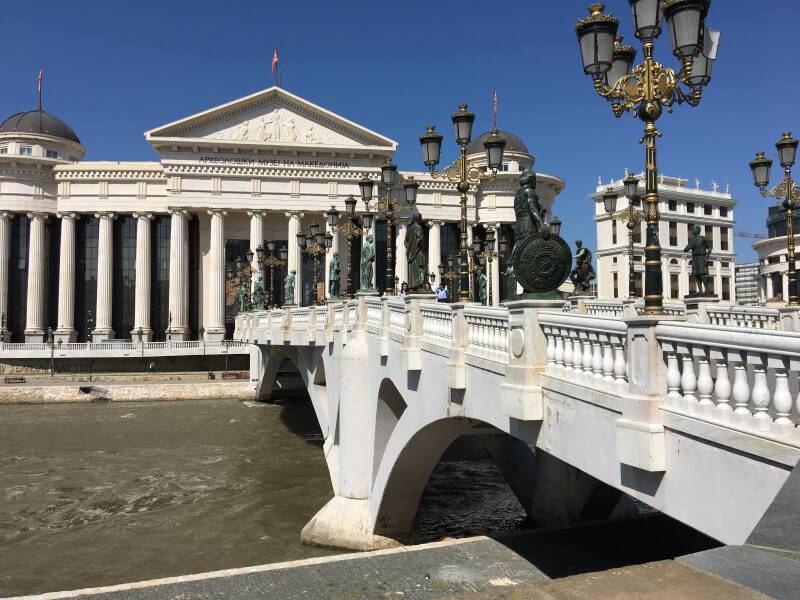
The Bridge of Civilizations and Archaeological Museum of North Macedonia.
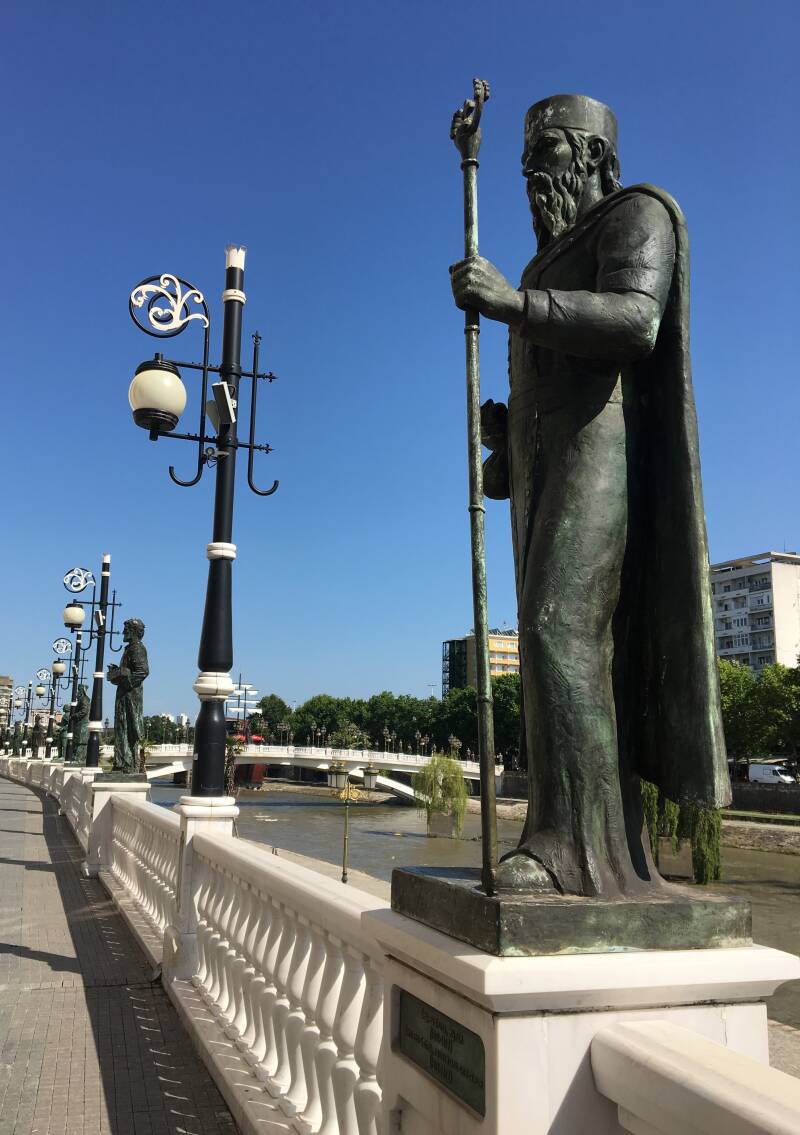
The Bridge of Civilizations.
Skopje’s grand makeover began in 2008 with a budget that floated somewhere between €80 and €500 million. The plan was to draw tourists and give the city a bold new identity, yet it quickly stirred debate. Many questioned why money was being poured into ornate neoclassical facades and theatrical statuary instead of much needed infrastructure. The tension fed protests and a wave of vandalism, with paint bombs splashed across some of the most prominent monuments.
At the heart of the main square stands the city’s biggest spectacle: a towering bronze of Alexander the Great on his horse Bucephalus, though it officially answers to the name The Great Warrior. The title sidesteps the long running dispute between North Macedonia and Greece over his legacy. Ringed by warriors and a fountain that joins the nightly light shows, the statue is impossible to miss, yet it remains a strangely anonymous homage to one of history’s most famous commanders. The city’s struggle to celebrate him without naming him captures the layered and sometimes tangled stories running through Skopje’s streets.
With a much more auspicious and classical facade, the Museum of the Macedonian Struggle was, surprisingly, only established in 2011. A wild blend of history-style paintings, didactic labels, diorama-like displays and mannequins, the number of wax figures in this museum must rival any of Madame Tussaud’s collections, only these ones are mostly serious rather than Hollywood-glamorous. Room after room of unsmiling figures seated, standing, hanging and suffering through scenes from the resistance movement, from Ottoman rule through to the declaration of independence in 1991, created a sense of creeping paranoia, especially when you are the sole visitor. Maybe it was fortunate that photography was not permitted. Otherwise I might have lingered there all day.
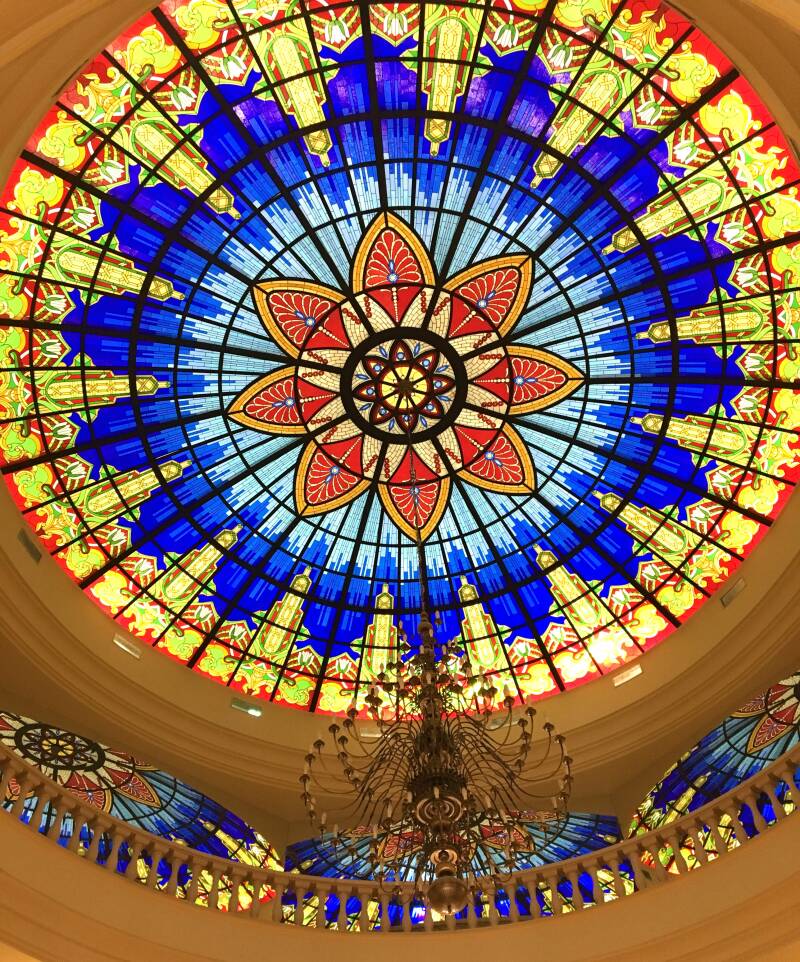
The atrium from the Museum of the Macedonian Struggle, all I was permitted to photograph.
With such a rich and complex history, it seems paradoxical that in Macedonia, the city is trying to revitalise the architecture by creating quasi-classical buildings through the Skopje 2014 Project. These building designs look old/ classical but they are not. One hopes that they will not destroy the unique concrete buildings created in the second half of the 20th century, so that Skopje can retain the nickname of Brutalist capital of the world.
Create Your Own Website With Webador